People, and why they do the things they do, are what draw me to a book and hold my interest. In Hilary Davidson's debut crime novel, THE DAMAGE DONE, she has written a provocative, extremely moving story that transcends the genre. For me, the appeal of this novel is the story about two very different sisters and the unshakeable allegiance they have to each other and the bonds of family - even amid a relationship that is frayed, flawed, and distant on so many levels.
How's this for a powerful opening paragraph?
It was the bright yellow tape that finally convinced me my sister was dead. When the police had called me, I’d cried for her, but afterward a slender thread of suspicion had snaked into my brain and coiled itself around my thoughts. Claudia was deceitful, like every junkie has to be, but she also had a temper and hated to be ignored. I’d kept my distance from her since September; maybe being the butt of the world’s worst practical joke was the price I would pay for four months of silence. That suspicion didn’t deter me from getting on the first flight I could out of Barcelona, but it kept my heart beating at a relatively steady pace until I’d arrived in New York. Part of me believed that I would come home and find my sister waiting for me with her dark eyes and twisted smile, pleased with herself for tricking me back into her orbit.
The twist is that Lily, the narrator of this well-rendered novel, learns that the body she has come home to identify is not the body of her sister, Claudia, at all. It seems as though somebody else has died in her apartment (an apartment she had sublet to her sister) and that somebody else had taken on her sister's identity. But where, then, is Claudia? The clues are many. Lily might've been estranged from her sister, but she knew Claudia's tastes always veered more toward Thomas Mann, Dostoyevsky and Poe rather than the Sex in the City DVD she finds left in the player in the apartment. Carefully revealed details like these and an intriguing cast of well-drawn characters make the reader question the motives of nearly everyone involved in this unraveling tale of psychological suspense.
Amid the plot points of the search, Claudia's absence turns into a presence that gradually becomes more and more palpable. Davidson peels back layers to reveal the psyches of these respective sisters, gradually exposing dark secrets spawned from shared traumas experienced in the girls' childhoods. Lily's determined plight to find her sister eventually forces her to confront her past until she ultimately discovers herself and comes to more fully appreciate the meaning of the verb to love. Along the way, Davidson keeps the reader guessing, turning pages to see what will happen next - and there are greats twists along the way.
The Damage Done by Hilary Davidson
Forge Books, Hardcover, 978-0765326973, 352 pages
Publication Date: September 28, 2010
To purchase a copy of this book via INDIEBOUND click HERE
Sunday, February 27, 2011
Sunday, February 13, 2011
The Secret Life of Emily Dickinson
I thought I'd read all there was to know about Emily Dickinson. But upon reading Jerome Charyn's historical, largely biographical novel, THE SECRET LIFE OF EMILY DICKINSON, I considered her in a whole new light. Could the famous recluse of Amherst, an obsessively private woman, who secretly stashed 1700 poems that were discovered in a dresser drawer after her death, have had a passionate, wild side?
My view of Emily Dickinson has largely been one of a great poet whose work reflects a life spent railing against a God she could not understand, nor fully accept, and a religious faith that was imposed upon her. Charyn has whittled away that view and has instead emphasized a flesh and blood human being who shares more universal baseline dreams, obsessions and longings. Drawing characters from Emily Dickinson's real life (and interspersing some fictionalized characters), Charyn shatters the image of Emily Dickinson as a repressed, timid spinster and portrays her as a willful, rebellious woman with great desires and ultimately, great disappointments in love. At one point, she even wanders alone into a disreputable "rum resort" and boldly sits on the lap of a man who is void of all manners. Could this really be the same Emily Dickinson whom history has cast as a prim, passive-aggressive-type?
The plot evolves around the great loves in Emily's life - and this part of the story (the real and the imagined) is what entices the reader most. These loves include a host of male figures, including her father and even her beloved dog, Carlo. Her brother, sister, sister-in-law and even a fictionalized best girlfriend from school, Zilpah - who becomes Emily's nemesis - also figure prominently. Charyn has a full grasp on the artistic temperament of his protagonist, a woman who displays dramatic fervor and intense devotion to the people and aims of her life. However, the author leaves admirers of Dickinson's work to speculate how these great loves might have influenced her poetry.
The book is told in the first-person point-of-view of Emily, whose voice is forthright and, at times, wickedly insightful. Charyn intersperses italicized, omniscient narrative chapters to segue scenes and offer back story. The novel opens at the Mount Holyoke Female Seminary. Emily, a reluctant 17 year-old student, is enthralled by Tom, the campus handyman (an illiterate pick-pocket), complete with a racy tattoo on his arm. When Tom becomes ill, Emily secretly goes to help him and their attraction solidifies. When the headmistress gets wind of this, she expels Emily, and Emily is forced to return home. By then, Emily is completely smitten with Tom, who continues to make cameos over the course of Emily's life and the trajectory of the story.
Once Emily returns to "The Homestead," her story becomes rather episodic, entrenched in the relationships Emily has with her controlling father, the rest of her family, and Zilpah, who comes to work as a housekeeper for the Dickinsons and wins the favor of Emily's father (in addition to Emily's resentment). Zilpah and her connection to Tom serve to keep continuity to the plot as a host of men (potential suitors) cross Emily's path - each with his own unique connection to Emily, and vice-versa.
THE SECRET LIFE OF EMILY DICKINSON is a well-told tale as a novel unto itself. It seems as though the author, in writing such a provocative story, has tried to imagine possible reasons why America's most alluring poetess lived such a mysterious, obscured life.
NOTE: This book was reviewed via an electronic ARC (Advanced Reader Copy) of the novel as provided by Tribute Books.
The Secret Life of Emily Dickinson by Jerome Charyn
(W. W. Norton & Company, Paperback, 9780393339178, 352pp.)
Publication Date: February 2011
To purchase a copy of this book via INDIEBOUND click HERE
My view of Emily Dickinson has largely been one of a great poet whose work reflects a life spent railing against a God she could not understand, nor fully accept, and a religious faith that was imposed upon her. Charyn has whittled away that view and has instead emphasized a flesh and blood human being who shares more universal baseline dreams, obsessions and longings. Drawing characters from Emily Dickinson's real life (and interspersing some fictionalized characters), Charyn shatters the image of Emily Dickinson as a repressed, timid spinster and portrays her as a willful, rebellious woman with great desires and ultimately, great disappointments in love. At one point, she even wanders alone into a disreputable "rum resort" and boldly sits on the lap of a man who is void of all manners. Could this really be the same Emily Dickinson whom history has cast as a prim, passive-aggressive-type?
The plot evolves around the great loves in Emily's life - and this part of the story (the real and the imagined) is what entices the reader most. These loves include a host of male figures, including her father and even her beloved dog, Carlo. Her brother, sister, sister-in-law and even a fictionalized best girlfriend from school, Zilpah - who becomes Emily's nemesis - also figure prominently. Charyn has a full grasp on the artistic temperament of his protagonist, a woman who displays dramatic fervor and intense devotion to the people and aims of her life. However, the author leaves admirers of Dickinson's work to speculate how these great loves might have influenced her poetry.
The book is told in the first-person point-of-view of Emily, whose voice is forthright and, at times, wickedly insightful. Charyn intersperses italicized, omniscient narrative chapters to segue scenes and offer back story. The novel opens at the Mount Holyoke Female Seminary. Emily, a reluctant 17 year-old student, is enthralled by Tom, the campus handyman (an illiterate pick-pocket), complete with a racy tattoo on his arm. When Tom becomes ill, Emily secretly goes to help him and their attraction solidifies. When the headmistress gets wind of this, she expels Emily, and Emily is forced to return home. By then, Emily is completely smitten with Tom, who continues to make cameos over the course of Emily's life and the trajectory of the story.
Once Emily returns to "The Homestead," her story becomes rather episodic, entrenched in the relationships Emily has with her controlling father, the rest of her family, and Zilpah, who comes to work as a housekeeper for the Dickinsons and wins the favor of Emily's father (in addition to Emily's resentment). Zilpah and her connection to Tom serve to keep continuity to the plot as a host of men (potential suitors) cross Emily's path - each with his own unique connection to Emily, and vice-versa.
THE SECRET LIFE OF EMILY DICKINSON is a well-told tale as a novel unto itself. It seems as though the author, in writing such a provocative story, has tried to imagine possible reasons why America's most alluring poetess lived such a mysterious, obscured life.
NOTE: This book was reviewed via an electronic ARC (Advanced Reader Copy) of the novel as provided by Tribute Books.
The Secret Life of Emily Dickinson by Jerome Charyn
(W. W. Norton & Company, Paperback, 9780393339178, 352pp.)
Publication Date: February 2011
To purchase a copy of this book via INDIEBOUND click HERE
Saturday, January 29, 2011
The Book of Tomorrow
My name is Tamara Goodwin. Goodwin . . . Sometimes when telling people my name I drop a syllable: Tamara Good, which is ironic as I've never been anything of the sort . . . (p. 3)
There's something about the Irish that makes them natural born storytellers, on and off the page - and Cecelia Ahern is no exception to that rule. This young, prolific, Irish born-and-bred author has become so successful that she's branded her own name. She writes everything from short stories to novels turned screenplays (P.S. I Love You), and she even created the television show Samantha Who?
I must admit that I never read Ahern's work before THE BOOK OF TOMORROW, but I was pleasantly surprised by this, her latest novel. It's the story of Tamara Goodwin, a rich and spoiled 16 year-old whose life is suddenly turned upside- down when her father commits suicide. He dies bankrupt and leaves behind a mountain of debt. This forces Tamara and her stunned, grief-addled mother to vacate their foreclosed mansion in Dublin and move in with distant relatives in an old farmhouse in County Meath (the rural countryside of Ireland). For Tamara, living in a place without her friends, Facebook and Twitter -- and living with a dictatorial aunt and hen-pecked uncle in the middle of nowhere -- is a living hell. But when a cute guy manning the traveling library truck acccidentally enters Tamara's life, things begin to change.
Tamara not only checks out the cute guy from the lending library, but she also checks out a leather-bound, padlocked book, void of title or author name. When she pries the book open, she discovers entries written in her own handwriting and dated for the next day - as if a diary penned twenty-fours in the future (hence the whole "tomorrow" tie-in of the title akin to the protagonist's name). Tamara, while at first skeptical, soon puts the powers of the book to work in order to help her solve the mystery of her father's death, why her mother seems to be plunging deeper into an almost comatose level of grief, and the very strange behaviors of her aunt and uncle. Add to the mix ruins of a burned down castle, an ancient (and charming) bee-keeping nun privy to Tamara's family history and many painful secrets, and Ahern spins this coming-of-age tale into one of magical suspense.
The mystery elements of the story certainly kept me turning pages, but it was the first-person narrative voice of Tamara that hooked me. Her grit, rebellion, and the flares of her sarcasm shed light on how a spoiled teenager navigates through the dark passageways of grief and loss - and that's what made me eager to suspend my disbelief at the fantasy elements of the plot and savor all 310 pages of this intriguing story.
NOTE: This book was reviewed via an ARC (Advanced Reader Copy) of the novel as provided by HarperCollins.
The Book of Tomorrow by Cecelia Ahern
(Harper, Hardcover, 9780061706301, 320pp.)
Publication Date: February 2011
To purchase this book via INDIEBOUND click HERE
There's something about the Irish that makes them natural born storytellers, on and off the page - and Cecelia Ahern is no exception to that rule. This young, prolific, Irish born-and-bred author has become so successful that she's branded her own name. She writes everything from short stories to novels turned screenplays (P.S. I Love You), and she even created the television show Samantha Who?
I must admit that I never read Ahern's work before THE BOOK OF TOMORROW, but I was pleasantly surprised by this, her latest novel. It's the story of Tamara Goodwin, a rich and spoiled 16 year-old whose life is suddenly turned upside- down when her father commits suicide. He dies bankrupt and leaves behind a mountain of debt. This forces Tamara and her stunned, grief-addled mother to vacate their foreclosed mansion in Dublin and move in with distant relatives in an old farmhouse in County Meath (the rural countryside of Ireland). For Tamara, living in a place without her friends, Facebook and Twitter -- and living with a dictatorial aunt and hen-pecked uncle in the middle of nowhere -- is a living hell. But when a cute guy manning the traveling library truck acccidentally enters Tamara's life, things begin to change.
Tamara not only checks out the cute guy from the lending library, but she also checks out a leather-bound, padlocked book, void of title or author name. When she pries the book open, she discovers entries written in her own handwriting and dated for the next day - as if a diary penned twenty-fours in the future (hence the whole "tomorrow" tie-in of the title akin to the protagonist's name). Tamara, while at first skeptical, soon puts the powers of the book to work in order to help her solve the mystery of her father's death, why her mother seems to be plunging deeper into an almost comatose level of grief, and the very strange behaviors of her aunt and uncle. Add to the mix ruins of a burned down castle, an ancient (and charming) bee-keeping nun privy to Tamara's family history and many painful secrets, and Ahern spins this coming-of-age tale into one of magical suspense.
The mystery elements of the story certainly kept me turning pages, but it was the first-person narrative voice of Tamara that hooked me. Her grit, rebellion, and the flares of her sarcasm shed light on how a spoiled teenager navigates through the dark passageways of grief and loss - and that's what made me eager to suspend my disbelief at the fantasy elements of the plot and savor all 310 pages of this intriguing story.
NOTE: This book was reviewed via an ARC (Advanced Reader Copy) of the novel as provided by HarperCollins.
The Book of Tomorrow by Cecelia Ahern
(Harper, Hardcover, 9780061706301, 320pp.)
Publication Date: February 2011
To purchase this book via INDIEBOUND click HERE
Sunday, January 23, 2011
NEWS: Contest Winner
I'm pleased to announce that one of my short stories has won the Ramsfield Press Award for Short Fiction.
(Ramsfield Press is an independent book publisher based out of the Chicago, Illinois area; William "Bill" Moser is the editor.) The contest dealt with stories centered around the themes of cooking and food - two of my favorite pastimes!
In this piece, entitled "B.B.," a young girl tells a tale of the summer she spent with her food-obsessed Southern Grandmother.
To read the story and learn more about Ramsfield Press, link HERE.
(Ramsfield Press is an independent book publisher based out of the Chicago, Illinois area; William "Bill" Moser is the editor.) The contest dealt with stories centered around the themes of cooking and food - two of my favorite pastimes!
In this piece, entitled "B.B.," a young girl tells a tale of the summer she spent with her food-obsessed Southern Grandmother.
To read the story and learn more about Ramsfield Press, link HERE.
Sunday, January 9, 2011
To Have And To Kill
Out of a job and stalled in the romance department, Piper returns home to temporarily live with her parents in suburban New Jersey. Her mother, the owner of a local bakery, declines the chance to make the wedding cake for Glenna Brooks, the star of A Little Rain Must Fall. Piper is perplexed because Glenna will soon be departing as the femme fatale of the popular daytime drama, and she is also Piper's friend. (Hint: Mom has a secret!)
With no other job prospects in sight, Piper steps into her mother's kitchen and decides to take on the challenge of making the wedding cake herself. In the process, she suddenly finds herself part of a larger storyline that bursts with more controversy and drama than the soap opera itself. A Little Rain Must Fall is planning a reunion show and a multitude of Glenna's old beaus suddenly climb out of the woodwork. Is someone trying to stop the wedding?
Clark concocts a recipe for page-turning suspense that includes expensive, lavish diamonds; a glamorous photo shoot with Martha Killeen (an Annie Leibovitz-type celebrity photographer); and the murder of one of daytime's hottest stars.
TO HAVE AND TO KILL is set in and around Manhattan and offers cameos in places like Saint Patrick's Cathedral and Colicchio and Sons, the restaurant manned by Tom Colicchio, one of the judges from TV's Top Chef.
While everyone is trying to flush out the murderer, a handsome FBI agent adds spice to the 93 compact chapters that count down to Glenna's big wedding day. This book will not only satisfy your craving for a good mystery, but it will also make you eager to see what Clark intends to whip up next in this exciting, brand new series.
NOTE: This book was reviewed via an ARC (Advanced Reader Copy) of the novel as provided by NetGalley.
To Have and to Kill (A Wedding Cake Mystery) by Mary Jane Clark
(William Morrow, Hardcover, 9780061995545, 320pp.)
Publication Date: January 2011
To purchase this book via INDIEBOUND click HERE
Sunday, December 19, 2010
Merry, Merry Ghost
Not since Clarence Oddbody (It's a Wonderful Life) and the ghosts of Christmas Past, Present and Future (A Christmas Carol) has there been a more charming character than Bailey Ruth Raeburn in MERRY, MERRY GHOST written by Carolyn Hart.
Bailey Ruth and her husband died in a capsized cabin cruiser off the coast of Texas. But when a staid, stuffed shirt in charge of Heaven's Department of Good Intentions decides to send Bailey Ruth back to earth to protect a little boy and foil a murder plot, her cheerful spirit is gleefully recharged.
The novel opens at Christmas - a time to cherish family and the spirit of giving. One night, a young boy, Keith, is dropped off anonymously at the house of his ailing grandmother, Susan - a wealthy woman whom he has never met. Susan is thrilled by the boy's sudden appearance. She believed she no longer had any direct descendants of her own. Years before, she'd lost a daughter, then her husband. Her only son recently died as a war hero in Iraq. Ailing Susan, thinking she was alone, had taken in and become the matriarch of her deceased husband's relatives. They all live on her dime and on her ranch in Adelaide, Oklahoma - which is also Bailey Ruth's old stomping ground. With Keith's mysterious arrival and the announcement that his father was the war hero, the tribe of relatives grows increasingly suspicious and concerned, especially when Susan sets out to change her will and make Keith the primary beneficiary of her estate. Before she can officially turn things over to Keith, Susan is murdered. This leaves a slew of suspects and motives.
MERRY, MERRY GHOST is a well-constructed mystery that will keep you guessing. The story, while dealing with serious subject matter, is leavened with a blend of wit and nuances of the supernatural. Bailey Ruth is a likeable, reliable narrator, and the ingenious strokes by which Carolyn Hart paints her protagonist, flaws and all, make her an incredibly fun super sleuth to pal around with on the page. Bailey Ruth loves fashion and good food and, having been given the power to make herself visible and invisible to achieve her ends, she cleverly stuns members of her old hometown with wry hilarity.
Carolyn Hart is a prolific mystery writer most noted for her award-winning DEATH ON DEMAND series of books. MERRY, MERRY GHOST is actually the third installment in the Bailey Ruth series. You don't need to read them to follow this novel, but GHOST AT WORK and GHOST IN TROUBLE were the first two Bailey Ruth stories - each great reads in their own right. If you're looking for a cozy mystery to cuddle up with by the fireplace during the Christmas Season, give Bailey Ruth Raeburn and MERRY, MERRY GHOST a try. It's sure to warm you up with fascination and delight.
Merry, Merry Ghost by Carolyn Hart
(Avon, Mass Market Paperback, 9780061962929, 336pp.)
Publication Date: November 2010
To purchase this book via INDIEBOUND click HERE
Bailey Ruth and her husband died in a capsized cabin cruiser off the coast of Texas. But when a staid, stuffed shirt in charge of Heaven's Department of Good Intentions decides to send Bailey Ruth back to earth to protect a little boy and foil a murder plot, her cheerful spirit is gleefully recharged.
The novel opens at Christmas - a time to cherish family and the spirit of giving. One night, a young boy, Keith, is dropped off anonymously at the house of his ailing grandmother, Susan - a wealthy woman whom he has never met. Susan is thrilled by the boy's sudden appearance. She believed she no longer had any direct descendants of her own. Years before, she'd lost a daughter, then her husband. Her only son recently died as a war hero in Iraq. Ailing Susan, thinking she was alone, had taken in and become the matriarch of her deceased husband's relatives. They all live on her dime and on her ranch in Adelaide, Oklahoma - which is also Bailey Ruth's old stomping ground. With Keith's mysterious arrival and the announcement that his father was the war hero, the tribe of relatives grows increasingly suspicious and concerned, especially when Susan sets out to change her will and make Keith the primary beneficiary of her estate. Before she can officially turn things over to Keith, Susan is murdered. This leaves a slew of suspects and motives.
MERRY, MERRY GHOST is a well-constructed mystery that will keep you guessing. The story, while dealing with serious subject matter, is leavened with a blend of wit and nuances of the supernatural. Bailey Ruth is a likeable, reliable narrator, and the ingenious strokes by which Carolyn Hart paints her protagonist, flaws and all, make her an incredibly fun super sleuth to pal around with on the page. Bailey Ruth loves fashion and good food and, having been given the power to make herself visible and invisible to achieve her ends, she cleverly stuns members of her old hometown with wry hilarity.
Carolyn Hart is a prolific mystery writer most noted for her award-winning DEATH ON DEMAND series of books. MERRY, MERRY GHOST is actually the third installment in the Bailey Ruth series. You don't need to read them to follow this novel, but GHOST AT WORK and GHOST IN TROUBLE were the first two Bailey Ruth stories - each great reads in their own right. If you're looking for a cozy mystery to cuddle up with by the fireplace during the Christmas Season, give Bailey Ruth Raeburn and MERRY, MERRY GHOST a try. It's sure to warm you up with fascination and delight.
Merry, Merry Ghost by Carolyn Hart
(Avon, Mass Market Paperback, 9780061962929, 336pp.)
Publication Date: November 2010
To purchase this book via INDIEBOUND click HERE
Sunday, December 5, 2010
The Christmas Tree
"See that star, Anna, there at the very top?" he said. "It's there to remind us of the beauty, even when all we feel is the hardness." The Christmas Tree by Julie Salamon (page 116)
I never thought I'd be one of those people who could grow attached to a tree...but lo, I have joined the ranks. A mighty oak tree, one that started as a twin oak and grew, over the years, into a quintuple oak, was trimmed and pruned for decades. But of late, the tree had grown quite unwieldy and so many colossal acorns were shed each fall it was as though a rather intense drummer had practiced his paradiddles on the roof, the trunk, and the hood of any poor car parked beneath its enormity.
After much deliberation, the towering tree, which served as a landmark to family history, was finally removed a few weeks ago. With its dismantling, memories from a family that grew up and grew old, and moved on, from beneath the fixed, forever-growing umbrella of shade the tree offered for almost 50 years, evoked a palpable sense of loss, remembrance and nostalgia...
All of this got me thinking of a great little book, now a classic, about trees and the deep-rooted emotional meanings they can hold in our lives.
THE CHRISTMAS TREE by Julie Salamon (illustrated by Jill Weber) is a beautiful, compact story that's very appropriate to be read at this time of the year.
It is a tale narrated by the chief gardener from Rockefeller Center in New York City and his quest to acquire an admirable and immense Norway Spruce from a convent in New Jersey. The book tells the story of Sister Anthony, an elderly nun at the Mother House, who refuses to accommodate the gardener's agenda to cut the tree down. During the process of many years of annual negotiations, Sister Anthony ultimately shares her story about how, when she was a shy, orphan girl named Anna, she was sent from New York City to live at the convent. Once there, she felt incredibly lonely, but she befriended a tiny fir tree whom she came to call, "Tree." Anna and Tree grew up together and it was through their life-long union that Anna came to love and appreciate the wonders of nature - a breadth of knowledge she generously passes on to the next generation.
One winter, when a harsh storm threatens Tree's safety, Sister Anthony begins to have second thoughts about the tree becoming the crown jewel of the Rockefeller Center Christmas display.
This is a sensitive, simply told and moving story, a perfect December read about growth, memory, love and letting go. You'll never look at a tree, or Rockefeller Center at Christmas-time, the same way...Trust me, I know.
The Christmas Tree by Julie Salamon; Jill Weber (Illustrator)
(Random House, Paperback, 9780375761089, 128pp.)
Publication Date: October 29, 2002
To purchase this book via INDIEBOUND click HERE
I never thought I'd be one of those people who could grow attached to a tree...but lo, I have joined the ranks. A mighty oak tree, one that started as a twin oak and grew, over the years, into a quintuple oak, was trimmed and pruned for decades. But of late, the tree had grown quite unwieldy and so many colossal acorns were shed each fall it was as though a rather intense drummer had practiced his paradiddles on the roof, the trunk, and the hood of any poor car parked beneath its enormity.
After much deliberation, the towering tree, which served as a landmark to family history, was finally removed a few weeks ago. With its dismantling, memories from a family that grew up and grew old, and moved on, from beneath the fixed, forever-growing umbrella of shade the tree offered for almost 50 years, evoked a palpable sense of loss, remembrance and nostalgia...
All of this got me thinking of a great little book, now a classic, about trees and the deep-rooted emotional meanings they can hold in our lives.
THE CHRISTMAS TREE by Julie Salamon (illustrated by Jill Weber) is a beautiful, compact story that's very appropriate to be read at this time of the year.
It is a tale narrated by the chief gardener from Rockefeller Center in New York City and his quest to acquire an admirable and immense Norway Spruce from a convent in New Jersey. The book tells the story of Sister Anthony, an elderly nun at the Mother House, who refuses to accommodate the gardener's agenda to cut the tree down. During the process of many years of annual negotiations, Sister Anthony ultimately shares her story about how, when she was a shy, orphan girl named Anna, she was sent from New York City to live at the convent. Once there, she felt incredibly lonely, but she befriended a tiny fir tree whom she came to call, "Tree." Anna and Tree grew up together and it was through their life-long union that Anna came to love and appreciate the wonders of nature - a breadth of knowledge she generously passes on to the next generation.

One winter, when a harsh storm threatens Tree's safety, Sister Anthony begins to have second thoughts about the tree becoming the crown jewel of the Rockefeller Center Christmas display.
This is a sensitive, simply told and moving story, a perfect December read about growth, memory, love and letting go. You'll never look at a tree, or Rockefeller Center at Christmas-time, the same way...Trust me, I know.
The Christmas Tree by Julie Salamon; Jill Weber (Illustrator)
(Random House, Paperback, 9780375761089, 128pp.)
Publication Date: October 29, 2002
To purchase this book via INDIEBOUND click HERE
Sunday, November 21, 2010
Bill Warrington's Last Chance
I've heard it said that there is often one person in a family whose choices have the ability to turn the tide and change the tenor of the entire group. Such is the case with the Warringtons. When Bill Warrington, a 79 year-old, widowed patriarch--an ex-marine and veteran of the Korean War and a domineering father--is diagnosed with an unnamed brain disorder (likely dementia), he tries to reunite his three, estranged grown children. When he learns that they don't share even a shred of his enthusiasm, Bill impulsively kidnaps his 15 year-old, granddaughter April (she goes with her granddad rather willing) and sets out on a summer road trip from the Midwest to California that he hopes will force the troops to finally have that reunion before it's too late.
This is a story about the journeys we make in life within our families - and often without them. Each of the characters at the beginning of Bill Warrington's Last Chance, the outstanding debut novel (winner of the 2009 Amazon Breakthrough Novel Award) by James King, seems stalled in their lives. Many years prior to the action of the narrative, Bill's wife and the mother of their children, died. Her passing has left lasting, far-reaching scars. But it is Bill's actions over the course of the story that provide a necessary jolt for each of these characters to reconnect with themselves and each other. There is Mike, the eldest son, who is in a troubled marriage and has distanced himself from his father. He believes Bill gave his mother an overdose of pain pills and ultimately caused her death. Nick, the middle child and a widower for three years, is struggling to get on with his life. And then, there is Marcy, a bitter, opinionated, take-charge divorcee challenged in her efforts to raise her rebellious, precocious daughter, April.
James King does a fine job of painting a very realistic (often bittersweet) portrait of modern-day family dynamics. He propels the story forward at a brisk pace by writing tight scenes that blend humor and pathos, pitch-perfect multi-generational dialogue, and dropping in carefully chosen details of back-story that account for many of the behaviors of these well-rendered characters in the present. King does all of this by fleshing out the novel through five, very effective, points of view.
The texture of the story is further enriched by the juxtaposition of April, an often snide young woman with her life ahead of her, against her curmudgeon grandfather, who is entering the final chapters of his life. The scenes between the two of them were most resonant - often harrowing and extremely moving. This is especially evident as Bill's thought processes begin to fail, and April must take over the driving and decision-making during the road trip. This debut novel successfully blends hot button topics with themes of reconciliation and redemption that make it appealing for a wide, crossover audience.
Bill Warrington's Last Chance by James King
(Viking Adult, Hardcover, 9780670021611, 304pp.)
Publication Date: August 5, 2010
To purchase this book via INDIEBOUND click HERE
This is a story about the journeys we make in life within our families - and often without them. Each of the characters at the beginning of Bill Warrington's Last Chance, the outstanding debut novel (winner of the 2009 Amazon Breakthrough Novel Award) by James King, seems stalled in their lives. Many years prior to the action of the narrative, Bill's wife and the mother of their children, died. Her passing has left lasting, far-reaching scars. But it is Bill's actions over the course of the story that provide a necessary jolt for each of these characters to reconnect with themselves and each other. There is Mike, the eldest son, who is in a troubled marriage and has distanced himself from his father. He believes Bill gave his mother an overdose of pain pills and ultimately caused her death. Nick, the middle child and a widower for three years, is struggling to get on with his life. And then, there is Marcy, a bitter, opinionated, take-charge divorcee challenged in her efforts to raise her rebellious, precocious daughter, April.
James King does a fine job of painting a very realistic (often bittersweet) portrait of modern-day family dynamics. He propels the story forward at a brisk pace by writing tight scenes that blend humor and pathos, pitch-perfect multi-generational dialogue, and dropping in carefully chosen details of back-story that account for many of the behaviors of these well-rendered characters in the present. King does all of this by fleshing out the novel through five, very effective, points of view.
The texture of the story is further enriched by the juxtaposition of April, an often snide young woman with her life ahead of her, against her curmudgeon grandfather, who is entering the final chapters of his life. The scenes between the two of them were most resonant - often harrowing and extremely moving. This is especially evident as Bill's thought processes begin to fail, and April must take over the driving and decision-making during the road trip. This debut novel successfully blends hot button topics with themes of reconciliation and redemption that make it appealing for a wide, crossover audience.
Bill Warrington's Last Chance by James King
(Viking Adult, Hardcover, 9780670021611, 304pp.)
Publication Date: August 5, 2010
To purchase this book via INDIEBOUND click HERE
Sunday, November 7, 2010
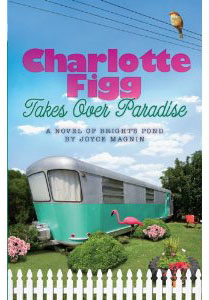
Charlotte Figg Takes Over Paradise
Liberation. That's the theme of CHARLOTTE FIGG TAKES OVER PARADISE, an uplifting, lively new novel by Joyce Magnin. When Charlotte Figg's oppressive, tyrannical husband of twenty years dies, the widow searches the internet and discovers a quaint, double-wide trailer in a place called "Paradise." In an effort to escape her past and start anew, she purchases the place sight unseen, packs up with her dog and hits the road with high hopes. However, when Charlotte gets to Paradise, she finds her new digs anything but.
Strapped with a trailer that is in complete disrepair, Charlotte, in search of a catharsis to ease her angst, takes to the kitchen and bakes her delectable fruit pies for her neighbors. It is in sharing each of these sweet treats that Charlotte slowly becomes acquainted with a cast of quirky characters as misfit as Charlotte, many of whom also feel trapped in dead-end marriages and stalled lives. There is a woman covered with tattoos, a dwarf, a woman who breast feeds a much too old child, a set of twins and a one-armed man. Charlotte remains undaunted by each challenge and person keeping her from the "paradise" she had envisioned for her future. She is determined to find meaning and purpose for her life, and in doing so, she becomes a catalyst that stirs things up in the community. As a means to reconnect with the joys of her youth and find herself again, Charlotte rallies the women of Paradise to join her in establishing a softball team. Think A League of Their Own meets The Bad News Bears. It is amid Charlotte's quest that the women of Paradise emerge to share a common bond, their individual secrets and tales of woe, and ultimately forge friendships. Domestic abuse is a thread running through this coming-of-middle-age, feel-good novel of faith and friendship.
NOTE: This book was reviewed via an ARC (Advanced Reader Copy) of the novel as provided by NetGalley.
Charlotte Figg Takes Over Paradise by Joyce Magnin
(Abingdon Press, Paperback, 9781426707667, 400pp.)
Publication Date: September 2010
To order this book via INDIEBOUND click HERE
Strapped with a trailer that is in complete disrepair, Charlotte, in search of a catharsis to ease her angst, takes to the kitchen and bakes her delectable fruit pies for her neighbors. It is in sharing each of these sweet treats that Charlotte slowly becomes acquainted with a cast of quirky characters as misfit as Charlotte, many of whom also feel trapped in dead-end marriages and stalled lives. There is a woman covered with tattoos, a dwarf, a woman who breast feeds a much too old child, a set of twins and a one-armed man. Charlotte remains undaunted by each challenge and person keeping her from the "paradise" she had envisioned for her future. She is determined to find meaning and purpose for her life, and in doing so, she becomes a catalyst that stirs things up in the community. As a means to reconnect with the joys of her youth and find herself again, Charlotte rallies the women of Paradise to join her in establishing a softball team. Think A League of Their Own meets The Bad News Bears. It is amid Charlotte's quest that the women of Paradise emerge to share a common bond, their individual secrets and tales of woe, and ultimately forge friendships. Domestic abuse is a thread running through this coming-of-middle-age, feel-good novel of faith and friendship.
NOTE: This book was reviewed via an ARC (Advanced Reader Copy) of the novel as provided by NetGalley.
Charlotte Figg Takes Over Paradise by Joyce Magnin
(Abingdon Press, Paperback, 9781426707667, 400pp.)
Publication Date: September 2010
To order this book via INDIEBOUND click HERE
Sunday, October 24, 2010
SCARECROW
"It was one of those freakish October days, when the mercury shoots up to the nineties, catching everyone off guard..." (Prologue)
When a young girl under her care dies, Dr. Jo Banks (20-something) is racked with guilt. In an effort to escape the pain and heartbreak of her misdiagnosis, Jo gets in her car and starts to drive. Lost in thought and with no destination in mind, she sets off from her home in Manhattan and hightails it onto the New Jersey Turnpike. Jo winds up hours - and what seems like a world - away from the big city, in Bayfield, a small, rural enclave in Southwest New Jersey, where "the serene line of the horizon (was) broken only by an occasional lone tree or scarecrow." Shortly after she checks in to the Oakview Motor Lodge, she is called upon to treat a woman staying at the motel who has suddenly taken ill. Jo's actions that night ultimately prompt her to uproot her life and take a job serving as a "cooperative house doctor" at several motels in the region. The nearest hospital is over an hour away.
Thus, Dr. Jo Banks' journey enters a new chapter. She is given her own cabin at Oakview in which to live and work. Slowly building her practice, Jo begins to fall in love with the small town and the people who live there. Feeling freer and more liberated than ever, she buys a motorcycle to make "house" calls. But when a dead man, disguised as a scarecrow, is found perched in a local farm field, Jo suddenly becomes swept up in a series of murders involving itinerant farm workers and morphs from town doctor to amateur sleuth.
SCARECROW is a brisk, fast-paced read - perfect to curl up with during this autumn time of year. SCARECROW is also the first in a series of three books (the next two are SATAN'S PONY and SLEIGHT OF HAND; a fourth is currently in the works) that features strong, independent Dr. Jo and a cast of intriguing, well-defined characters.
Robin Hathaway is masterful at writing short, tightly compressed chapters (with astutely rendered descriptions) that balance rich characterizations with an engaging plot. I marvel at how she gives so much information and backstory with a single line of description and/or dialogue. Read Chapter One and you'll see what I mean...In four, crisp pages, Hathaway presents everything you need to know about Dr. Jo Banks by showing you, rather than telling you. Impeccable!
If you like Jo Banks as much as I do, don't miss Hathaway's other award-winning mysteries, the Dr. Fenimore series of books.
To watch an interview with Robin Hathaway link HERE.
Scarecrow by Robin Hathaway
(Minotaur Books, Hardcover, 9780312308513, 224pp.)
Publication Date: April 2003
To purchase this book via INDIEBOUND click HERE
When a young girl under her care dies, Dr. Jo Banks (20-something) is racked with guilt. In an effort to escape the pain and heartbreak of her misdiagnosis, Jo gets in her car and starts to drive. Lost in thought and with no destination in mind, she sets off from her home in Manhattan and hightails it onto the New Jersey Turnpike. Jo winds up hours - and what seems like a world - away from the big city, in Bayfield, a small, rural enclave in Southwest New Jersey, where "the serene line of the horizon (was) broken only by an occasional lone tree or scarecrow." Shortly after she checks in to the Oakview Motor Lodge, she is called upon to treat a woman staying at the motel who has suddenly taken ill. Jo's actions that night ultimately prompt her to uproot her life and take a job serving as a "cooperative house doctor" at several motels in the region. The nearest hospital is over an hour away.
Thus, Dr. Jo Banks' journey enters a new chapter. She is given her own cabin at Oakview in which to live and work. Slowly building her practice, Jo begins to fall in love with the small town and the people who live there. Feeling freer and more liberated than ever, she buys a motorcycle to make "house" calls. But when a dead man, disguised as a scarecrow, is found perched in a local farm field, Jo suddenly becomes swept up in a series of murders involving itinerant farm workers and morphs from town doctor to amateur sleuth.
SCARECROW is a brisk, fast-paced read - perfect to curl up with during this autumn time of year. SCARECROW is also the first in a series of three books (the next two are SATAN'S PONY and SLEIGHT OF HAND; a fourth is currently in the works) that features strong, independent Dr. Jo and a cast of intriguing, well-defined characters.
Robin Hathaway is masterful at writing short, tightly compressed chapters (with astutely rendered descriptions) that balance rich characterizations with an engaging plot. I marvel at how she gives so much information and backstory with a single line of description and/or dialogue. Read Chapter One and you'll see what I mean...In four, crisp pages, Hathaway presents everything you need to know about Dr. Jo Banks by showing you, rather than telling you. Impeccable!
If you like Jo Banks as much as I do, don't miss Hathaway's other award-winning mysteries, the Dr. Fenimore series of books.
To watch an interview with Robin Hathaway link HERE.
Scarecrow by Robin Hathaway
(Minotaur Books, Hardcover, 9780312308513, 224pp.)
Publication Date: April 2003
To purchase this book via INDIEBOUND click HERE
Saturday, October 9, 2010
Vestments
Modern-day Catholics and the contemporary Catholic family are Reimringer's focus, and he knows the landscape very well. There is Jim, the priest, who was drawn to the church--namely the rituals and ceremonies--as a young boy. It seems that Jim took his vows less for the spiritual implications and more as a place of refuge from a dysfunctional family. However, this choice has actually isolated and alienated Jim from his kin. Jim has an alcoholic father, who is not keen about (nor proud of) his son's choice of career. His mother is a church-going Catholic who prefers to adhere to her own rules rather than those of the church. Jim's brother's and sister's only claim to being Catholic is their reference to Jim as "our brother, the priest." Jim's ailing grandfather tenaciously clings to his faith to escape the lingering emotional wounds of war and his fear of impending death. He seems to be the family member who shows the most reverence for God and displays a sincere depth of spirituality.
Jim returns to his hometown after being forced to take a sabbatical from the priesthood - he has broken his vows of celibacy with several women. Once home, he tries to deal with his family and grapple with the implications of what he has done. If that weren't enough, Reimringer ups the ante by having Jim cross paths with an old flame, a woman who was his first true love. Through a parallel structure, Reimringer peels back Jim's layers by interspersing powerful scenes from the past with the present action. This romantic subplot, told in real time and flashback, forces Jim to reconcile his feelings for the priesthood and helps him decide if he can stay committed to the celibate life, once and for all.
Reimringer casts Jim as a liberal ("abortion is not all wrong") and very self-forgiving Catholic. His modernity is real, and it makes him all the more accessible to the reader. However, what was Jim's ultimate goal for his life by serving in the priesthood? And beyond the physicality of the Catholic Church and its rituals, did Jim ever cultivate an intimate, personal relationship with God and Jesus Christ? Questions like these kept me riveted to this novel and made me eager to make an emotional investment in this provocative story until the very last page.
Sunday, September 26, 2010
Molly Fox's Birthday
Can you ever really know someone? That's the question evoked by the novel MOLLY FOX'S BIRTHDAY. It is the latest from Irish writer, Deirdre Madden. This richly woven story is told from the point of view of an unnamed narrator, a young woman, a successful playwright, suffering a bout of writer's block. She is house-sitting for her long-time friend, Molly Fox, an equally successful actress, whose need for privacy shrouds her in layers of mystery.
The setting of the book is Ireland and the action takes place all on one day, the Summer Solstice (the longest day of the year), which is also Molly Fox's birthday. Over the course of the story, the narrator inhabits Molly's house and wanders the rooms therein, reliving decades of their friendship via flashbacks. In the process, she conjures scenes of Molly Fox that inspire feelings of love, admiration, jealousy and even resentment. But who really is Molly Fox? This gently paced, beautifully written novel is about how we shape our identities and relationships - the relationship we have to ourselves, our family and friends, our passions and most significantly, our artistic inclinations.
Through the narrative flashback arc, each character in this novel seems a misfit, shaped by some sense of loss and trauma in their families that has encouraged him/her to turn to the arts. The narrator comes from a big, Irish, baby-making clan. It is her brother, a solitary Catholic priest, who helps her understand and appreciate how being different and living an unconventional/introspective life can be an asset and not a liability--especially for a writer. Molly spends her life, off-stage, trying to escape the lasting wounds of a largely absent mother and caring for an emotionally troubled brother. But it is a seemingly secondary character, Andrew, a documentary filmmaker and an old friend of both the narrator and Molly--a man who lost his brother, the favorite son of his family, to the Irish rebel cause--who figures most predominantly into the denouement of this deeply moving story.
"Sometimes the most important and powerful element is an absence, a lack, a burnished space in your mind that glows and aches as you try to fill it," the narrator tell us.
The book seems to suggest that an artistic life--be it on the page, stage or screen--can be a bulwark against loneliness and feelings of emptiness. In the end, the losses and empty spaces in life, and how one responds to them on an emotional level, are what come to define these very authentic, three-dimensional characters. A thought-provoking read!
Subscribe to:
Posts (Atom)


