My Yorkshire terrier and
I were profiled in USA Today for the "Authors and Pets at Work" Lifestyle
column. To read the article and learn more about my "literary
co-pilot"--and my forthcoming novel, The Thing Is--click on the article title, in bold, below:
Sunday, October 25, 2015
Sunday, October 11, 2015
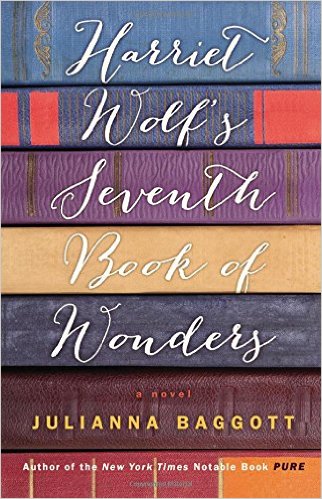
Harriet Wolf's Seventh Book of Wonders
Stories--in
real life and in fiction--take on lives of their own in Julianna
Baggott's, Harriet Wolf's Seventh Book of Wonders. This sensitively rendered,
well-balanced novel is told via four, female points-of-view. At the heart is
Harriet Wolf, a reclusive, revered author of six adventurous novels featuring
two characters, Daisy and Weldon, who fall in love with each other as children
and as they age, from book to book, are "separated by wars and disasters,
by acts of God and calamities of the heart. When they finally reunite they
suffer." Harriet died before the seventh book was published, yet enamored
readers believe it would've revealed whether the entire series "was a
tragedy or a love story, whether humanity is basically good or doomed."
Harriet's
daughter, Eleanor—a mother with two adult daughters of her own—despises and
resents her mother's success and having had to share Harriet with the world.
When Eleanor suffers a mild heart attack, her own fractured nuclear family reunites.
This includes Ruth—married to a Harriett Wolf scholar, but trying to lead a
"normal" life while estranged from the family for 14 years—and
Tilton—a sheltered, "special needs" shut-in—who shared an intimate
bond with her grandmother and made a pact with her regarding the rumored
seventh book. With Eleanor ailing, is it time for Tilton to finally expose the
mystery surrounding Harriet's last book?
With keen
insight, Baggott
(Burn) offers an original, richly textured story infused with dark
secrets, promises, loyalties, love stories and the psychological complexities
of family dynamics across generations.
Publication Date: August 18, 2015
Note: This review is a reprint and is being posted (in a slightly
different form) with the permission of
Shelf
Awareness. To read this review on Shelf Awareness: Reader's Edition (9/1/15),
link HERE
Sunday, September 27, 2015
First Pages in Fiction: The Sea Keeper's Daughters
In this continuing series, "Novel Beginnings," I dissect first paragraphs of novels and show how the opening of a book sets the foundation for what's to follow in terms of tone, character and story intent. In this installment, we'll explore The Sea Keeper's Daughters
by Lisa Wingate. Here are the opening
paragraphs:
Perhaps denial is the mind's way of protecting the heart from a sucker punch it can't handle. Or maybe it's simpler than that. Maybe denial is the face of overwhelming evidence is a mere byproduct of stubbornness.
Whatever the reason, all I
could think standing in the doorway, one hand on the latch and the other
trembling on the keys, was, This can't be happening. This can't be how it ends. It's
so…quiet. A dream should make noise when
it's dying. It deserves to go out in a tragic blaze of glory. There should be a
dramatic death scene, a gasping for breath…something.
Denise laid a hand on my
shoulder, whispered, "Are you all right?" Her voice faded at the end,
cracking into jagged pieces.
"No." A hard,
bitter tone sharpened the cutting edge on the word. It wasn't aimed at Denise.
She knew that. "Nothing about this is all right. Not
one single thing."
"Yeah." Resting
against the doorframe, she let her neck go slack until her cheek touched the
wood. "I'm not sure if it's better or worse to stand here looking at it,
though. For the last time, I mean."
"We put our hearts into
this place…" Denial reared its unreasonable head again. I would've called
it hope, but if it was hope, it was false and paper-thin kind. The kind that
only teases you...
Wingate launches her story with a profound statement
about denial. And the paragraphs that follow bring an immediate sense of intimacy. Notice, however, the use of the words "death," "bitter," "hard," and "sharpening." This speaker is not happy and is grappling, but the philosophical nature of the opening sentences reveal the speaker to be wistful and sensitive. The
speaker (not sure if it's a man or a woman) is taking a last look at a place
that was obviously dear to her/him. Readers don't know what--or where--that place
is, but intrigue deepens, especially when Denise offers a gentle
touch and then breaks the speaker's reverie to ask, "Are you all
right?" Denise's actions and words--and the conversation that ensues--gives
the reader a sense that she is a friend and confidante, and she has a stake,
along with the speaker, in something that is coming to a close or someplace
these two people will have to leave. The speaker's "hard, bitter" response indicates that she is not a willful participant in whatever change is taking place. And thus, this story begins at the end of something.
If you're familiar with books by Lisa Wingate (this novel is actually the
third in her series of Carolina-based
stories; read my review of The
Prayer Box), you already know she writes multi-generational, dual
time-frame novels of domestic fiction, where she often merges two story
threads—a present-day story with a story from the past. You'd have to keep reading
this novel to see how this opening scene serves to launch the journey of Whitney
Monroe, a high-end (yet struggling) restaurant owner in Michigan who comes from a complicated family. When Whitney's elderly, estranged stepfather
takes ill, she travels to the Outer Banks of North Carolina to be with him. He
lives at the Excelsior, a famed hotel from the Gilded Age, which he also owns. (Whitney
will one day inherit the hotel.) While Whitney is in residence, memories from
her childhood are evoked, and she also discovers family heirlooms and letters exchanged
between her grandmother and a relative Whitney never knew existed. In reading the
letters and experiencing incidents involved, Whitney questions her family and heritage, and she is forced to
confront issues of race, politics, identity and secrets.
Wingate once again
writes an intriguing, multi-layered story where her main character must take a
physical journey in order to trek deeper into the recesses of her soul.
Tyndale
House Publishers, $19.99 Hardcover, 9781414388274, 448 pp
Publication Date: September 8, 2015
To order this book via INDIEBOUND link HERE
Sunday, September 20, 2015
The Woman Who Stole My Life
In The Woman Who Stole My Life,
Marian Keyes delivers a warm and
positive--at times hilarious--read about the effects of serious illness.
The story is told by
charming and chatty, Stella Sweeney--age "forty-one and a
quarter"--and the account of what happened when she was a 37 year-old
Irish beautician; the wife of a "successful but creatively
unfulfilled" bathroom designer; and mother of two rebellious teenagers.
Stella's life was humbly ordinary until a strange illness overtook her, making
her paralyzed and mute. The diagnosis, Guillain-Barre syndrome--a rare, yet
usually temporary, autoimmune disorder--attacks the nervous system. Stella,
mentally attentive, remained confined to an I.C.U. The only way she could
communicate was via blinking, and the only person who understood her was her
handsome neurologist, Dr. Mannix Taylor. During her long hospital stay, the two
bond and share intimate details about their lives.
After her arduous recovery,
an American tabloid publishes a photo of the Vice-President's wife reading a
self-help book called One Blink at a Time—Stella's story, complete
with clever, stoic aphorisms she spouted during her ordeal. Stella is surprised
to learn it was self-published, behind her back, by dreamy Dr. Taylor. The
exposure brings Stella instant international fame and fortune—and the
possibility of new love. But at what price?
Keyes (The Mystery
of Mercy Close) depicts the realities of illness for the patient and
all involved. Her comic take on Stella's journey--coupled with her
distinctive brand of humor and wit--showcases her imagination in top form.
The Woman Who Stole My Life by Marian Keyes
Viking, $27.95 Hardcover, 9780525429258, 464 pp
Publication Date: July 7, 2015
To order this book via INDIEBOUND link HERE
Note: This review is a reprint and is being posted (in a slightly different form) with the permission of Shelf Awareness. To read this review on Shelf Awareness: Reader's Edition (7/24/15), link HERE
Viking, $27.95 Hardcover, 9780525429258, 464 pp
Publication Date: July 7, 2015
To order this book via INDIEBOUND link HERE
Note: This review is a reprint and is being posted (in a slightly different form) with the permission of Shelf Awareness. To read this review on Shelf Awareness: Reader's Edition (7/24/15), link HERE
Sunday, September 6, 2015
The Love She Left Behind

A dead woman is the central character of The Love She Left Behind by British author Amanda Coe (What They Do in the Dark). The deceased is Sara, who, 35 years before her death from stomach cancer, deserted her husband and children--Nigel, then age 13, and Louise, age 10--and gave up everything to live with Patrick, a playwright for whom she was muse. Patrick never had any fondness for his stepchildren. After Sara uprooted her life for him, he paid for Nigel to attend boarding school and Louise was shipped off to live with an aunt after their birth father remarried and rejected them.
The book opens in Cornwall, in the now-dilapidated house Sara and Patrick shared. Nigel--a married, type-A lawyer and father--has little care or respect for Louise, a divorced, overweight, working-class mother of two rebellious teenagers over whom she has little control. They are faced with Patrick's irritability, drunkenness and writer's block. As the three go over details and assimilate the contents of Sara's will, it is revealed that the couple's house and the dramatic rights to Bloody Empire--a popular play Patrick wrote in the 1980s--were put in Sara's name for tax purposes. Patrick battles Nigel and Louise over the transfer of ownership, and brother and sister also lock horns.
Coe employs dark comedy to piece together and acutely observe emotional issues dealing with abandonment, loss, death and grief. The idea that we do not truly know the ones we love serves to solidify the cracked fault lines in the foundation of this thoroughly entertaining and thought-provoking family saga.
The Love She Left Behind by Amanda Coe
W.W. Norton, $25.95 Hardcover, 978039324543, 256 pp
Publication Date: July 15, 2015
To order this book via INDIEBOUND link HERE
Note: This review is
a reprint and is being posted (in a slightly different form) with the
permission of Shelf
Awareness. To read this review on Shelf Awareness: Reader's Edition (7/14/15),
click HERE
Sunday, August 30, 2015
First Pages in Fiction: Scents and Sensibility
The
first paragraphs of a novel can set the foundation for
what's to follow in terms of tone, character and story intent.
Here are the first few paragraphs from the novel, Scents and Sensibility by Spencer Quinn:
Home at
last! We'd been away so long, first in swampy country, then in a big city--maybe
called Foggy Bottom--that confused me from the get-go. Is there time to mention
the air in both those places before we really get started? Soggy and heavy: that
sums it up.
Where
were we? Was it possibly . . . home? Yes! Home! Home at last! Our home--mine
and Bernie's--is on Mesquite Road. Mesquite Road's in the Valley. Quite
recently I might have heard that the Valley's in Arizona, but don't count on
that. What matters is that right now I was inhaling a nice big noseful of
Valley air. Light and dry, with a hint of greasewood and just plain grease:
perfect. I felt tip-top. Bernie opened our door, kicked aside a huge pile of
mail, and we went in.
"Ah,"
said Bernie, dropping our duffel bag on the floor. I did the first thing that
came to mind--just about always my MO--which in this case meant sniffing my way
from room to room to room, zigzagging back and forth, nose to floor. Front
hall, our bedroom, Charlie's bedroom--mattress bare on account of Charlie not
being around much since the divorce--office, with the circus-elephant-pattern
rug, where I actually picked up the faint whiff of elephant, even though no
elephant had ever been in the office. I'd had some experience with elephants,
specifically an elephant name of Peanut, no time to go into that now...
Do
you get the idea the narrator isn't a person? Can you tell the voice leading
you into the story is that of a dog? How? The speaker seems conflicted, yet what person do you know who sniffs
his way from room to room? And the setting? It's telling that the speaker
doesn't really know where "the Valley" is located, but as he inhales
a "big, noseful of Valley air," he finds it light and dry, so we can
gather this scene is set in the desert. And what's with the elephant rug? Well,
that's what makes the reader keep reading...
If
you're not familiar with the Chet and
Bernie mystery-thriller series, you're missing out. Each book, there are
eight in all, is narrated by Chet, a
hyperactive dog, who works with his laid-back master and partner, Bernie Little
of the Little Detective Agency.
In
Scents and
Sensibility, the duo have returned home from visiting Bernie's
girlfriend in Washington D.C. and realize they've been robbed. The safe in
Bernie's office has been pried out of a wall and stolen—complete with a prized
watch that belonged to Bernie's grandfather. Then they realize their neighbor has
an adult son (one they never knew he had, who is now residing next door) and
also has a mature Saguaro Cactus suddenly growing on his front lawn. Where did it come from? How did it get there? It's
against the law to move a cactus of this variety. Knowing the neighbor had a key to Chet and Bernie's house in case
of emergency, is it possible the neighbor's son is the thief and the
cactus transporter? What begins as a simple welcome home set-up evolves into
another case—another dangerous, crime-solving adventure—for Chet and Bernie involving
cactus thieves, murder and a kidnapping.
This
clever, funny and riveting series is perfect for fans of crime/mystery fiction
and animal/pet lovers.
Atria
Books, $25.00 Hardcover, 9781476703428, 320 pp
Publication Date: July 14, 2015
To order this book via INDIEBOUND link HERE
Labels:
Animals,
Atria Books,
Crime Fiction,
Detective Fiction,
Dogs,
Dogs in Fiction,
First Pages in Fiction,
Mysteries,
Novel Beginnings,
Pets,
Pets in Fiction,
Spencer Quinn,
Thrillers,
Writing as a Craft
Sunday, August 23, 2015
The Unexpected Consequences of Love
Romantic entanglements are Jill Mansell's specialty, and in The
Unexpected Consequences of Love, she cleverly snares knots into several
interwoven story threads spun from St. Carys, a seaside town in Cornwall, UK.
Amid Josh's pursuit, Sophie's free-spirited best friend, Tula, loses her job and moves to St. Carys. When Tula arrives, she is instantly attracted to Josh, but another man from town, Riley--a ne'er do well and flirt--has eyes for Tula. What will it take for Riley to turn Tula's head? Things grow even more complicated when Tula lands a job at Mariscombe House.
Mansell has written another lively, engaging romance where an ensemble of characters--including Grandma Dot--have had their hearts wounded by the past and secrets. Each member of the cast is faced with hang-ups and heartbreaks and the conflicts inherent in the prospect of loving again. Amid obstacles that challenge happy endings, Mansell braids in poignancy, humor and unexpected grace.
The Unexpected Consequences of Love by Jill Mansell
Sourcebooks Landmark, $14.00 Paperback, 9781492602088, 432 pp
Publication Date: February 3, 2015
To order this book via INDIEBOUND link HERE
Note: This review is a reprint and is being posted (in a slightly different form) with the permission of Shelf Awareness. To read this review on Shelf Awareness: Reader's Edition (2/10/15), link HERE
Saturday, August 15, 2015
A Legendary 40 Years of Publishing for Author Mary Higgins Clark
"Where Are the Children?" the breakout suspense novel
by author
turns 40 years old
Saturday, August 15, 2015
Opinion/Editorial: "Other Views/ Guest Columnist" (Section A-11)
BY KATHLEEN GERARD
To read the article in its entirety, click on the highlighted title above
Sunday, July 26, 2015
Valley Fever
A broken romantic relationship propels a disillusioned young
woman back to her hometown of Fresno, Calif., in Katherine Taylor's vivid, enjoyable
second novel, Valley Fever. This story of
family, friendship, loyalty and betrayal is narrated by sharp-witted,
30-something Ingrid Palamede, who settles into the colorful backdrop of the
Central Valley and her family's faltering 20,000-acre riverside
vineyard--Palamede Farms. The vineyard has a storied history: Ingrid's father,
Ned, inherited his first hundred acres and, over the years, kept buying and
cultivating more land. But the farm is now in financial trouble, Ned is ill and
Ingrid's mother is contemptuous. With plenty of free time now, Ingrid offers to
help. Is she the savior the farm needs?
As she becomes embroiled in the small-town landscape that shaped her, Ingrid revisits her past, brushing up against an old flame, an estranged best friend and an employee suspected of stealing from the farm. Ingrid's sister, Anne--a successful voice-over actress in Los Angeles who would do anything for her--is leery about Ingrid's plight. And then there's "Uncle" Felix, Ned's oldest and dearest friend, another vintner, who makes his living by purchasing grapes from other farmers--including the Palamedes. With Ingrid in charge, will Felix hold up his end of the bargain, or will sour grapes and self-interest trump professional bonds?
Taylor (Rules for Saying Goodbye) delivers a vivid, bittersweet, entertaining drama that harvests ripe truths about self-discovery, the workings of the heart and the tangled vines of families and fortunes.
As she becomes embroiled in the small-town landscape that shaped her, Ingrid revisits her past, brushing up against an old flame, an estranged best friend and an employee suspected of stealing from the farm. Ingrid's sister, Anne--a successful voice-over actress in Los Angeles who would do anything for her--is leery about Ingrid's plight. And then there's "Uncle" Felix, Ned's oldest and dearest friend, another vintner, who makes his living by purchasing grapes from other farmers--including the Palamedes. With Ingrid in charge, will Felix hold up his end of the bargain, or will sour grapes and self-interest trump professional bonds?
Taylor (Rules for Saying Goodbye) delivers a vivid, bittersweet, entertaining drama that harvests ripe truths about self-discovery, the workings of the heart and the tangled vines of families and fortunes.
Farrar, Straus &
Giroux, $26 Hardcover, 9780374299149, 304 pp
Publication Date: June
9, 2015
Note: This review is
a reprint and is being posted (in a slightly different form) with the
permission of Shelf
Awareness. To read this review on Shelf Awareness: Reader's Edition (6/30/15),
click HERE
Saturday, July 11, 2015
Commentary: Go Set a Watchman by Harper Lee
TO KILL A WATCHMAN?
The buzz has been building for Go Set a Watchman.
This long-awaited first novel was written 50 years ago by Harper Lee before she
re-tooled it as To Kill a Mockingbird.
I've always been a fan of Mockingbird and Lee (see my Op-Ed
in The Record, 7/6/10). And while, as a writer, I am very
intrigued by the whole premise of reading the vision of a work before it was
edited, early reviews of the novel are making me very leery. And I would bet
there have been more articles and criticism already written about—and in
anticipation of—Watchman than
the 288 pages of the novel itself!
Reviews of Watchman have
been disillusioned and unsettling. Most notably (and shockingly) is the
character of lawyer and father, Atticus Finch. In Mockingbird, he
was a paragon of virtue. In Watchman,
reviewers are saying he is a racist bigot—who even attended a Ku Klux Klan
meeting. Watchman is
set 20 years later than Mockingbird and
builds on the premise of now 20-year-old Scout and her return visit to Maycomb,
Ala. from where she now lives in New York City. Upon arriving back in her
hometown, Scout is shocked to find that her father holds "abhorrent views
on race and segregation," according to Michiko Kakutani of The New York Times.
How did this happen?
If this review and others are accurate in their assessments, then
the very idea of Watchman is
confusing and troubling. Was Mockingbird scrubbed
of Atticus's racist tendencies in order to make him and the story more
commercially viable—to appeal to the masses, a wide swatch of African-Americans
and Caucasians? If so, was this choice an artistically aesthetic choice or
simply a means to drive up book sales? What might be the reason why Lee would
recast Atticus so significantly from a racist "sinner" in Watchman into
a morally upright and virtuous "saint" in Mockingbird ? Yes,
the novel is fiction, as is the character of Atticus Finch (although he is said
to be closely based on Lee's own father). But for a writer, this would be like
rewriting the character of Mother Theresa into an abusive harridan the likes of
Joan Crawford!
Mockingbird has sold well over 50
million copies. What author wouldn't want their work read and enjoyed, debated
and celebrated by the masses? It remains required reading in schools throughout
the USA and beyond. And yes, Lee has made millions and even won a Pulitzer Prize for Mockingbird.
But did Lee pay a price—in her soul—to craft the Mockingbird narrative
away from her original vision as found in Watchman?
Which leads to my next question: if early reviews of Watchman are
discerningly on-target, then did Lee really sanction its publication? Could
suspicions of Lee's lack of cognizance be accurate? Why would she strip off the
idyllic finish of Atticus as portrayed in Mockingbird and
tarnish his persona by finally exposing his "dark side" in Watchman? And
why now? Was Lee manipulated into publishing Watchman just as
she was manipulated to rewrite the essence of Watchman and
transform it into the more idealistic version of Mockingbird?
On the flip side remains the possibility that Lee is completely
aware of her intentions—that she is fully mindful and astute. Whether she
"sold out" her story or not for Mockingbird, perhaps
before her life ends, she wants, for her own peace of mind, for others to
experience her original vision, the way she first envisioned the novel? After all, considering the strides made for equality over the
past 50 years, the racial divide is still miles apart and a hot-button
issue—especially with the police-civilian riots in St. Louis and Baltimore and
the Charleston, South Carolina church massacre. Perhaps Lee has been closely
watching current world events unfold and believes Watchman—with its
darker, less politically correct themes—may prove even more relevant today than
if the book was released 50 years before?
Calculated decision or coercion, we'll likely never know the
author's true intent or the real story behind the reasons for publication
of Watchman. And maybe "not knowing" will, in the
end, serve to further ratchet up book sales, intensify conversations and
debates about the continued racial unrest in our country and ultimately
make Watchman even more appealing and well-read than Mockingbird.
"To Kill A Watchman?" (commentary) © 2015 by Kathleen
Gerard
Note: Do not reprint, reproduce, post
online or copy without proper attribution
Harper, $27.99 Hardcover,
9780062409850, 288 pp
Publication Date: July 14, 2015
To order this book via INDIEBOUND link HERE
To
Kill a Mockingbird by
Harper Lee (50th Anniversary Edition)
Harper Torch, $25.00 Hardcover,
9780061743528, 323 pp
Publication Date: May 11, 2010
To order this book via INDIEBOUND link HERE
Monday, July 6, 2015
Nina George: The Power of Books to Heal
The Writer's Life
Nina George writes contemporary novels centered on people "who undertake a physical journey that leads to self-discovery" because, she admits, she does the very same thing in her own life. "The quests, the odysseys, the 'joyful wanderings' (exploration, seeking the way, straying from the beaten path) are what constitutes a life." While she is of German descent, France is "in her blood" due to influences from her mother's side of the family. She believes "the French soul lay closer to (her) heart than German sensibilities." George lives in the Finistére region of Brittany, "at the end of the world.... Although," she claims, "some say it is where the world begins." The Little Paris Bookshop (read the review below or link HERE) was first published in German as "Das Lavendelzimmer" in 2013; it has sold over 500,000 copies and been translated into more than 27 languages. Crown will publish the novel in the U.S. in June. (Interview translated by Heidi Holzer.)
Note: This interview is a reprint and is being posted with the permission of Shelf Awareness. To read this
The Little Paris Bookshop largely takes place on French waterways. Have you ever taken a river cruise through France?
My father died the same year I'd planned to take the tour, and I also had a titanium implant in my neck. So I talked to "river people" and borrowed their river diaries. I spoke with tourists and locals. In 2014 (after the book had been on the bestseller list for a year), my husband, Jo, and I finally drove along the route. We ate and drank in Montargis and Cepoy, checked out houseboats for sale and drove across the canal bridge in Briare.
Sanary-sur-mer becomes the cornerstone of the novel. Is there any special reason why you chose to make this locale central to the plot of the story?
Oh, yes! In 2012, I explored Provence and drove around the region, 1,500 kilometers [930 miles], until the land answered my questions. I went to Sanary-sur-mer because it was the home of German women writers in exile. In a way, I felt as though I were in exile as well. My father had died, my body--my neck--was injured. It felt as though I'd lost my way: my life, my sense of inner childhood, my security. Sanary was a place of healing for me. I believe that everyone has a secret place where they are made "whole" again, no matter what it was that broke them in the first place.
Would you say a sense of brokenness inspired the novel?
Life. Death. Books. Dreams.... It began with the success of Die Mondspielerin/The Moon Musician, after which people expected me to write another novel. I wanted to explore the great themes of guilt, heartbreak and beginning one's "'actual" life all over again. My father died in 2011, and that was the caesura in my life, in everything that I am. I've been writing for 23 years. I'm a professional writer. Yet after my father's much too sudden death, I felt something break inside--my deep grief brought me back to myself. And it also redefined what I want to and am able to write about.
So I wrote about life, about survival after the death of a loved one, about the power of books that can heal everything--absolutely everything. And about living in one's own dreams. I felt free to do whatever I wanted, because I'd already gone through the worst possible thing in life. Since then, rules have no longer applied to me. For survivors, nothing is forbidden.
You pay your father a beautiful tribute in the dedication to this novel.
My father was a loving man. I never met any human being like him. He was kind and strong. He didn't have a great deal of education--no one did in postwar Germany--and yet he was wise and read up on everything. We'd been discussing my work since the early days of my career--I landed my first job, with a newspaper, at the age of 19. By 22, I'd written the first of what are now 26 books--and he read everything I wrote. We debated, he offered praise. He always wanted to know how I came up with things. No one else has ever been so intensely interested in what I think. He never wanted me to be simply "pretty" or "a good girl." His desire was for me to think, to develop internal endurance. He encouraged me in sports, challenged me to think. He helped develop my political sensibility and demanded that I respect people, cultures and religions. I was never to assume that my truth is the only one that matters. In a sense, the way he brought me up laid the groundwork for how I'm able to see the world.
Why has this novel resonated so deeply with readers?
Because it's a story about death and about how much we can be shaped by loss, by missing a person. Grieving, or admitting that the loss of a loved one has derailed us, was unfashionable, forbidden for much of the past. Also, there is a dedicated community of people in the world who will always be able to connect with each other across all languages, boundaries and religions. It is the "Readers' Club." People who read a lot, starting at a very young age, are people who were raised by books. They have learned about forms of love and hate, kindness, respect and ideas that are different from their own. They experience the world as something infinitely larger than before. They enjoy the indescribable feeling of having found their true selves.
We readers are book people, and Jean Perdu [the protagonist] is one of us. We are all traveling on an invisible literary riverboat, one that carries us down the stream of life. It shapes, holds and comforts us.
At the end of the novel, you include a compendium of books/titles to cure whatever ails a reader. If you were to include The Little Paris Bookshop on that list, what ailment would this novel serve to cure/alleviate?
Catharsis and healing. Das Lavendelzimmer/The Little Paris Bookshop is both a kind of cleansing and a literary form of solace. It penetrates areas of the soul where old and grand emotions are hidden. Grief, melancholy, regret that we are not 16 anymore, compassion, the desire to be loved by our parents, finding the place where we feel whole, understanding the fears in our dreams. The book cleanses these wounds--and above all, it provides solace. In Germany, people often give books to friends who are starting over: a new life, a new job, a new era.
Jean Perdu has a favorite book that changed his life. Do you have a book that changed yours?
My library holds 3,500 books, and I've read around 4,200 in my life. Every book has had an effect on me, but I'll mention only three:
Ein Fisch ohne Fahrrad (A Fish Without a Bicycle) by Elizabeth Dunkel: At a time when I didn't know whether I wanted to love or be loved, or which one would be harder to bear.
The Elegance of the Hedgehog by Muriel Barbery: At a time when I felt I didn't trust myself to be the person I am.
The diaries of Anais Nin: To help me understand that I have a sexual identity.
Will there be a 27th book?
I'm working on a novel that is about being afraid that one is not good enough and what awaits us in the space between life and death. It also deals with the question of whether there is even such a thing as the "right" life.
Note: This interview is a reprint and is being posted with the permission of Shelf Awareness. To read this
Q&A as originally published on Shelf Awareness (4/8/15), click HERE
Labels:
Book-selling,
Books,
Bookshops,
Cruises in Fiction,
Fiction,
France,
Grief,
Journeys in Fiction,
Love Stories,
Nina George,
Novel,
Paris-France,
Q&A,
River Seine,
Shelf Awareness,
Writing Life
Subscribe to:
Posts (Atom)