Showing posts with label Book of the Week. Show all posts

Sunday, July 29, 2012

The Unlikely Pilgrimage of Harold Fry


The world was made up of people putting one foot in front of the other; and a life might appear ordinary simply because the person living it had been doing so for a long time. Harold could no longer pass a stranger without acknowledging the truth that everyone was the same, and also unique; and that this was the dilemma of being human. -- from The Unlikely Pilgrimage of Harold Fry by Rachel Joyce
Harold Fry, a sixty-five year old British retiree receives a letter from Queenie Hennessy, a long lost friend and former coworker who once did Harold a big favor. The letter reveals that Queenie is in a hospice center, dying.  

Shaken by the news, Harold pens a response. But when he sets off to mail his reply at the corner post box, he is suddenly inspired to deliver the letter in person - 500 miles away. Leaving behind his stale, stagnant life, including a wife, Maureen, who is bothered by practically everything Harold says and does, he impulsively leaves his small English village--on foot, without a map or his mobile phone; he's wearing shoddy sneakers--and begins the journey to reach his dying friend. He comes to believe that as long as he keeps walking, Queenie will wait for him and continue to live.
Harold isn't the only pilgrim in this story. Queenie is taking her own solitary pilgrimage through a fatal illness. In Harold's absence, Maureen begins to sort through the past in order to discover the real reason why she and Harold have grown apart. And the people Harold meets along the way, those with stories of their own hardships and struggles, encourage Harold to reflect and delve deeper into the meaning of his existence and as a result, reconcile the deeply repressed regrets of his own life. 
Pretty soon, Harold is no longer walking the length of England alone. When the press gets wind of his quest, other people join the pilgrimage and Harold begins to feel crowded out by all the fuss. Can Harold maintain his focus on what he originally set out to do? Does he have the physical stamina? And can his walking, an act of faith, save Queenie Hennessy?
Rachel Joyce has written a moving, compulsively readable novel infused with a well-balanced combination of humor and pathos. By exposing the emotional wounds of a host of ordinary people who are all trying to navigate through the challenges of life, Joyce taps into universal themes about the moral and spiritual ways in which we atone and seek to save ourselves...insights that stretch far beyond the ultimate 87 days and 627 miles of Harold's journey.

The Unlikely Pilgrimage of Harold Fry by Rachel Joyce
Random House, $25, Hardcover, 978081299395, 336 pp
Publication Date: July 24, 2012
To order this book via INDIEBOUND link HERE

Sunday, July 15, 2012

A Gift for My Sister


Take two, fatherless half-sisters. Make one sister, Sky, an obedient, play-it-safe type. Portray the other, Tara, as a reckless, no-holds-barred younger sister rebel. Reinforce their differences by designating different typeface fonts that reflect the distinct voice of each sister as they narrate this story via alternating, first person points of view and what emerges is A Gift for My Sister by Ann Pearlman (The Christmas Cookie Club), a moving, deeply resonant novel.

The story begins with Sky, a happily married lawyer with a young daughter who resides in a California beachfront condo. Beyond her seemingly idyllic life, 30-something Sky is riddled with bitterness and worry incurred from a past marred by challenges and loss--the death of her father when she was a teenager, miscarriages and the passing of her best friend. Tara, on the other hand, is a free spirit whose father abandoned her. In high school, she entered into an interracial romance with an ex-juvenile prison inmate and became pregnant. With beau and baby in tow, Troy took off to pursue her dreams of becoming a musician and is now on the verge rap music superstardom.

When tragedy strikes, Sky and Tara are forced to reunite. By rendering shared experiences via their opposing personalities and viewpoints, Pearlman skillfully evokes empathy on both sides. Resentment, rivalry, fear of love and loss and the idea of forgiveness infuse what ultimately becomes a road-trip novel--from California to Michigan--where the sisters try to understand each other, the complications of their own lives and the larger ramifications of family.

Atria/Emily Bestler Books, $24.99, Hardcover, 9781439159491, 288 pp
Publication Date: May 1, 2012
To order this book via INDIEBOUND link HERE

Please note: This review is a reprint and is being posted (in a slightly different form) with the permission of Shelf Awareness. To read this review on Shelf Awareness: Reader's Edition (5/29/12), click HERE.

Sunday, June 3, 2012

The First Warm Evening of the Year


Forty-something Geoffrey Tremont thought he was settled in his life in New York City - he has many friends, a successful career doing voice-over spots and a relationship with a woman who offers him companionship. But when Tremont is notified that he has been named the executor of a will for an old college friend, Laura Wells, whom he hasn't seen in twenty years, and he sets off to reconcile her estate in Shady Grove, a small town in upstate New York in the Berkshire Mountains, his life is suddenly upended. He falls, love at first sight, for Marian Ballantine, a dear friend of the departed, a woman living in a perpetual state of mourning since her husband's death and stuck in a repressed relationship of her own.

The inherent risks--and joys--of love and loving are the cornerstones of The First Warm Evening of the Year by Jamie M. Saul (Light of Day).  This is a psychologically astute and emotionally evocative novel about death (literal and figurative), the nature of grief, passion, self-knowledge and the complexities of love. Laura's passing assembles a cast of deeply drawn supporting characters forced to examine their own intimate associations - or lack thereof. Sometimes people settle and use substitutes for cultivating more substantial relationships in their lives. But as one character remarks when considering the risks of love despite the consequences of heartbreak, "What's the point of having a heart, if you're not going to use it?" Those in this absorbing, beautifully written novel ultimately discover that sometimes love is not a choice, but rather a matter of having no choice. 

William Morrow, $24.99, Hardcover, 9780061449727, 304 pp
Publication Date: April 24, 2012
To order this book via INDIEBOUND link HERE

Please note:  This review is a reprint and is being posted (in a slightly different form) with the permission of Shelf Awareness. To read this review on Shelf Awareness: Reader's Edition (4/27/12), click HERE.

Sunday, December 18, 2011

A Christmas Memory

"I've always thought a body would have to be sick and dying before they saw the Lord. And I imagined that when He came it would be like looking at the Baptist window: pretty as colored glass with the sun pouring through, such a shine you don't know it's getting dark. And it's been a comfort: to think of that shine taking away all the spooky feeling. But I'll wager it never happens. I'll wager at the very end a body realizes the Lord has already shown Himself . . . I could leave the world with today in my eyes."
~from A Christmas Memory by Truman Capote

I read A CHRISTMAS MEMORY by Truman Capote every year, and every year this carefully crafted story, steeped in great sensory detail and palpable atmosphere, takes on more depth and resonance. 

The setting is the rural South of the 1930s, during the Great Depression.  The story is told looking back via the perspective of a then, seven year-old boy remembering a Christmas he spent with his much older cousin, a childlike woman in her sixties who has never "seen a movie...eaten in a restaurant, traveled more than five miles from home, received or sent a telegram, read anything except funny papers and the Bible, worn cosmetics, cursed, wished someone harm, told a lie on purpose, let a hungry dog go hungry." These two seemingly lost souls are largely disregarded while living in a house populated with other people (some family members), and their being lost in the shuffle forges their friendship, along with a dog named Queenie, who rounds out the trio. 

During this one recalled Christmas, the best friends pool their nickels and dimes and set out on a quest to bake 31 Fruit Cakes (complete with a trek to acquire illicit whiskey from a creepy man named Mr. Haha Jones) to send to "persons we've met maybe once, perhaps not at all. People who've struck our fancy. Like President Roosevelt."

This aptly titled memory story is filled with details that evoke a sense of nostalgia, loss and ultimately, longing. It is a poignant, beautifully rendered tale about the bonds of love and friendship, gift-giving and the often simple pleasures that bring joy and meaning to our lives - however fleeting.  Truman Capote has given us a great gift in crafting, A Christmas Memory.  It reminds us that nothing last forever, but if we're lucky, memory does - and that is precisely what can sustain us.

Merry Christmas to all!

A Christmas Memory by Truman Capote
(30th Anniversary Special Edition Hardcover)
Publication Date: 2006
Knopf Books, $17.95, 9780375837890, 49 pp

A Christmas Memory by Truman Capote
(A Tale Blazer Paperback)
Publication Date: 1990
Perfection Learning,  $3.35, 9780895986634, 36 pp

Note:  This story was originally published in 1956.
To order this book (paperback edition) via INDIEBOUND click HERE

Sunday, October 9, 2011

The Girl in the Polka-Dot Dress

"When I write a novel, I'm writing about my own life; I'm writing a biography almost always. And to make it look like a novel, I either have a murder or a death at the end."  ~ Beryl Bainbridge

I had never heard of the British novelist, Beryl Bainbridge until she died on July 2, 2010. It was by perusing her obituaries, and learning her take on writing and craft, that I became interested in seeking out more of her work. She didn't have an easy life or road to publication, but that didn't stop her from trying to make sense of the world by writing stories. She was a career novelist, and at the time of her death, she left behind twenty books. Her historical fiction was critically acclaimed and launched by her interest in real life figures (Adolf Hitler in her novel, Young Adolf) or topics (the Titantic in Every Man for Himself). She could construct an entire fictional universe around small kernels of truth.

The Girl in the Polka-Dot Dress was the novel Bainbridge had been working on at the time of her death. It was "re-mastered" and published posthumously. The story is classic Bainbridge - a compressed read (under 200 pages) where every word and scene is carefully chosen and infused with great wit and absurdity, however dark the themes.

The Girl in the Polka-Dot Dress grew out of Bainbridge's interest in the mystery girl who was reportedly involved in the assassination of Robert Kennedy. The story is also said to be based on Bainbridge's own experiences while traveling through the United States in the 1960s. 

Bainbridge sets this novel in 1968. It traces the cross-country adventure of two misfits: Rose, a young dental hygienist, who arrives in the U.S. from London; and Harold, an older man, a widower from the States, stuck in a psychological state of inertia. What brings the two, very different characters together is their mutual search to find Dr. Wheeler, a man working on the campaign trail for Robert Kennedy.

The doctor holds a sense of personal significance to both Rose and Harold. For Rose, Dr. Wheeler was a force for good amid her troubled childhood (although as the story unravels, "good" becomes a rather questionable adjective). For Harold, Dr. Wheeler represents a force of evil that led to the greatest calamity of his life. Over the course of the story, Dr. Wheeler is a presence that continues to elude the duo as they travel from Baltimore to Los Angeles. Thus, the doctor's absence drives the plot. However, the true resonance of the story lies in the numerous encounters Rose and Harold have along the way. The eccentricities of each person they meet reveal something more about Rose and Harold, while also making larger statements about the menacing nature of the world, especially in the 60s.

What I found most intriguing about The Girl in the Polka-Dot Dress was how the reader knows exactly where the story is headed and yet, via Bainbridge's presentation--the nuances of her characters and themes of sin, sudden death and violence--she adds surprising twists and levity to what becomes an immensely gripping story. In the end, the book becomes less about the destination and more about the journey, which is especially apropos in terms of the "unfinished" nature of the book and Bainbridge's immortality on the page.

The Girl in the Polka-Dot Dress by Beryl Bainbridge
Europa Editions, Trade Paper, 978-1609450564, 162 pp.
Publication Date: August 30, 2011
To order this book via INDIEBOUND link HERE

Sunday, July 17, 2011

Saving CeeCee Honeycutt

“When a chapter of your Life Book is complete, your spirit knows it’s time to turn the page so a new chapter can begin. Even when you’re scared or think you’re not ready, your spirit knows you are.”  (Saving CeeCee Honeycutt by Beth Hoffman)

It's 1967 in Willoughby, Ohio, and Cecelia Rose (CeeCee) Honeycutt is no ordinary 12 year-old. Largely abandoned by her father, CeeCee emerges as her mother's self-imposed caretaker - a woman with mental illness who clings to a shining moment in 1951 when she was crowned Miss Vidalia Onion Queen. When CeeCee's mother is killed by a speeding ice cream truck, it would appear as though things have gone from bad to worse, and CeeCee's world has irrevocably been torn apart. But what underlies the tragedy is a miraculous saving grace in the form of CeeCee's elderly great-aunt, "Tootie" Caldwell, a woman whom CeeCee has never met.

Setting off in her aunt's shiny red Packard convertible, which is as colorful as her personality, CeeCee is whisked away to live with well-to-do Tootie in her historic, Greek-revival style home on Gaston Street in Savannah, Georgia. It seems a magical place, and CeeCee wonders if it is providential that she has arrived in the very city to which her mother had always aspired to return. This coming-of-age story depicts a transitional summer for a wounded, frightened young girl who is anchored back to the world via a cast of strong, Southern women - each a survivor in her own right and each with her own unique blend of eccentricities and challenges in the class-conscious, racially-charged south.

It is through the wit and wisdom of these likeable, well-drawn characters--and the climax of the story that centers around a robbery attempt--that CeeCee is rescued and buoyed by the love that ultimately surrounds her. Hoffman has a real flair for turning out lively metaphors that leap off the page, where tight, concise scenes transform this bittersweet story into one full of comfort and hope.

Saving CeeCee Honeycutt by Beth Hoffman
Pamela Dorman Books, Hardcover, 9780670021390, 320pp.
Publication Date: January 12, 2010
To order this book via INDIEBOUND link HERE

Sunday, June 5, 2011

Faith

Faith by Jennifer Haigh is a novel that reads like a fictional memoir. Father Art, a respected and lauded Catholic parish priest in Boston was accused amid the pedophilia scandal in 2002. Sheila, Father Art's step-sister, is an all-knowing narrator who tells the story much like Nick Carraway in The Great Gatsby - by standing on the periphery of the larger story. From the outset, she spells out her intent to shed light on the facts that implicated her step-brother in the alleged abuse of an 8 year-old boy. This leads to a novel well-structured in three parts and told largely in flashbacks. Part one details how and why Art became a priest. Part two delves into the ramifications of Art's life in the priesthood and what led to the scandal. And part three unravels the story, exposing how the scandal that plagued Art rocked his life and the lives of every member of a rather old-school, Irish-Catholic family.

Jennifer Haigh embroils her characters in a moral dilemma and renders them with great sensitivity and compassion. For every flaw revealed, Haigh presents a plausible justification that ultimately exposes redeeming qualities - in everyone. Haigh's writing--the straight prose and the pivotal scenes--is beautifully nuanced, and she made me care and feel for these people . . . Art, a truly faith-filled, yet isolated, man, who gave 25 years of his life to his church only to have that church betray him; Sheila, unwavering in her belief in her step-brother's innocence, but not without regret and sorrow; Mike, who convicts his step-brother from the get-go but who goes to great lengths to ultimately form his own conclusion; and the now elderly matriarch and patriarch of the family, who are steeped in denial - perhaps with good reason.

These characterizations, coupled with a plot that is hinged on discoveries and epiphanies that culminate toward the end of the narrative, ultimately deliver a suspenseful book that is fascinating in both its presentation and portrayal.

Faith by Jennifer Haigh
Harper, Hardcover, 9780060755805, 336pp.
Publication Date: May 2011
To purchase this book via INDIEBOUND link HERE

In order to write this review, I received a copy of this book via TLC Book Tours in conjuction with HarperCollins Publishers.

Sunday, April 24, 2011

The Weird Sisters

The Andreas sisters are old enough to realize that the lives they've imagined don't measure up to the ones they're actually living. Is their disappointment and lack of self-fulfillment the result of being named for great Shakespearean characters - as imposed by their father, a scholar of the English Bard?

When their mother falls ill, the three, single sisters--each facing her own personal dilemma and demons--are suddenly reunited. There is Rose (Rosalind), the dutiful oldest sister, who has never left the hometown and is having a hard time committing to the man she loves; Bean (Bianca), a brusque, fashion-conscious middle child with a shopping compulsion; and Cordy (Cordelia), the beatnik baby of the bunch who has lived like a gypsy over the years.

With the trio back under the same roof to care for their ailing mother and emotionally-distant father, the disparate sisters are forced to face each other, their sibling rivalries and the limitations of their lives - all while struggling with issues of mortality, love, and the reversal of parent-child roles.

With fully realized characters, beautiful writing and a meandering story arc that encourages readers to linger over each and every word, what I loved even more about this book was the voice that led me through the narrative. "Our mother was facing a crisis..." "Our little sister was..." By writing via a first person plural point-of-view, it made me feel as though I, myself, were a member of this dynamic, literary-loving family - and that lent a sense of intimacy that further immersed me in this story and enriched my reading experience.

Eleanor Brown's THE WEIRD SISTERS  is a contemporary familial saga that stays true to the tenets of classical Shakespearean storytelling, where you can always count on a birth or a marriage to reconcile domesticity until it brims with hope.

The Weird Sisters by Eleanor Brown
Amy Einhorn Books/Putnam, Hardcover, 9780399157226, 336pp.
Publication Date: January 20, 2011
To order this book via INDIEBOUND click HERE

Sunday, April 10, 2011

Joe DiMaggio: The Long Vigil

From the prologue of The Long Vigil, author Jerome Charyn does not mince words, thoughts or ideas about Joe DiMaggio, The Yankee Great, versus Joe DiMaggio, a man with glaring foibles, weaknesses and crippling limitations. Having been witness to the Yankee Clipper in action when he played in Yankee Stadium, the writing is rich with Charyn's passion and enthusiasm for the game, its history and his own personal intrigue over the larger than life mystique of "The Jolter," as he calls him. But for all of Charyn's adulation of DiMaggio's dignified and elegant baseball prowess, he deems DiMaggio, the person, a "savant" - a man insecure in managing life off the baseball diamond and grossly inept in maintaining interpersonal relationships.

Charyn divides the book into two parts. Part One, "The Player," delves into the years DiMaggio spent as a New York Yankee, racking up accomplishments and setting records. However challenging and physically demanding, for those thirteen years it would seem that Joe DiMaggio felt most alive. In the second part of the book, "The Demon Lover," DiMaggio struggles with the perils of life after baseball, and the story shifts to DiMaggio's obsessive relationship with Marilyn Monroe, the great love of his life. The before and after of these two sections set up possible reasons why Joltin' Joe ultimately left the game and gradually disappeared inside himself and his mystique.

DiMaggio and Monroe were star-crossed lovers who were both private, shy and distrustful of the majority of people who populated their worlds. Charyn sets up a paradigm that shows how alike the two were - Monroe's self-worth came from the screen, DiMaggio's from the baseball field. Both were "fractured beauties," vulnerable and fragile creatures, who achieved great success, yet both were filled with anger and rage that were made manifest in different ways.

When Monroe would not give up her acting career to become the wife and mother DiMaggio wanted, their relationship soured. Monroe's rejection--and later, her tragic death--is the devastating blow from which DiMaggio never recovers. In Charyn's account, DiMaggio wanders through the next 37 years of his life, a broken misfit of a man - yet one who treasured Monroe's memory until he died.

After Monroe's death, money became the priority of DiMaggio's life. Some claimed that to Joe, baseball was "just a business" that fueled his need to keep making a profit off his name, via the greed and stinginess for which he became legendary. The author postulates (p. 75) that DiMaggio's focus on money was all about pride and his way to soothe his own "narrow world of perfection." DiMaggio always had a need to be heralded as "The Greatest Living Ballplayer," and he cultivated that legacy with the same fervor and intensity he gave to the game. The facts Charyn presents indicate that a quest for perfection is inherent in all phases and aspects of DiMaggio's life. And it would seem that the New York Yankees, which would come to define DiMaggio and give his life its sole sense of meaning and purpose, tapped into those roots of perfectionism before he ever took to the field at Yankee Stadium for the first time. 

Charyn paints a picture of New York City, post-Babe Ruth and pre-DiMaggio:  "There was an emptiness, a terrible void, that no one could fill." The author points up the proliferation of Italian-Americans crowding New York and most big-league cities at the time. From a business standpoint, the Yankees' franchise cleverly capitalized on those statistics to boost the appeal of DiMaggio and their fan base. A headline in The Sporting News even read, "Fans Expect Recruit From Coast to be Cobb, Ruth, Jackson In One." Imagine the pressure that placed on the rookie. If DiMaggio, by nature, was a perfectionist, then surely the expectations placed upon him (and even those he placed upon himself) only exacerbated his one-track focus, discipline and dedication to the art of the sport. It brought him the recognition he craved. However, did he ever really feel a sense of personal fulfillment?  Charyn's account suggests that DiMaggio's lack of dominance and control outside of baseball only served to heighten his personal insecurities, making the remainder of his life anti-climactic.

Charyn (The Secret Life of Emily Dickinson) once again succeeds as a thorough and thought-provoking writer. The Long Vigil presents the many facets of the price DiMaggio paid for his success and the sad, tragic burden there was in living the life of Joe DiMaggio - on and off the field.

NOTE:  In order to write this review, I received a copy of this book from Tribute Books.

Joe DiMaggio: The Long Vigil by Jerome Charyn
(Yale University Press, Hardcover, 9780300123289, 192pp.)
Publication Date: March 2011
To order this book via INDIEBOUND click HERE

Sunday, March 13, 2011

Twelve Rooms with a View

I was actually standing on the edge of my mother’s open grave when I heard about the house. Some idiot with tattoos and a shovel had tossed a huge wad of dirt at me. I think he was perturbed that everyone else had taken off, the way they’re supposed to, and I was standing there like someone had brained me with a frying pan. It’s not like I was making a scene. But I couldn’t leave. The service in the little chapel had totally blown—all that deacon or what ever he was could talk about was god and his mercy and utter unredeemable nonsense that had nothing to do with her—so I was just standing there, thinking maybe something else could be said while they put her in the earth, something simple but hopefully specific. Which is when Lucy came up and yanked at my arm.

“Come on,” she said. “We have to talk about the house.”

And I’m thinking, what house?    

Twelve Rooms with a View (Chapter One, Page One) 

Can you imagine your estranged, alcoholic mother dying and leaving her second husband's $11 million dollar Central Park West (NYC) apartment, to you and your sisters? Well, acclaimed playwright (novelist and screenwriter) Theresa Rebeck imagined it and shaped it into her novel, TWELVE ROOMS WITH A VIEW. In the story, the Finn Sisters suddenly find themselves strategizing ways to keep the historic piece of inherited real estate in their possession - away from the Drinans, the three sons of the second husband who grew up in the legendary, Edgewood Building, and a co-op board that wants to usurp the property from both of the families.

The apartment itself (including a ghost), and the dead, eccentric mother, emerge as central characters in this book narrated by Tina Finn. She is a young woman, a house cleaner, who lives in a trailer park and is on the skids, both professionally and in the relationship department. After the mother's funeral, Tina is appointed by her much more successful and domineering sisters to move into the palatial Edgewood as a squatter and stake the sisters' claim to the apartment they feel they've rightfully inherited. However, when Tina settles in, she is met with legal opposition and entanglements from the quirky Drinan sons (one of whom is a NYPD cop and has romantic designs on Tina), the co-op board, and certain residents of the Edgewood with agendas all their own.

The arc of the story follows Tina, a petty thief, who is suddenly forced (at the age of 32) to assess her own life, the lives of her sisters, the life and death of her mother, and even the Drinan sons on a level much deeper than she's normally accustomed to. It is in doing so that Rebeck offers a fascinating exploration into the themes of family (and the flaws and secrets therein), grief, forgiveness, greed, self-interest and the lengths some people must go to in order to do the right thing and transform their lives - and the lives of those around them.

Rebeck writes big scenes and pitch-perfect dialogue. And while the richly woven characterizations and sprawling interior monologues often over-shadow the plot, for me that's what made the story even more compelling. Beyond the legal and real estate intricacies, you'll be eager to make the journey with Tina Finn because she offers a bold, comically honest and ultimately self-aware voice in modern, contemporary fiction.

Twelve Rooms with a View by Theresa Rebeck
Crown, Hardcover, 9780307394163, 352pp.
Publication Date: May 4, 2010
To order this book via INDIEBOUND click HERE

Sunday, February 13, 2011

The Secret Life of Emily Dickinson

I thought I'd read all there was to know about Emily Dickinson. But upon reading Jerome Charyn's historical, largely biographical novel, THE SECRET LIFE OF EMILY DICKINSON, I considered her in a whole new light. Could the famous recluse of Amherst, an obsessively private woman, who secretly stashed 1700 poems that were discovered in a dresser drawer after her death, have had a passionate, wild side?

My view of Emily Dickinson has largely been one of a great poet whose work reflects a life spent railing against a God she could not understand, nor fully accept, and a religious faith that was imposed upon her. Charyn has whittled away that view and has instead emphasized a flesh and blood human being who shares more universal baseline dreams, obsessions and longings. Drawing characters from Emily Dickinson's real life (and interspersing some fictionalized characters), Charyn shatters the image of Emily Dickinson as a repressed, timid spinster and portrays her as a willful, rebellious woman with great desires and ultimately, great disappointments in love. At one point, she even wanders alone into a disreputable "rum resort" and boldly sits on the lap of a man who is void of all manners. Could this really be the same Emily Dickinson whom history has cast as a prim, passive-aggressive-type?

The plot evolves around the great loves in Emily's life - and this part of the story (the real and the imagined) is what entices the reader most. These loves include a host of male figures, including her father and even her beloved dog, Carlo. Her brother, sister, sister-in-law and even a fictionalized best girlfriend from school, Zilpah - who becomes Emily's nemesis - also figure prominently. Charyn has a full grasp on the artistic temperament of his protagonist, a woman who displays dramatic fervor and intense devotion to the people and aims of her life. However, the author leaves admirers of Dickinson's work to speculate how these great loves might have influenced her poetry.

The book is told in the first-person point-of-view of Emily, whose voice is forthright and, at times, wickedly insightful. Charyn intersperses italicized, omniscient narrative chapters to segue scenes and offer back story. The novel opens at the Mount Holyoke Female Seminary. Emily, a reluctant 17 year-old student, is enthralled by Tom, the campus handyman (an illiterate pick-pocket), complete with a racy tattoo on his arm. When Tom becomes ill, Emily secretly goes to help him and their attraction solidifies. When the headmistress gets wind of this, she expels Emily, and Emily is forced to return home. By then, Emily is completely smitten with Tom, who continues to make cameos over the course of Emily's life and the trajectory of the story.

Once Emily returns to "The Homestead," her story becomes rather episodic, entrenched in the relationships Emily has with her controlling father, the rest of her family, and Zilpah, who comes to work as a housekeeper for the Dickinsons and wins the favor of Emily's father (in addition to Emily's resentment). Zilpah and her connection to Tom serve to keep continuity to the plot as a host of men (potential suitors) cross Emily's path - each with his own unique connection to Emily, and vice-versa.

THE SECRET LIFE OF EMILY DICKINSON is a well-told tale as a novel unto itself.  It seems as though the author, in writing such a provocative story, has tried to imagine possible reasons why America's most alluring poetess lived such a mysterious, obscured life.

NOTE: This book was reviewed via an electronic ARC (Advanced Reader Copy) of the novel as provided by Tribute Books. 

The Secret Life of Emily Dickinson by Jerome Charyn
(W. W. Norton & Company, Paperback, 9780393339178, 352pp.)
Publication Date: February 2011
To purchase a copy of this book via INDIEBOUND click HERE

Saturday, January 29, 2011

The Book of Tomorrow

My name is Tamara Goodwin. Goodwin . . . Sometimes when telling people my name I drop a syllable: Tamara Good, which is ironic as I've never been anything of the sort . . . (p. 3)

There's something about the Irish that makes them natural born storytellers, on and off the page - and Cecelia Ahern is no exception to that rule. This young, prolific, Irish born-and-bred author has become so successful that she's branded her own name. She writes everything from short stories to novels turned screenplays (P.S. I Love You), and she even created the television show Samantha Who?

I must admit that I never read Ahern's work before THE BOOK OF TOMORROW, but I was pleasantly surprised by this, her latest novel. It's the story of Tamara Goodwin, a rich and spoiled 16 year-old whose life is suddenly turned upside- down when her father commits suicide. He dies bankrupt and leaves behind a mountain of debt. This forces Tamara and her stunned, grief-addled mother to vacate their foreclosed mansion in Dublin and move in with distant relatives in an old farmhouse in County Meath (the rural countryside of Ireland). For Tamara, living in a place without her friends, Facebook and Twitter -- and living with a dictatorial aunt and hen-pecked uncle in the middle of nowhere -- is a living hell. But when a cute guy manning the traveling library truck acccidentally enters Tamara's life, things begin to change.

Tamara not only checks out the cute guy from the lending library, but she also checks out a leather-bound, padlocked book, void of title or author name. When she pries the book open, she discovers entries written in her own handwriting and dated for the next day - as if a diary penned twenty-fours in the future (hence the whole "tomorrow" tie-in of the title akin to the protagonist's name). Tamara, while at first skeptical, soon puts the powers of the book to work in order to help her solve the mystery of her father's death, why her mother seems to be plunging deeper into an almost comatose level of grief, and the very strange behaviors of her aunt and uncle. Add to the mix ruins of a burned down castle, an ancient (and charming) bee-keeping nun privy to Tamara's family history and many painful secrets, and Ahern spins this coming-of-age tale into one of magical suspense.

The mystery elements of the story certainly kept me turning pages, but it was the first-person narrative voice of Tamara that hooked me. Her grit, rebellion, and the flares of her sarcasm shed light on how a spoiled teenager navigates through the dark passageways of grief and loss - and that's what made me eager to suspend my disbelief at the fantasy elements of the plot and savor all 310 pages of this intriguing story.

NOTE: This book was reviewed via an ARC (Advanced Reader Copy) of the novel as provided by HarperCollins.

The Book of Tomorrow by Cecelia Ahern
(Harper, Hardcover, 9780061706301, 320pp.)
Publication Date: February 2011
To purchase this book via INDIEBOUND click HERE

Sunday, December 5, 2010

The Christmas Tree

"See that star, Anna, there at the very top?" he said. "It's there to remind us of the beauty, even when all we feel is the hardness." The Christmas Tree by Julie Salamon (page 116)

I never thought I'd be one of those people who could grow attached to a tree...but lo, I have joined the ranks. A mighty oak tree, one that started as a twin oak and grew, over the years, into a quintuple oak, was trimmed and pruned for decades. But of late, the tree had grown quite unwieldy and so many colossal acorns were shed each fall it was as though a rather intense drummer had practiced his paradiddles on the roof, the trunk, and the hood of any poor car parked beneath its enormity.

After much deliberation, the towering tree, which served as a landmark to family history, was finally removed a few weeks ago. With its dismantling, memories from a family that grew up and grew old, and moved on, from beneath the fixed, forever-growing umbrella of shade the tree offered for almost 50 years, evoked a palpable sense of loss, remembrance and nostalgia...


All of this got me thinking of a great little book, now a classic, about trees and the deep-rooted emotional meanings they can hold in our lives.

THE CHRISTMAS TREE by Julie Salamon (illustrated by Jill Weber) is a beautiful, compact story that's very appropriate to be read at this time of the year.

It is a tale narrated by the chief gardener from Rockefeller Center in New York City and his quest to acquire an admirable and immense Norway Spruce from a convent in New Jersey. The book tells the story of Sister Anthony, an elderly nun at the Mother House, who refuses to accommodate the gardener's agenda to cut the tree down.  During the process of many years of annual negotiations, Sister Anthony ultimately shares her story about how, when she was a shy, orphan girl named Anna, she was sent from New York City to live at the convent. Once there, she felt incredibly lonely, but she befriended a tiny fir tree whom she came to call, "Tree." Anna and Tree grew up together and it was through their life-long union that Anna came to love and appreciate the wonders of nature - a breadth of knowledge she generously passes on to the next generation.
One winter, when a harsh storm threatens Tree's safety, Sister Anthony begins to have second thoughts about the tree becoming the crown jewel of the Rockefeller Center Christmas display.  

This is a sensitive, simply told and moving story, a perfect December read about growth, memory, love and letting go. You'll never look at a tree, or Rockefeller Center at Christmas-time, the same way...Trust me, I know.

The Christmas Tree by Julie Salamon; Jill Weber (Illustrator)
(Random House, Paperback, 9780375761089, 128pp.)
Publication Date: October 29, 2002
To purchase this book via INDIEBOUND click HERE

Sunday, November 21, 2010

Bill Warrington's Last Chance

I've heard it said that there is often one person in a family whose choices have the ability to turn the tide and change the tenor of the entire group. Such is the case with the Warringtons. When Bill Warrington, a 79 year-old, widowed patriarch--an ex-marine and veteran of the Korean War and a domineering father--is diagnosed with an unnamed brain disorder (likely dementia), he tries to reunite his three, estranged grown children. When he learns that they don't share even a shred of his enthusiasm, Bill impulsively kidnaps his 15 year-old, granddaughter April (she goes with her granddad rather willing) and sets out on a summer road trip from the Midwest to California that he hopes will force the troops to finally have that reunion before it's too late.

This is a story about the journeys we make in life within our families - and often without them. Each of the characters at the beginning of Bill Warrington's Last Chance, the outstanding debut novel (winner of the 2009 Amazon Breakthrough Novel Award) by James King, seems stalled in their lives. Many years prior to the action of the narrative, Bill's wife and the mother of their children, died. Her passing has left lasting, far-reaching scars. But it is Bill's actions over the course of the story that provide a necessary jolt for each of these characters to reconnect with themselves and each other. There is Mike, the eldest son, who is in a troubled marriage and has distanced himself from his father. He believes Bill gave his mother an overdose of pain pills and ultimately caused her death. Nick, the middle child and a widower for three years, is struggling to get on with his life. And then, there is Marcy, a bitter, opinionated, take-charge divorcee challenged in her efforts to raise her rebellious, precocious daughter, April.

James King does a fine job of painting a very realistic (often bittersweet) portrait of modern-day family dynamics. He propels the story forward at a brisk pace by writing tight scenes that blend humor and pathos, pitch-perfect multi-generational dialogue, and dropping in carefully chosen details of back-story that account for many of the behaviors of these well-rendered characters in the present. King does all of this by fleshing out the novel through five, very effective, points of view.

The texture of the story is further enriched by the juxtaposition of April, an often snide young woman with her life ahead of her, against her curmudgeon grandfather, who is entering the final chapters of his life. The scenes between the two of them were most resonant - often harrowing and extremely moving. This is especially evident as Bill's thought processes begin to fail, and April must take over the driving and decision-making during the road trip. This debut novel successfully blends hot button topics with themes of reconciliation and redemption that make it appealing for a wide, crossover audience.

Bill Warrington's Last Chance by James King
(Viking Adult, Hardcover, 9780670021611, 304pp.)
Publication Date: August 5, 2010
To purchase this book via INDIEBOUND click HERE

Sunday, November 7, 2010

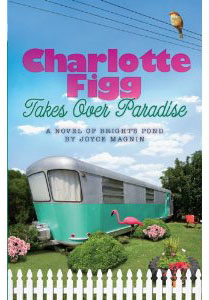
Charlotte Figg Takes Over Paradise

Liberation. That's the theme of CHARLOTTE FIGG TAKES OVER PARADISE, an uplifting, lively new novel by Joyce Magnin. When Charlotte Figg's oppressive, tyrannical husband of twenty years dies, the widow searches the internet and discovers a quaint, double-wide trailer in a place called "Paradise."  In an effort to escape her past and start anew, she purchases the place sight unseen, packs up with her dog and hits the road with high hopes. However, when Charlotte gets to Paradise, she finds her new digs anything but. 

Strapped with a trailer that is in complete disrepair, Charlotte, in search of a catharsis to ease her angst, takes to the kitchen and bakes her delectable fruit pies for her neighbors. It is in sharing each of these sweet treats that Charlotte slowly becomes acquainted with a cast of quirky characters as misfit as Charlotte, many of whom also feel trapped in dead-end marriages and stalled lives. There is a woman covered with tattoos, a dwarf, a woman who breast feeds a much too old child, a set of twins and a one-armed man. Charlotte remains undaunted by each challenge and person keeping her from the "paradise" she had envisioned for her future. She is determined to find meaning and purpose for her life, and in doing so, she becomes a catalyst that stirs things up in the community. As a means to reconnect with the joys of her youth and find herself again, Charlotte rallies the women of Paradise to join her in establishing a softball team. Think A League of Their Own meets The Bad News Bears. It is amid Charlotte's quest that the women of Paradise emerge to share a common bond, their individual secrets and tales of woe, and ultimately forge friendships. Domestic abuse is a thread running through this coming-of-middle-age, feel-good novel of faith and friendship.

NOTE: This book was reviewed via an ARC (Advanced Reader Copy) of the novel as provided by NetGalley.

Charlotte Figg Takes Over Paradise by Joyce Magnin
(Abingdon Press, Paperback, 9781426707667, 400pp.)
Publication Date: September 2010
To order this book via INDIEBOUND click HERE

Sunday, October 24, 2010

SCARECROW

"It was one of those freakish October days, when the mercury shoots up to the nineties, catching everyone off guard..."  (Prologue)

When a young girl under her care dies, Dr. Jo Banks (20-something) is racked with guilt. In an effort to escape the pain and heartbreak of her misdiagnosis, Jo gets in her car and starts to drive. Lost in thought and with no destination in mind, she sets off from her home in Manhattan and hightails it onto the New Jersey Turnpike. Jo winds up hours - and what seems like a world - away from the big city, in Bayfield, a small, rural enclave in Southwest New Jersey, where "the serene line of the horizon (was) broken only by an occasional lone tree or scarecrow." Shortly after she checks in to the Oakview Motor Lodge, she is called upon to treat a woman staying at the motel who has suddenly taken ill. Jo's actions that night ultimately prompt her to uproot her life and take a job serving as a "cooperative house doctor" at several motels in the region. The nearest hospital is over an hour away.

Thus, Dr. Jo Banks' journey enters a new chapter. She is given her own cabin at Oakview in which to live and work. Slowly building her practice, Jo begins to fall in love with the small town and the people who live there. Feeling freer and more liberated than ever, she buys a motorcycle to make "house" calls. But when a dead man, disguised as a scarecrow, is found perched in a local farm field, Jo suddenly becomes swept up in a series of murders involving itinerant farm workers and morphs from town doctor to amateur sleuth.

SCARECROW is a brisk, fast-paced read - perfect to curl up with during this autumn time of year. SCARECROW is also the first in a series of three books (the next two are SATAN'S PONY and SLEIGHT OF HAND; a fourth is currently in the works) that features strong, independent Dr. Jo and a cast of intriguing, well-defined characters.

 Robin Hathaway is masterful at writing short, tightly compressed chapters (with astutely rendered descriptions) that balance rich characterizations with an engaging plot. I marvel at how she gives so much information and backstory with a single line of description and/or dialogue. Read Chapter One and you'll see what I mean...In four, crisp pages, Hathaway presents everything you need to know about Dr. Jo Banks by showing you, rather than telling you. Impeccable!

If you like Jo Banks as much as I do, don't miss Hathaway's other award-winning mysteries, the Dr. Fenimore series of books. 

To watch an interview with Robin Hathaway link HERE.

Scarecrow by Robin Hathaway
(Minotaur Books, Hardcover, 9780312308513, 224pp.)
Publication Date: April 2003
To purchase this book via INDIEBOUND click HERE