Showing posts with label Personal Journey stories. Show all posts

Wednesday, March 15, 2023

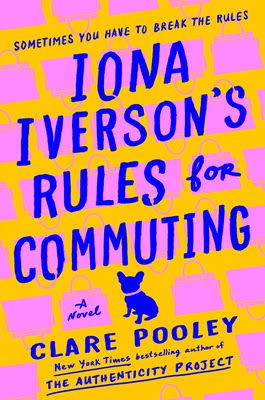
Iona Iverson's Rules for Commuting

An uplifting, immensely entertaining novel about how strangers on a commuter train becomes unlikely friends via a shared near-death experience. 

In the world today, many people tend to live anonymously, in their own personal microcosms. However, in Iona Iverson’s Rules for Commuting, British author Clare Pooley brings people together--strangers--in such a fun, spirited way that it’s bound to spark readers to expand their worldview.


This endearing novel, told from the points of view of an ensemble cast of vividly drawn characters, starts on a London commuter train. At the center of it all is Iona Iverson, a vibrantly quirky, 57-year-old magazine advice therapist--an observant creature of habit with job security issues--who leaves Bea, her significant other, and sets off to work with her beloved French bulldog, Lulu. Every day, Iona and Lulu sit in the same carriage--usually in the “seventh aisle,” seat “number three”--as the train traverses ten stops over 36 minutes from Hampton Court to Waterloo Station. In her mind, Iona assigns clever pet names to the seasoned commuters with whom she daily co-exists, but never speaks to. This includes “Impossibly-Pretty-Bookworm” and “Mr.-Too-Good-to-beTrue.” The other passengers, likewise, do the same—Iona is referred to by one as “Rainbow Lady” and another as “Crazy Dog Woman.”


One fateful day, a man who doesn’t normally ride the 8:06 a.m. train--whom Iona bills as a “Smart-But-Sexist-Manspreader,” who talks too loudly on his mobile phone and refers to his wife as “the ball and chain”--boards Iona’s carriage. He dresses exquisitely but has his look “ruined” because he displays an “extraordinary sense of entitlement which only really comes with being white, male, heterosexual and excessively solvent.” When he starts choking on a grape from his fruit salad, the normal, everyday order of the commute is upended. A medically capable oncology nurse, Sanjay--who has the hots for the “Impossibly-Pretty-Bookworm” but lacks romantic confidence--performs the Heimlich maneuver on the “Manspreader.” Sanjay’s heroic, life-saving act serves as a catalyst that suddenly transforms the travelers from strangers into friends. Over the course of the story, the soul-filled truth of each person connected to the near-death experience is revealed. The stereotyping of appearances can be very deceiving.


As in her previous novel, The Authenticity Project, Pooley’s grasp on the constraints and longings of the human condition proves immensely entertaining. Readers will be charmed by this uplifting, hopeful story rife with tender insights. Traveling with Iona Iverson is a literary journey well worth taking.


Iona Iverson’s Rules for Commuting: A Novel by Clare Pooley

Pamela Dorman Books (Penguin Books), $27.00 hardcover, 352 pages, 9781984878649

Publishing Date: June 7, 2022

To order this book on INDIEBOUND link HERE


NOTE: To read this review as published on Shelf Awareness for the Book Trade (April 14, 2022 ), link HERE


NOTE: To read a condensed version of this review on Shelf Awareness: Reader's Edition (June 6, 2022), link HERE


Wednesday, December 9, 2020

Friends: Voices on the Gift of Companionship

Pleased to have an essay featured in a new anthology: FRIENDS: VOICES ON THE GIFT OF COMPANIONSHIP (edited by Amy Lou Jenkins). This moving compilation of 24 stories examines the meaning of both having and being a friend. 

My essay, "Little Black Marks," conveys the story of a life-changing friendship that grew out of a fondness for storytelling and a love of the written word...the power of putting letters on a page and having those letters give meaning and form to life and living. 

As the dedication of the anthology reads, some gifts of friendship endure for "a day, for a season or last a lifetime." But stories...they're forever!

This tender, inspirational anthology would make a great gift for a friend you cherish or to read with your book club. 


Friends: Voices on the Gift of Companionship edited by Amy Lou Jenkins

Jack Walker Press, $14.99 Paperback, 9781945378089, 238 pages

Publication Date: October 14, 2020

To order this book via INDIEBOUND, link HERE

To order this book via Amazon, link HERE

To order this book via Barnes and Noble, link HERE


Wednesday, February 19, 2020

The Confession Club


This novel of Women’s Fiction is a continuation of a heartwarming series by Elizabeth Berg that started with, The Story of Arthur Truluv.

A group of women form an unlikely bond of trust that allows them to share personal revelations.

When a participant in a local dining club in Mason, Mo., reveals a personal secret over dinner, the gathering is suddenly transformed into a "safe space": members of the group share not only a weekly feast, but begin to confess dilemmas from their private lives. Elizabeth Berg's illuminating novel The Confession Club brings together a small group of women--ages 20 to their 70s--who maintain an oath of confidentiality as they voice their sins, burdens, inadequacies and shameful secrets, offering each other opinions and advice without judgment. Among the members are a preacher's wife, who is a kleptomaniac; a woman remorseful over the way she chronically lied to her parents during adolescence; and another who finds herself attracted to an exhibitionist.

New additions to the group include some beloved characters from Berg's prior novels, including Iris Winters, from Night of Miracles, a divorcée who runs a baking school out of her home. She falls for a handsome, bright, high-functioning--yet homeless--Vietnam veteran with PTSD. And Maddy Harris, introduced in The Story of Arthur Truluv, is a married mother who returns to town to regroup and reconcile feelings from the past that prohibit her from sharing her soul with her husband.

Readers don't need to be familiar with Berg's prior books in the Mason series to enjoy this one--a tenderhearted, at times philosophical, patchwork quilt of stories. Berg extols the benefits of these unlikely people forming a bond and a community of trust and friendship that changes their lives for the better.


The Confession Club: A Novel (Book 3 of 3 in the Mason Series) by Elizabeth Berg

Random House, $26.00 Hardcover, 9781984855176, 304 pages

Publication Date: April 2, 2019

To order this book on INDIEBOUND, link HERE


NOTE: This review is a reprint and is being posted with the permission of Shelf Awareness. To read this review on Shelf Awareness: Reader's Edition (January 10, 2020), link HERE


Saturday, July 11, 2015

Commentary: Go Set a Watchman by Harper Lee


TO KILL A WATCHMAN?


The buzz has been building for Go Set a Watchman. This long-awaited first novel was written 50 years ago by Harper Lee before she re-tooled it as To Kill a Mockingbird. I've always been a fan of Mockingbird and Lee (see my Op-Ed in The Record,  7/6/10). And while, as a writer, I am very intrigued by the whole premise of reading the vision of a work before it was edited, early reviews of the novel are making me very leery. And I would bet there have been more articles and criticism already written about—and in anticipation of—Watchman than the 288 pages of the novel itself!


Reviews of Watchman have been disillusioned and unsettling. Most notably (and shockingly) is the character of lawyer and father, Atticus Finch. In Mockingbird, he was a paragon of virtue. In Watchman, reviewers are saying he is a racist bigot—who even attended a Ku Klux Klan meeting.  Watchman is set 20 years later than Mockingbird and builds on the premise of now 20-year-old Scout and her return visit to Maycomb, Ala. from where she now lives in New York City. Upon arriving back in her hometown, Scout is shocked to find that her father holds "abhorrent views on race and segregation," according to Michiko Kakutani  of The New York Times.


How did this happen?


If this review and others are accurate in their assessments, then the very idea of Watchman is confusing and troubling. Was Mockingbird scrubbed of Atticus's racist tendencies in order to make him and the story more commercially viable—to appeal to the masses, a wide swatch of African-Americans and Caucasians? If so, was this choice an artistically aesthetic choice or simply a means to drive up book sales? What might be the reason why Lee would recast Atticus so significantly from a racist "sinner" in Watchman into a morally upright and virtuous "saint" in Mockingbird ?  Yes, the novel is fiction, as is the character of Atticus Finch (although he is said to be closely based on Lee's own father). But for a writer, this would be like rewriting the character of Mother Theresa into an abusive harridan the likes of Joan Crawford!


Mockingbird has sold well over 50 million copies. What author wouldn't want their work read and enjoyed, debated and celebrated by the masses? It remains required reading in schools throughout the USA and beyond. And yes, Lee has made millions and even won a Pulitzer Prize for Mockingbird


But did Lee pay a price—in her soul—to craft the Mockingbird narrative away from her original vision as found in Watchman?


Mockingbird is and will more than likely remain a classic novel. But might Lee have felt, deep down, that she "sold out" her vision by acquiescing to editorial demands--overhauling the Atticus of Watchman in order to make the good and evil aspects of Mockingbird more black-and-white (pardon the pun) and more marketable? Could it be that she felt it was best to let the worldly success and glory of Mockingbird remain as is and never allow her work (or even herself) to be doctored for mass appeal ever again? Might her 50-years of public silence be more understandable when viewed in this context?


Which leads to my next question: if early reviews of Watchman are discerningly on-target, then did Lee really sanction its publication? Could suspicions of Lee's lack of cognizance be accurate? Why would she strip off the idyllic finish of Atticus as portrayed in Mockingbird and tarnish his persona by finally exposing his "dark side" in Watchman? And why now? Was Lee manipulated into publishing Watchman just as she was manipulated to rewrite the essence of Watchman and transform it into the more idealistic version of Mockingbird?  


On the flip side remains the possibility that Lee is completely aware of her intentions—that she is fully mindful and astute. Whether she "sold out" her story or not for Mockingbird, perhaps before her life ends, she wants, for her own peace of mind, for others to experience her original vision, the way she first envisioned the novel?  After all, considering the strides made for equality over the past 50 years, the racial divide is still miles apart and a hot-button issue—especially with the police-civilian riots in St. Louis and Baltimore and the Charleston, South Carolina church massacre. Perhaps Lee has been closely watching current world events unfold and believes Watchman—with its darker, less politically correct themes—may prove even more relevant today than if the book was released 50 years before?


Calculated decision or coercion, we'll likely never know the author's true intent or the real story behind the reasons for publication of Watchman. And maybe "not knowing" will, in the end, serve to further ratchet up book sales, intensify conversations and debates about the continued racial unrest in our country and ultimately make Watchman even more appealing and well-read than Mockingbird.


"To Kill A Watchman?" (commentary) © 2015 by Kathleen Gerard 
Note: Do not reprint, reproduce, post online or copy without proper attribution 


Harper, $27.99 Hardcover, 9780062409850, 288 pp

Publication Date: July 14, 2015

To order this book via INDIEBOUND link HERE


To Kill a Mockingbird by Harper Lee (50th Anniversary Edition)

Harper Torch, $25.00 Hardcover, 9780061743528, 323 pp

Publication Date: May 11, 2010

To order this book via INDIEBOUND link HERE