Showing posts with label Journeys in Fiction. Show all posts

Wednesday, October 11, 2023

The Little Italian Hotel


A tender, hopeful story about a woman who, after her marriage comes undone, sets off on an inspiring Italian holiday with four strangers.

Five strangers are brought together on an Italian holiday in The Little Italian Hotel, a sweetly immersive novel brimming with the hope of new beginnings by Phaedra Patrick.


To celebrate 25-years of marriage, Ginny Splinter--a 49-year-old,  problem-solving, British radio talk show host--surprises her husband, Adrian, by planning an upscale trip to Italy for just the two of them. But when she presents the gift, Adrian announces that he doesn’t want to go on a vacation. He wants a divorce. Shaken and jarred, heartsick Ginny decides, on a lark, to invite four loyal listeners, at random, to accompany her on the trip instead. This is accomplished by her swapping out the pricy luxury accommodations she’d planned for her and Adrian in Vigornuovo, a small Italian village in Bologna, (10, 48) in exchange for more modest lodgings for she and her guests. The five strangers--ranging in age from 27 to 80--meet for the first time, where they all set off, touring Venice and Florence. The sights of Italy may be wonders to behold, but the life stories of the strangers--each on the cusp of change in his and her own life--prove equally enriching amidst the journey.


Patrick (The Messy Lives of Book People) is a beautiful writer of optimistic stories that probe the true meaning of life and the human quest to find happiness and fulfillment. In The Little Italian Hotel, she once again mines the bittersweet landscape of the human heart with great tenderness, insight, and wisdom.


The Little Italian Hotel by Phaedra Patrick

Park Row (Harlequin/Harper Collins), $18.99 original paperback, 9780778387121, 320 pages, Publishing Date: June 6, 2023

To order this book on INDIEBOUND/Bookshop.Org, link HERE


NOTE: This review is a reprint and is being posted with the permission of Shelf Awareness. To read this review on Shelf Awareness: Reader's Edition (June 6, 2023), link HERE

Wednesday, March 15, 2023

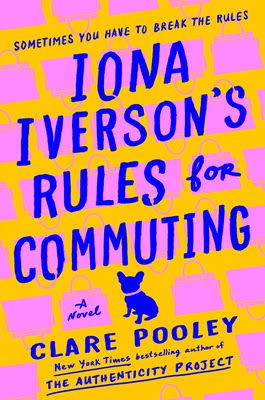
Iona Iverson's Rules for Commuting

An uplifting, immensely entertaining novel about how strangers on a commuter train becomes unlikely friends via a shared near-death experience. 

In the world today, many people tend to live anonymously, in their own personal microcosms. However, in Iona Iverson’s Rules for Commuting, British author Clare Pooley brings people together--strangers--in such a fun, spirited way that it’s bound to spark readers to expand their worldview.


This endearing novel, told from the points of view of an ensemble cast of vividly drawn characters, starts on a London commuter train. At the center of it all is Iona Iverson, a vibrantly quirky, 57-year-old magazine advice therapist--an observant creature of habit with job security issues--who leaves Bea, her significant other, and sets off to work with her beloved French bulldog, Lulu. Every day, Iona and Lulu sit in the same carriage--usually in the “seventh aisle,” seat “number three”--as the train traverses ten stops over 36 minutes from Hampton Court to Waterloo Station. In her mind, Iona assigns clever pet names to the seasoned commuters with whom she daily co-exists, but never speaks to. This includes “Impossibly-Pretty-Bookworm” and “Mr.-Too-Good-to-beTrue.” The other passengers, likewise, do the same—Iona is referred to by one as “Rainbow Lady” and another as “Crazy Dog Woman.”


One fateful day, a man who doesn’t normally ride the 8:06 a.m. train--whom Iona bills as a “Smart-But-Sexist-Manspreader,” who talks too loudly on his mobile phone and refers to his wife as “the ball and chain”--boards Iona’s carriage. He dresses exquisitely but has his look “ruined” because he displays an “extraordinary sense of entitlement which only really comes with being white, male, heterosexual and excessively solvent.” When he starts choking on a grape from his fruit salad, the normal, everyday order of the commute is upended. A medically capable oncology nurse, Sanjay--who has the hots for the “Impossibly-Pretty-Bookworm” but lacks romantic confidence--performs the Heimlich maneuver on the “Manspreader.” Sanjay’s heroic, life-saving act serves as a catalyst that suddenly transforms the travelers from strangers into friends. Over the course of the story, the soul-filled truth of each person connected to the near-death experience is revealed. The stereotyping of appearances can be very deceiving.


As in her previous novel, The Authenticity Project, Pooley’s grasp on the constraints and longings of the human condition proves immensely entertaining. Readers will be charmed by this uplifting, hopeful story rife with tender insights. Traveling with Iona Iverson is a literary journey well worth taking.


Iona Iverson’s Rules for Commuting: A Novel by Clare Pooley

Pamela Dorman Books (Penguin Books), $27.00 hardcover, 352 pages, 9781984878649

Publishing Date: June 7, 2022

To order this book on INDIEBOUND link HERE


NOTE: To read this review as published on Shelf Awareness for the Book Trade (April 14, 2022 ), link HERE


NOTE: To read a condensed version of this review on Shelf Awareness: Reader's Edition (June 6, 2022), link HERE


Wednesday, October 20, 2021

When We Were Young

A moving, life-affirming story about two male friends who reunite and unravel old secrets and resentments while taking a long hike.

British novelist Richard Roper has the uncanny ability to embroil quirky characters in heart-wrenching situations, rendering their predicaments into immensely appealing fiction. In How Not to Die Alone (retitled and reissued as Something to Live For), a grief-stricken man grappled with his sad lot in life. In Roper's second novel, When We Were Young, he again mines the theme of how breaking the shackles of the past can lead to transcendence. 

As teenagers, Theo and Joel--would-be writers--were best friends until a life-changing accident drove a wedge between them. Now, estranged for more than 10 years, the two men lead separate lives. Hard-driving Joel, from a sordid family background, is a successful TV writer who harbors secrets. Floundering, lovesick and bitter Theo is barely scraping by, living in a backyard shed at his parents' house. Things take a turn when Joel crashes Theo's 30th birthday party, hoping to reconnect with his long-lost friend and to convince him to make good on a promise made in their youth: to hike all 184 miles of the Thames Path, from Gloucestershire to south east London. As the two set out on the long, arduous journey, they wind through episodic memories of the past--what united and divided them. What will it take for them to bury the hatchet and make peace? 

Roper delivers an enormously moving and surprising story about the rarely documented bond of male friendship, focusing on the lengths some must travel in order truly to forgive and sacrifice for another. 


When We Were Young: A Novel by Richard Roper

G. P. Putnam’s Sons, $26.00 Hardcover, 9780525539919, 352 pages

Publication Date: July 20, 2021

To order this book on INDIEBOUND, link HERE


NOTE: This review is a reprint and is being posted with the permission of Shelf Awareness. To read this review on Shelf Awareness: Reader's Edition (July 27, 2021), link HERE

Monday, August 28, 2017

Nina George: Writing, Loving, Fighting

The Writer's Life
Nina George is the author of the bestselling novel The Little Paris Bookshop, a story about how books have the power to change destinies. She also writes (in German, with her husband, Jens "Jo" Kramer) a mystery series set in Provence under the pseudonym Jean Bagnol; has written science thrillers as Nina Kramer; and many titles about love, relationships, Eros and femininity as Anne West. In her 27th book, The Little French Bistro (see my review below), George tells the fictional story of a 60-year-old German woman's quest for reinvention and self-discovery. 

Why use the word "little" in the titles of both novels?

In every language, my books have totally different titles. Every market has its own rules. And let's face it: I like to write intimate stories, set in a specific place--because the place is a sort of secret protagonist. Every landscape, every room has its character, which helps me to describe certain emotions and cultural attitudes.

Both "little" books are journey stories. What did you learn about yourself in taking the journey to write these novels?

I love to tell "road stories." The art of developing a "quest," the searching and finding, is one of the oldest ways to create legends. You have to move on--our own, real lives are daily-quests, too. With
The Little French Bistro, I found my writing voice. I had nearly 18 years of practice in professional writing, but with Marianne (the protagonist of The Little French Bistro), I reached the magical point of telling the story just exactly the way it wanted to be told. A story finds its way to a writer in different ways. When I found the tale of Marianne, it all started with her "getting lost at the end of the world." And like Marianne, I also found my home--at the "end of the world."

That "end of the world" reference is to Kerdruc, the setting of this novel.

Yes, Kerdruc is a very,
very small village in the "Commune Nevez," which is part of the Region Cornouaille in the Department Finistère in the State Brittany (Bretagne) of France. Some call it a place at the "end of the world."

How did you discover Kerdruc?

Years ago, my husband and I traveled without any GPS, and one day we ended up at the Port of Kerdruc. It was like a slap in the face: I had the idea to develop a setting right then and there.

You divide your time between Berlin and Brittany.

Brittany is the place where I feel at home. I belong to the sea, the beauty of the nights; I feel familiar with the savage seashore, the stones and the stolid nature of Bretons.

Did that Breton sensibility spark the idea for this story?

The idea was born when I noticed a group of older people hanging around in a Bar Tabac on a Monday morning--drinking, chatting, enjoying their friendship and their time left together. I wanted to tell a story about older people and why they are still together--is it friendship? Is it love? Is it just home? What is necessary to do in your own life to find the exact place that is meant for you? 

Is that why you chose to create Marianne--the protagonist of The Little French Bistro--as a 60-year-old, as opposed to someone younger?

Modern literature often ignores older people in the autumn of their lives. At 60 years old, the layers of your emotions, your memories, and also the cage you have built up around you, are more complex.

Community is the centerpiece of both "little" books.

Our memories are made of the people we've spent our time with. Life is not about what you get. Not your career or success. It's about who you choose to spend your short time on earth with: friendship--short or long-term--love, an encounter with a stranger on a train by night....

What research was necessary to tell this story?

For several weeks, I traveled through the Finistère; watching, listening, visiting forests and chapels, feeling the loneliness and freedom of this part of old Europe, learning how to cook like the Bretons.

Cooking and gastronomic delights are backdrops of the novel. Are you a cook?

Bah oui! I was raised in a family of cooks. For me it is normal to get something good on the table--to please me, to please the one I love. And I really love to take care of guests. One day, I will open a guest house with a fine kitchen and a library in each room.

How has your life changed since the success of The Little Paris Bookshop?

It took me 20 years to become famous "overnight"... but those years help me to stay humble today. No one tells you beforehand that it is even harder to write another successful novel after having a bestseller. The success also makes it easier for me to support others. The royalties allow me to advocate for authors' rights, for women in literature and to defend those whose voices are silenced. We have to care for the world and the future.

Will there be another "little" book?

I am working right now on a new novel, my 28th, which asks the existential question: Did I become (the woman) who I could have been? It will be based in Brittany again in an endless summer, an intimate play between two women and two men. 
Note: This interview is a reprint and is being published with the permission of Shelf Awareness. To read this Q&A with Nina George as originally published on Shelf Awareness for Readers (7/7/17), link HERE.

Monday, July 6, 2015

Nina George: The Power of Books to Heal

The Writer's Life
Nina George writes contemporary novels centered on people "who undertake a physical journey that leads to self-discovery" because, she admits, she does the very same thing in her own life. "The quests, the odysseys, the 'joyful wanderings' (exploration, seeking the way, straying from the beaten path) are what constitutes a life." While she is of German descent, France is "in her blood" due to influences from her mother's side of the family. She believes "the French soul lay closer to (her) heart than German sensibilities." George lives in the Finistére region of Brittany, "at the end of the world.... Although," she claims, "some say it is where the world begins." The Little Paris Bookshop (read the review below or link HERE) was first published in German as "Das Lavendelzimmer" in 2013; it has sold over 500,000 copies and been translated into more than 27 languages. Crown will publish the novel in the U.S. in June. (Interview translated by Heidi Holzer.)
The Little Paris Bookshop largely takes place on French waterways. Have you ever taken a river cruise through France?
My father died the same year I'd planned to take the tour, and I also had a titanium implant in my neck. So I talked to "river people" and borrowed their river diaries. I spoke with tourists and locals. In 2014 (after the book had been on the bestseller list for a year), my husband, Jo, and I finally drove along the route. We ate and drank in Montargis and Cepoy, checked out houseboats for sale and drove across the canal bridge in Briare.
Sanary-sur-mer becomes the cornerstone of the novel. Is there any special reason why you chose to make this locale central to the plot of the story?
Oh, yes! In 2012, I explored Provence and drove around the region, 1,500 kilometers [930 miles], until the land answered my questions. I went to Sanary-sur-mer because it was the home of German women writers in exile. In a way, I felt as though I were in exile as well. My father had died, my body--my neck--was injured. It felt as though I'd lost my way: my life, my sense of inner childhood, my security. Sanary was a place of healing for me. I believe that everyone has a secret place where they are made "whole" again, no matter what it was that broke them in the first place.
Would you say a sense of brokenness inspired the novel?
Life. Death. Books. Dreams.... It began with the success of Die Mondspielerin/The Moon Musician, after which people expected me to write another novel. I wanted to explore the great themes of guilt, heartbreak and beginning one's "'actual" life all over again. My father died in 2011, and that was the caesura in my life, in everything that I am. I've been writing for 23 years. I'm a professional writer. Yet after my father's much too sudden death, I felt something break inside--my deep grief brought me back to myself. And it also redefined what I want to and am able to write about.
So I wrote about life, about survival after the death of a loved one, about the power of books that can heal everything--absolutely everything. And about living in one's own dreams. I felt free to do whatever I wanted, because I'd already gone through the worst possible thing in life. Since then, rules have no longer applied to me. For survivors, nothing is forbidden.
You pay your father a beautiful tribute in the dedication to this novel.
My father was a loving man. I never met any human being like him. He was kind and strong. He didn't have a great deal of education--no one did in postwar Germany--and yet he was wise and read up on everything. We'd been discussing my work since the early days of my career--I landed my first job, with a newspaper, at the age of 19. By 22, I'd written the first of what are now 26 books--and he read everything I wrote. We debated, he offered praise. He always wanted to know how I came up with things. No one else has ever been so intensely interested in what I think. He never wanted me to be simply "pretty" or "a good girl." His desire was for me to think, to develop internal endurance. He encouraged me in sports, challenged me to think. He helped develop my political sensibility and demanded that I respect people, cultures and religions. I was never to assume that my truth is the only one that matters. In a sense, the way he brought me up laid the groundwork for how I'm able to see the world.
Why has this novel resonated so deeply with readers?
Because it's a story about death and about how much we can be shaped by loss, by missing a person. Grieving, or admitting that the loss of a loved one has derailed us, was unfashionable, forbidden for much of the past. Also, there is a dedicated community of people in the world who will always be able to connect with each other across all languages, boundaries and religions. It is the "Readers' Club." People who read a lot, starting at a very young age, are people who were raised by books. They have learned about forms of love and hate, kindness, respect and ideas that are different from their own. They experience the world as something infinitely larger than before. They enjoy the indescribable feeling of having found their true selves.
We readers are book people, and Jean Perdu [the protagonist] is one of us. We are all traveling on an invisible literary riverboat, one that carries us down the stream of life. It shapes, holds and comforts us.
At the end of the novel, you include a compendium of books/titles to cure whatever ails a reader. If you were to include The Little Paris Bookshop on that list, what ailment would this novel serve to cure/alleviate?
Catharsis and healing. Das Lavendelzimmer/The Little Paris Bookshop is both a kind of cleansing and a literary form of solace. It penetrates areas of the soul where old and grand emotions are hidden. Grief, melancholy, regret that we are not 16 anymore, compassion, the desire to be loved by our parents, finding the place where we feel whole, understanding the fears in our dreams. The book cleanses these wounds--and above all, it provides solace. In Germany, people often give books to friends who are starting over: a new life, a new job, a new era.
Jean Perdu has a favorite book that changed his life. Do you have a book that changed yours?
My library holds 3,500 books, and I've read around 4,200 in my life. Every book has had an effect on me, but I'll mention only three:
Ein Fisch ohne Fahrrad (A Fish Without a Bicycle) by Elizabeth Dunkel: At a time when I didn't know whether I wanted to love or be loved, or which one would be harder to bear.
The Elegance of the Hedgehog by Muriel Barbery: At a time when I felt I didn't trust myself to be the person I am.
The diaries of Anais Nin: To help me understand that I have a sexual identity.
Will there be a 27th book?
I'm working on a novel that is about being afraid that one is not good enough and what awaits us in the space between life and death. It also deals with the question of whether there is even such a thing as the "right" life. 

Note: This interview is a reprint and is being posted with the permission of
 Shelf Awareness. To read this 

Q&A as originally published on Shelf Awareness  (4/8/15), click HERE


The Little Paris Bookshop


Nina George's enchanting The Little Paris Bookshop deals with the nature of grief; the power of friendship, love and truth; and how reading and books have the capacity to change peoples' lives, souls and destinies. The narrative centers on 50-year-old Monsieur Jean Perdu, who owns a bookstore called the Literary Apothecary--actually a floating barge "the length of three truck trailers" that houses 8,000 books, moored on the Seine. Perdu lives at 27 Rue Montagnard and is a passionate bibliophile who believes that booksellers don't just look after books, they look after people. 

Things take a turn when two new residents move into Rue Montagnard. Max Jordan is a young author whose debut novel has made him famous, but he is plagued with writers' block. The other new neighbor is Madame Catherine, who moves into the flat across the hall from Perdu. The tenants of the building rally to help this newly cast-off wife who has nothing of her own to set up her new apartment. 

Perdu delivers a table to Madame Catherine's apartment, and she discovers a letter hidden inside that causes Perdu's head and heart to spiral into an emotional tailspin. He takes refuge in the Literary Apothecary, soon hauling anchor and setting sail--but not before Max, who's being pursued by paparazzi, jumps aboard the moving barge. 

George is a lyrical writer whose beautiful, sensory language and imagery enhance this adventurous, moving narrative. On their voyage, the men are frequently mistaken for father and son, and they pass the time by sharing life stories. In the end, their excursion propels Perdu to finally reconnect with himself--the person he was, is and who he will become in the future.

The Little Paris Bookshop by Nina George
Crown Publishing, $25.99 Hardcover, 9780553418774, 400 pp
Publication Date: June 23, 2015
To order this book via INDIEBOUND link HERE 

Note: This review is a reprint and is being posted (in a slightly different form) with the permission of Shelf Awareness. To read this review on Shelf Awareness: Reader's Edition (6/30/15), click HERE

To read the full review of this novel as originally published as a special feature of Shelf Awareness: Maximum Shelf (4/8/15)--a much longer and much more comprehensive review--link HERE