Showing posts with label British Lit. Show all posts

Wednesday, September 18, 2024

How to Age Disgracefully

An adventurous, madcap novel about a group of rebellious British pensioners who must fight to keep their community center ‘hangout’ open.


In How to Age Disgracefully, Clare Pooley delivers another off-beat comedy--with a hopeful message--that brings together a cast of quirky, raucous British pensioners whose lively antics will charm readers.


The story is set amidst a London-Metro community center in need of revitalization—literally and figuratively. A roof collapse kills the headmistress. Lydia, a 53-year-old wife and mother--and a once in-demand food stylist who is suffering a mid-life crisis--has been hired as the facility’s new Senior Citizens’ Social Club. However, a ceiling collapse kills one of their members during the first meeting. In addition to stepping up to establish the club, Lydia and the group also take on “Maggie Thatcher,” the “ugly-looking,” now orphaned dog of the deceased woman.


The small club is comprised of septuagenarians who are vastly different in backgrounds and temperaments who are in search of adventure. The group includes a former businesswoman-turned-loner with secrets; an aging actor with kleptomaniac tendencies, who’s tired of playing grumpy old men and dead bodies; a retired paparazzo; a hardcore knitting addict; and woman who is ‘pushy,’ in every sense of the word, including how she navigates her walker. Lydia learns that managing the health and safety of this less-than-sedate group--on a cash-strapped budget--is no easy task. And when the town threatens to bulldoze their hangout, the group rebels in hilarious ways—complete with help from kids at the nursery school, housed in the same facility.


Readers are in for great fun, traveling along with Pooley’s (The Authenticity Project, Iona Iverson’s Rules for Commuting) assembly of madcap characters who refuse to succumb to age—or play by the rules


How to Age Disgracefully by Clare Pooley

Pamela Dorman Books/Penguin, $29.00 hardcover, 352 pages, 9780593831496

Publishing Date: June 11, 2024 

To order this book on INDIEBOUND/Bookshop.Org, link HERE


NOTE: This review is a reprint and is being posted with the permission of Shelf Awareness. To read this review as originally published on Shelf Awareness (July 5, 2024), link HERE 


Wednesday, March 15, 2023

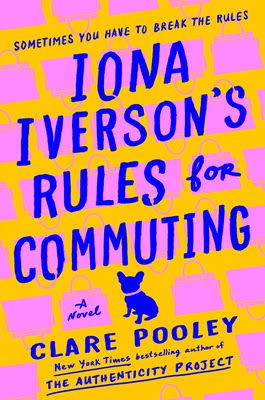
Iona Iverson's Rules for Commuting

An uplifting, immensely entertaining novel about how strangers on a commuter train becomes unlikely friends via a shared near-death experience. 

In the world today, many people tend to live anonymously, in their own personal microcosms. However, in Iona Iverson’s Rules for Commuting, British author Clare Pooley brings people together--strangers--in such a fun, spirited way that it’s bound to spark readers to expand their worldview.


This endearing novel, told from the points of view of an ensemble cast of vividly drawn characters, starts on a London commuter train. At the center of it all is Iona Iverson, a vibrantly quirky, 57-year-old magazine advice therapist--an observant creature of habit with job security issues--who leaves Bea, her significant other, and sets off to work with her beloved French bulldog, Lulu. Every day, Iona and Lulu sit in the same carriage--usually in the “seventh aisle,” seat “number three”--as the train traverses ten stops over 36 minutes from Hampton Court to Waterloo Station. In her mind, Iona assigns clever pet names to the seasoned commuters with whom she daily co-exists, but never speaks to. This includes “Impossibly-Pretty-Bookworm” and “Mr.-Too-Good-to-beTrue.” The other passengers, likewise, do the same—Iona is referred to by one as “Rainbow Lady” and another as “Crazy Dog Woman.”


One fateful day, a man who doesn’t normally ride the 8:06 a.m. train--whom Iona bills as a “Smart-But-Sexist-Manspreader,” who talks too loudly on his mobile phone and refers to his wife as “the ball and chain”--boards Iona’s carriage. He dresses exquisitely but has his look “ruined” because he displays an “extraordinary sense of entitlement which only really comes with being white, male, heterosexual and excessively solvent.” When he starts choking on a grape from his fruit salad, the normal, everyday order of the commute is upended. A medically capable oncology nurse, Sanjay--who has the hots for the “Impossibly-Pretty-Bookworm” but lacks romantic confidence--performs the Heimlich maneuver on the “Manspreader.” Sanjay’s heroic, life-saving act serves as a catalyst that suddenly transforms the travelers from strangers into friends. Over the course of the story, the soul-filled truth of each person connected to the near-death experience is revealed. The stereotyping of appearances can be very deceiving.


As in her previous novel, The Authenticity Project, Pooley’s grasp on the constraints and longings of the human condition proves immensely entertaining. Readers will be charmed by this uplifting, hopeful story rife with tender insights. Traveling with Iona Iverson is a literary journey well worth taking.


Iona Iverson’s Rules for Commuting: A Novel by Clare Pooley

Pamela Dorman Books (Penguin Books), $27.00 hardcover, 352 pages, 9781984878649

Publishing Date: June 7, 2022

To order this book on INDIEBOUND link HERE


NOTE: To read this review as published on Shelf Awareness for the Book Trade (April 14, 2022 ), link HERE


NOTE: To read a condensed version of this review on Shelf Awareness: Reader's Edition (June 6, 2022), link HERE


Tuesday, September 25, 2018

Mr. Gandy's Grand Tour


A washed-up, middle-aged British man sets off on a tour of Europe that changes him in unexpected, profound ways.
When Timothy Gandy's job as a graphic designer is made redundant, the 55-year-old Brit discovers that he's too old to find a new job and too young to retire. Taking stock, he realizes he's invisible in the shadow of his domineering wife--a woman involved with social and philanthropic causes, and to whom he's been married for 40 years. And he doesn't always see eye-to-eye with his adult children. Son Oliver is a successful barrister. He and his wife are highfalutin, materialistic intellectuals. Middle daughter Alice is single, a distant and reclusive librarian. However, good-natured Rosie, a schoolteacher, shares a bond with her father. She understands him. She and her conservationist, naturalist beau struggle to make ends meet, while happily raising their daughter together. 
The sting of unemployment followed by a shattering personal loss convinces Timothy to follow his long-repressed yearnings for travel. Despite staunch objections from his family--all except Rosie--he finally asserts himself. He sets off on a grand tour of Europe modeled in the style of those taken by young men of means in the late 18th century. Timothy leaves his Chichester, England, home and begins an exciting journey that takes him through France and Italy, where he makes unexpected new friends that change him and his outlook on life. 
Noted gardening guru Alan Titchmarsh (Bring Me Home) plants seeds of hope in another wholesome, richly entertaining story. Readers will be eager to accompany his sensitive, winning protagonist through an itinerary of many adventures.


Mr. Gandy's Grand Tour by Alan Titchmarsh

Hodder & Stoughton, $26.99 Hardcover,  9780340953075, 320  pages

Publication Date: April 24, 2018

To order this book on INDIEBOUND, link HERE


NOTE: This review is a reprint and is being posted with the permission of Shelf Awareness. To read this review on Shelf Awareness: Reader's Edition (May 22, 2018), link HERE


Tuesday, August 28, 2018

Little Big Love


A lovable, determined, 11-year-old boy seeks to unravel a decade-long mystery in his family and finally find his birth father.
One night in June 2005 changes the lives of a family in Little Big Love by British author Katy Regan. Set in Grimsby, a small fishing village in England, the story is told from three distinct perspectives of the Hutchinson family. Zac is a precocious, inquisitive 11-year-old, who has blue eyes just like his father's. He is obsessed with food, the memory of his deceased Uncle Jamie, a chef who died a tragic death, and finding his father, Liam, who left before Zac was born.
Zac's mother, Juliet, is a single mom who has a tendency to overeat and to shoplift food from grocery stores. She still carries a torch for her old flame, Liam Jones. Her inability to get over his departure makes dating a challenge--often quite comical. Finally, there is Mick, her dad, ensnarled in the devastating situation that tore his family apart--a situation that has kept his daughter and his wife in a state of inertia for 10 years, and has burdened him with secrets.

The inability of the three narrators to move beyond the impact and implications of the night that changed everything--a night that, in its aftermath, has perpetuated lies and mystery--forms the impetus for this moving, bittersweet story that seeks to unravel the truth of what really happened and why.
Little Big Love is Katy Regan's U.S. debut; as in her U.K. releases (How We MetThe One Before the One), she delivers an affirming, buoyant novel populated by authentic, empathetic characters, young and old, who infuse her adventurous story with great poignancy, humor and heart. 

Little Big Love by Katy Regan
Berkley, $26.00 Hardcover,  9780451490346, 368 pages
Publication Date: June 12, 2018
To order this book on INDIEBOUND, link HERE

NOTE: This review is a reprint and is being posted with the permission of Shelf Awareness. To read this review on Shelf Awareness: Reader's Edition (June 15, 2018), link HERE


Tuesday, July 31, 2018

The Lido

A community rallies to save a South London pool facing closure, and a friendship is sparked between an 86-year-old resident and a 20-something rookie reporter.

A public, outdoor swimming pool in Brixton, a small enclave of south London, forms the bedrock of The Lido, a feel-good first novel by British author Libby Page. The tight-knit community is changing. The local library has closed and has since been transformed into a bar. A Starbucks and a TJ Maxx chain store have moved in. And the public pool--the lido--in Brockwell Park, is being threatened with closure by a powerful, local land developer who wants to buy the property.

Rosemary Peterson, who has spent all 86 years of her life in Brixton, hates to see her beloved lido close. She worked in the town library before lack of funds shut it down, and she regrets not having done more to save it. While much has changed over the years in Brixton, the lido has served as a unifying, reassuring constant in Rosemary's changeable life. As a result, she feels powerless when she learns that the pool will close, until loner Kate Matthews--a shy, insecure reporter in her mid-20s, new to Brixton and the local paper--interviews her for a story. The two women are worlds and generations apart. However, as Rosemary regales Kate with stories about the lido and what it has meant to her--and to the history of the town--a bond of friendship grows between them, transforming both of their lives.

Page assembles a lively, diverse cast and heartwarming remembrances about the pool and how it sustained and enriched the town over time. Readers diving into this hopeful, tender story can emerge refreshed by the meaningful depths of community and the bonds of indelible friendships.


Simon and Schuster, $25.00 Hardcover,  9781501182037, 330  pages

Publication Date: February 7, 2017

To order this book on INDIEBOUND, link HERE


NOTE: This review is a reprint and is being posted with the permission of Shelf Awareness. To read this review on Shelf Awareness: Reader's Edition (July 24, 2018), link HERE

This review was originally published (in a longer form) on Shelf Awareness for The Book Trade (June 14, 2018). To read this review on Shelf Awareness for the Book Trade, link HERE

Tuesday, June 5, 2018

Matt Haig: History in the Mix


The Writer's Life

Matt Haig is the author of five novels, several award-winning children's books and the memoir Reasons to Stay Alive, which is an account of Haig's battle with depression and how he overcame it with the help of reading, and writing, and the support of his family. In How to StopTime (Viking, $26), Haig tells an imaginative, adventurous story about a man who has lived for centuries and his journey to reconcile his past and present in order to face the future. The novel dips into 500 years worth of history and is being made into a movie starring Benedict Cumberbatch. My review is below.

How did this novel take root?

I had the idea brewing for a long time. Nearly a decade. But it wasn't fully there. I had the voice of someone impossibly old, but I didn't have a story. Then I saw a painting of Omai in the National Portrait Gallery in London. Omai was the Pacific Islander brought to England after Captain Cook's second voyage and prized as an exotic oddity. It got my mind ticking and--even though Omai isn't the main character--he was the starting point.

How to Stop Time straddles genres of fantasy, romance, adventure and comedy. Was this intentional?

I have no idea. But it made the writing of it more fun. I love mixing things up. It just feels more natural to me than to compartmentalize the imagination like that.

The protagonist of the novel is 439 years old yet appears to be a 41-year-old man. Why did you choose these two specific ages?

Well, I was 41 when I created Tom Hazard, the protagonist. So I suppose that was the reason. As for 439 years, I wanted Tom to live within a realistic timeframe for a creature to live. There are clams that can live to 500. And Greenland sharks can live to be 1,000. So 439 began to feel almost realistic.

What was most fulfilling in writing this novel?

The amount of research I had to do was simultaneously the most fulfilling and the most challenging aspect. It was like researching 12 different historical novels in one. But I love social history. I love learning about, for instance, how ale was considered healthier than water for children to drink in Shakespearean times. (In fairness, it was.)

Tom Hazard shares life-changing experiences with notables such as William Shakespeare, Captain Cook and F. Scott Fitzgerald--to name a few. I wanted to mix the very famous with the less well known--such as Omai and the real-life Dr. Jonathan Hutchinson--because I loved the challenge of making people who have become legends into real, living people... with halitosis, in Shakespeare's case.

If you could live in another time, when would it be and why?

To be totally honest, I would like to go back into my own past in order to give myself some life advice before I fell into depression and anxiety disorder in my 20s. Also: ancient Greece, to have a chat with Plato and drink some wine.

Philosophical ideas of time are central to the novel. And there's a quote in the book, "The past resides inside the present, repeating, hiccupping...."

Yes, I think we are repeating the mistake of dehumanizing people. People not like us. I think we are dangerously losing faith in the idea of central unifying narratives. The collective experience of a shared life in a shared society is falling apart. I think social media is sending us back to an age before the mass circulation of the old media, where truth was whatever you wanted to hear, whatever your neighbors whispered to you. It is terrifying if you think about it. But there are signs of hope and progress, too. We are alert to injustices in ways we never were before.

What did you learn about yourself in writing the novel?

That writing can be fun. I had been forgetting that for a few years.

What will readers take away from reading How to Stop Time?

I hope, primarily, readers will be entertained. I don't think there should be any shame in entertainment. I suppose my point in writing the novel was to make people, including me, appreciate life and the nature of our brief and wonderful time here.

Time, loss, death, the surmounting of tragedies--and characters who feel like outsiders--recur in much of your work.

I try to write books that can comfort by showing hardship and the overcoming of that hardship.... I think fiction can be nourishing. I think it can help us cope with life.

Your books, while dealing with dark themes, are often leavened with hope and playfulness. From where do you draw your sense of optimism?

Strangely, I think it comes from depression and anxiety. My experience of those things made me more optimistic. Optimism--hard earned--became essential. It kept me alive. Optimism is very often a product of pain, I think.

If readers are unfamiliar with your work, what book should they read first?

After How to Stop Time, either
The Humans or Reasons to Stay Alive. Stay away from The Possession of Mr. Cave--I was in a dark mood when I wrote it.

After writing so many books, how do you maintain enthusiasm for the craft?

I try to keep things new--switch genres, write for children sometimes, or for film or nonfiction. I try to make every book feel like it is a first book.
This interview is a reprint and is being posted with the permission of Shelf Awareness. To read this Q&A on Shelf Awareness for Readers (February 23, 2018), link HERE 
Author Photo by Ken Lailey

Tuesday, July 4, 2017

A French Wedding

Close-knit college friends with a long, sordid past reunite in the French countryside to celebrate the 40th birthday of one of their own.
In Hannah Tunnicliffe's A French Wedding, a former Parisian restaurateur serves as private chef for six college friends--and their significant others--who gather in a small French coastal town to eat, drink and be merry. Their celebration marks the 40th birthday of Max Dresner, a party boy and rogue rock star who's reassessing his life.

Juliette is a workaholic French chef who faces the breakup of a meaningful romantic relationship and tries to manage Delphine, her Paris eatery. When Juliette chooses to give up ownership of the café and care for her parents, she fears her dreams are forever shattered. Hired by Max as a housekeeper, she tends to his guests. The group includes Nina and Lars, college sweethearts, and their 15-year-old daughter, Sophie; Rosie and her surgeon husband, Hugo, an outsider to the clique; Eddie, who used to date Rosie in college, and his current girlfriend, Beth, an American hairdresser, younger than Eddie and the rest; and Helen, a free spirit and avant-garde art gallery owner, to whom Max finally intends to propose marriage over the weekend. 

While throughout the reunion the guests savor Juliette's gourmet food and the wine flows, spirits ultimately sour. Add percolating secrets, old resentments and an unexpected illness, and it looks like Max's birthday party--and his sincere intent to profess publicly his love for Helen--may fall flat. 

Tunnicliffe's well-drawn characters are forced to reconcile the past and face up to emotional midlife struggles in this bittersweet story with a deeply satisfying conclusion.
Doubleday, $26.95 Hardcover, 9780385541848, 320 pages
Publication Date: June 6, 2017
To order this book on INDIEBOUND, link HERE

NOTE: This review is a reprint and is being posted with the permission of Shelf Awareness. To read this review on Shelf Awareness: Reader's Edition (July 4, 2017), link HERE

Monday, June 19, 2017

The Keeper of Lost Things

A heartwarming, enchanting novel about how lost things--and the lost souls of people--can often be found via serendipity and fate.

The mysteries behind unclaimed treasures, those who have lost them and the man determined to reunite possession and owner are the carefully tended threads of The Keeper of Lost Things, a rich and heartfelt first novel by Ruth Hogan.

Seventy-four-year-old Anthony Peardew, an unmarried British writer, resides in a charming mansion. Forty years earlier his beloved fiancée, Therese, as a token of her love, gave him her Communion medallion embossed with a tiny picture of St. Therese of the Roses. Soon thereafter, Peardew lost the medallion on the same day that Therese died unexpectedly. As atonement for the eerie timing of the lost medal, he made it his purpose in life to gather, meticulously label and give a loving home to a "sad salmagundi" of lost objects--jigsaw puzzle pieces, hair bobbles, gemstones and even a biscuit tin containing cremation remains--which he stored in his large study.

But objects aren't the only things in life that can get lost. People, too, often lose their way and need someone to rescue them. Laura, Peardew's devoted housekeeper and a childless divorcee, finds asylum in his home. And after he dies, she teams up with his neighbor Sunshine and Freddy the gardener to carry on Peardew's legacy.

Hogan's prose is thoughtful and elegant. She richly portrays a cast of likable characters, wounded souls in search of love, peace and a sense of belonging. Readers are bound to discover joy and hope in this quietly moving, tender story that examines how serendipity often plays a pivotal role in human interconnectedness.

William Morrow and Company, $26.99 Hardcover, 9780062473530, 288 pp
Publication Date: February 21, 2017
To order this book via INDIEBOUND link HERE


Note: This review is a reprint and is being posted (in a slightly different form) with the permission of Shelf Awareness. To read this review on Shelf Awareness: Reader's Edition (3/10/17), link HERE

Friday, May 26, 2017

Paula Hawkins: Drawn to Dark Subject Matter

The Writer's Life
Paula Hawkins is best known for The Girl on the Train, her psychological thriller (turned major motion picture) about a despondent, down on her luck, voyeuristic commuter who gets swept up in a murder investigation. Hawkins's sophomore psychological suspense novel, Into the Water (just published by Riverhead; click HERE to read my review below), delivers another dark, spellbinding story that explores the overt and subtle ways trauma, grief and long-buried secrets can affect minds, hearts and motivations. 

Why do you think The Girl on the Train resonated so deeply with readers?
Author photo by Alisa Connan


I think there are two main points of resonance: the voyeuristic impulse, which I believe is universal, and the character of Rachel (the main protagonist). Rachel is liked and loathed, but she rarely bores.

Has success altered how you write?

Success is both reassuring (people liked the book, so I must have done something right) and unnerving (I now have a huge readership with sky-high expectations). When I was writing Into the Water, I just had to shut out the noise, concentrate on the task at hand and write the best book that I could. That is how I approach every book: I want to improve, to stretch myself.

Is the town of Beckford, the setting of Into the Water, based on an actual place?

Beckford is entirely fictional, although the part of the world in which I have placed it--Northumberland, in the northeast of England--is real.

Why did you choose to structure the book via varying points of view, weaving in a complex and historical backstory and even including fictional book passages?

I had to devise all sorts of strategies in order to tell this twisted tale. There are many mysteries in the book, both current and historic--and the challenge was to allow the characters' secrets to reveal themselves at the right pace and in an interesting way. So I chose to tell my story from many different viewpoints, some first person and some third person; I chose to include flashbacks and a book-within-a-book.... I even chose to leave one or two mysteries unsolved.

A large cast of characters populates Into the Water and those characters are quite diverse in terms of age, life experience, status and background.

The characters developed slowly, over time, the way my characters always do. I have to live with them for a while, to get into their heads and under their skin. That was quite a task for this book, because it has a much wider cast of characters than The Girl on the Train did.

Any favorite characters--who and why?

I love Nickie Sage. Nickie claims to be a psychic--she says she's descended from witches and that she can talk to the dead. Everyone in the village thinks she's a nutter, or a fraud, so they ignore her. But--whether you believe her outlandish claims or not--the fact is, she's an observer. She's canny and astute, and she knows everybody's business.

When you sit down to write a new novel, do you conceptualize the book from start to finish, or does the story arise organically?

I usually know the bones of the story, its basic architecture. But the detail evolves during the writing. I think that many of my better ideas and more ingenious twists have come to me while I was immersed in the writing process.

Do you ever get blocked or stalled in your writing? If so, what do you do?

I don't tend to get blocked, but I do sometimes write myself into a corner from which I find it difficult to escape. When that happens, I usually go for a walk, take a long hot bath or, if neither of those things help, I turn to my agent, my plotting co-conspirator.

You were a journalist before writing novels. What was the impetus for you to branch out?

I was on staff at the Times for several years, but I also freelanced, working for a number of publications. I covered finance and property (real estate), which I really enjoyed, but I was never a great journalist. I'm much better at making up stories than I am at getting the truth out of a reluctant subject.

Using the pseudonym Amy Silver, you wrote "chick lit" novels. Did those influence the writing you're doing today?

Writing those books was wonderful training: I learned a great deal about developing character and about how to pace a novel in order to draw the reader into the story.

Would you ever return to writing romantic comedies?

No. I wouldn't--it really wasn't my forte (I'm not romantic, or particularly funny for that matter...).

How and why did you switch to writing such dark, psychological suspense?

Psychological suspense is much more my cup of tea--I'm drawn to dark subject matter. I'm fascinated by the behavior of people who are frightened, or grieving, or lonely, or damaged in some other way.

Who are your favorite authors?

I have so many favourites. To name just a few: Kate Atkinson, Pat Barker, Margaret Atwood, Sebastian Barry, Armistead Maupin, John Boyne, Cormac McCarthy. In terms of contemporary psych-suspense, I think Megan Abbott is wonderful.

Any plans for Into the Water to hit the big screen? And who do you think should play the key characters?

Dreamworks has optioned it, so hopefully we'll see it up on the big screen before too long. I'm not fantasy-casting just yet. Don't want to jinx anything....
NOTE: This interview is a reprint and is being published with the permission of Shelf Awareness. To read this Q&A as originally published on Shelf Awareness for Readers (5/26/17), link HERE

Into the Water

A close-knit British community grapples with mysterious deaths--past and present--that occurred at a notorious local riverbank.


Paula Hawkins (The Girl on the Train) delivers another dark, spellbinding suspense novel with Into the Water. This time, the search to unravel a mysterious death focuses on the river that cuts through Beckford, a small, northern British town. Nicknamed the "Drowning Pool," the river is where, over the centuries, local women--outsiders as well as misfits from within the community--have died under tragic, often suspicious, circumstances.

Danielle "Nel" Abbott--a single mother, successful photographer and lifetime Beckford resident who had been writing a book about the Drowning Pool, its history and its secrets--has become a suicide casualty at the very place of horror she had been researching. Her younger sister, Jules Abbott, gladly fled Beckford years before. An unmarried social worker in London whose bitterness and resentment kept her estranged from Nel for years, Jules returns to Beckford to sort out the "bloody mess" and care for Nel's outspoken and rebellious 15-year-old daughter, Lena. Neither believes that Nel killed herself, and Lena also has doubts about the suicide of her best friend, Katie Whittaker, at the Drowning Pool six months earlier. Katie's inconsolable parents are wracked with guilt. Were they so focused on their anxious, sensitive son that they didn't give proper attention to their confident, over-achieving--yet obviously vulnerable--daughter?

Hawkins keeps readers guessing while exploring the overt and subtle ways trauma, grief and long-buried secrets can affect minds, hearts and motivations. A growing undertow of suspense builds as some characters, consciously and subconsciously, cannot face who they are, so they reinvent themselves and their memories. This intricate story is filled with red herrings and surprising reversals that probe the tangled depths of family loyalty.


Riverhead Books, $28.00 Hardcover, 9780735211209, 400 pages
Publication Date: May 2, 2017
To order this book on INDIEBOUND, link HERE


NOTE: This review is a reprint and is being posted with the permission of Shelf Awareness. To read this review on Shelf Awareness: Reader's Edition (May 26, 2017), link HERE