Sunday, December 5, 2010

The Christmas Tree

"See that star, Anna, there at the very top?" he said. "It's there to remind us of the beauty, even when all we feel is the hardness." The Christmas Tree by Julie Salamon (page 116)

I never thought I'd be one of those people who could grow attached to a tree...but lo, I have joined the ranks. A mighty oak tree, one that started as a twin oak and grew, over the years, into a quintuple oak, was trimmed and pruned for decades. But of late, the tree had grown quite unwieldy and so many colossal acorns were shed each fall it was as though a rather intense drummer had practiced his paradiddles on the roof, the trunk, and the hood of any poor car parked beneath its enormity.

After much deliberation, the towering tree, which served as a landmark to family history, was finally removed a few weeks ago. With its dismantling, memories from a family that grew up and grew old, and moved on, from beneath the fixed, forever-growing umbrella of shade the tree offered for almost 50 years, evoked a palpable sense of loss, remembrance and nostalgia...


All of this got me thinking of a great little book, now a classic, about trees and the deep-rooted emotional meanings they can hold in our lives.

THE CHRISTMAS TREE by Julie Salamon (illustrated by Jill Weber) is a beautiful, compact story that's very appropriate to be read at this time of the year.

It is a tale narrated by the chief gardener from Rockefeller Center in New York City and his quest to acquire an admirable and immense Norway Spruce from a convent in New Jersey. The book tells the story of Sister Anthony, an elderly nun at the Mother House, who refuses to accommodate the gardener's agenda to cut the tree down.  During the process of many years of annual negotiations, Sister Anthony ultimately shares her story about how, when she was a shy, orphan girl named Anna, she was sent from New York City to live at the convent. Once there, she felt incredibly lonely, but she befriended a tiny fir tree whom she came to call, "Tree." Anna and Tree grew up together and it was through their life-long union that Anna came to love and appreciate the wonders of nature - a breadth of knowledge she generously passes on to the next generation.
One winter, when a harsh storm threatens Tree's safety, Sister Anthony begins to have second thoughts about the tree becoming the crown jewel of the Rockefeller Center Christmas display.  

This is a sensitive, simply told and moving story, a perfect December read about growth, memory, love and letting go. You'll never look at a tree, or Rockefeller Center at Christmas-time, the same way...Trust me, I know.

The Christmas Tree by Julie Salamon; Jill Weber (Illustrator)
(Random House, Paperback, 9780375761089, 128pp.)
Publication Date: October 29, 2002
To purchase this book via INDIEBOUND click HERE

Sunday, November 21, 2010

Bill Warrington's Last Chance

I've heard it said that there is often one person in a family whose choices have the ability to turn the tide and change the tenor of the entire group. Such is the case with the Warringtons. When Bill Warrington, a 79 year-old, widowed patriarch--an ex-marine and veteran of the Korean War and a domineering father--is diagnosed with an unnamed brain disorder (likely dementia), he tries to reunite his three, estranged grown children. When he learns that they don't share even a shred of his enthusiasm, Bill impulsively kidnaps his 15 year-old, granddaughter April (she goes with her granddad rather willing) and sets out on a summer road trip from the Midwest to California that he hopes will force the troops to finally have that reunion before it's too late.

This is a story about the journeys we make in life within our families - and often without them. Each of the characters at the beginning of Bill Warrington's Last Chance, the outstanding debut novel (winner of the 2009 Amazon Breakthrough Novel Award) by James King, seems stalled in their lives. Many years prior to the action of the narrative, Bill's wife and the mother of their children, died. Her passing has left lasting, far-reaching scars. But it is Bill's actions over the course of the story that provide a necessary jolt for each of these characters to reconnect with themselves and each other. There is Mike, the eldest son, who is in a troubled marriage and has distanced himself from his father. He believes Bill gave his mother an overdose of pain pills and ultimately caused her death. Nick, the middle child and a widower for three years, is struggling to get on with his life. And then, there is Marcy, a bitter, opinionated, take-charge divorcee challenged in her efforts to raise her rebellious, precocious daughter, April.

James King does a fine job of painting a very realistic (often bittersweet) portrait of modern-day family dynamics. He propels the story forward at a brisk pace by writing tight scenes that blend humor and pathos, pitch-perfect multi-generational dialogue, and dropping in carefully chosen details of back-story that account for many of the behaviors of these well-rendered characters in the present. King does all of this by fleshing out the novel through five, very effective, points of view.

The texture of the story is further enriched by the juxtaposition of April, an often snide young woman with her life ahead of her, against her curmudgeon grandfather, who is entering the final chapters of his life. The scenes between the two of them were most resonant - often harrowing and extremely moving. This is especially evident as Bill's thought processes begin to fail, and April must take over the driving and decision-making during the road trip. This debut novel successfully blends hot button topics with themes of reconciliation and redemption that make it appealing for a wide, crossover audience.

Bill Warrington's Last Chance by James King
(Viking Adult, Hardcover, 9780670021611, 304pp.)
Publication Date: August 5, 2010
To purchase this book via INDIEBOUND click HERE
Sunday, November 7, 2010

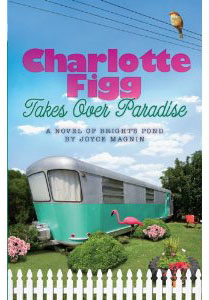
Charlotte Figg Takes Over Paradise

Liberation. That's the theme of CHARLOTTE FIGG TAKES OVER PARADISE, an uplifting, lively new novel by Joyce Magnin. When Charlotte Figg's oppressive, tyrannical husband of twenty years dies, the widow searches the internet and discovers a quaint, double-wide trailer in a place called "Paradise."  In an effort to escape her past and start anew, she purchases the place sight unseen, packs up with her dog and hits the road with high hopes. However, when Charlotte gets to Paradise, she finds her new digs anything but. 

Strapped with a trailer that is in complete disrepair, Charlotte, in search of a catharsis to ease her angst, takes to the kitchen and bakes her delectable fruit pies for her neighbors. It is in sharing each of these sweet treats that Charlotte slowly becomes acquainted with a cast of quirky characters as misfit as Charlotte, many of whom also feel trapped in dead-end marriages and stalled lives. There is a woman covered with tattoos, a dwarf, a woman who breast feeds a much too old child, a set of twins and a one-armed man. Charlotte remains undaunted by each challenge and person keeping her from the "paradise" she had envisioned for her future. She is determined to find meaning and purpose for her life, and in doing so, she becomes a catalyst that stirs things up in the community. As a means to reconnect with the joys of her youth and find herself again, Charlotte rallies the women of Paradise to join her in establishing a softball team. Think A League of Their Own meets The Bad News Bears. It is amid Charlotte's quest that the women of Paradise emerge to share a common bond, their individual secrets and tales of woe, and ultimately forge friendships. Domestic abuse is a thread running through this coming-of-middle-age, feel-good novel of faith and friendship.

NOTE: This book was reviewed via an ARC (Advanced Reader Copy) of the novel as provided by NetGalley.

Charlotte Figg Takes Over Paradise by Joyce Magnin
(Abingdon Press, Paperback, 9781426707667, 400pp.)
Publication Date: September 2010
To order this book via INDIEBOUND click HERE

Sunday, October 24, 2010

SCARECROW

"It was one of those freakish October days, when the mercury shoots up to the nineties, catching everyone off guard..."  (Prologue)

When a young girl under her care dies, Dr. Jo Banks (20-something) is racked with guilt. In an effort to escape the pain and heartbreak of her misdiagnosis, Jo gets in her car and starts to drive. Lost in thought and with no destination in mind, she sets off from her home in Manhattan and hightails it onto the New Jersey Turnpike. Jo winds up hours - and what seems like a world - away from the big city, in Bayfield, a small, rural enclave in Southwest New Jersey, where "the serene line of the horizon (was) broken only by an occasional lone tree or scarecrow." Shortly after she checks in to the Oakview Motor Lodge, she is called upon to treat a woman staying at the motel who has suddenly taken ill. Jo's actions that night ultimately prompt her to uproot her life and take a job serving as a "cooperative house doctor" at several motels in the region. The nearest hospital is over an hour away.

Thus, Dr. Jo Banks' journey enters a new chapter. She is given her own cabin at Oakview in which to live and work. Slowly building her practice, Jo begins to fall in love with the small town and the people who live there. Feeling freer and more liberated than ever, she buys a motorcycle to make "house" calls. But when a dead man, disguised as a scarecrow, is found perched in a local farm field, Jo suddenly becomes swept up in a series of murders involving itinerant farm workers and morphs from town doctor to amateur sleuth.

SCARECROW is a brisk, fast-paced read - perfect to curl up with during this autumn time of year. SCARECROW is also the first in a series of three books (the next two are SATAN'S PONY and SLEIGHT OF HAND; a fourth is currently in the works) that features strong, independent Dr. Jo and a cast of intriguing, well-defined characters.

 Robin Hathaway is masterful at writing short, tightly compressed chapters (with astutely rendered descriptions) that balance rich characterizations with an engaging plot. I marvel at how she gives so much information and backstory with a single line of description and/or dialogue. Read Chapter One and you'll see what I mean...In four, crisp pages, Hathaway presents everything you need to know about Dr. Jo Banks by showing you, rather than telling you. Impeccable!

If you like Jo Banks as much as I do, don't miss Hathaway's other award-winning mysteries, the Dr. Fenimore series of books

To watch an interview with Robin Hathaway link HERE.

Scarecrow by Robin Hathaway
(Minotaur Books, Hardcover, 9780312308513, 224pp.)
Publication Date: April 2003
To purchase this book via INDIEBOUND click HERE

Saturday, October 9, 2010

Vestments

James "Jim" Dressler is a kind, gentle 20-something young man who shoots hoops and plays poker with his buddies, likes to hang out in bars and have a few drinks, and has a weakness for women, which often makes him unable to quell his sensual urges. He is also a Roman Catholic Priest. Therein lies the moral conflict imbued in VESTMENTS, a beautifully-rendered debut novel from John Reimringer.

Modern-day Catholics and the contemporary Catholic family are Reimringer's focus, and he knows the landscape very well. There is Jim, the priest, who was drawn to the church--namely the rituals and ceremonies--as a young boy. It seems that Jim took his vows less for the spiritual implications and more as a place of refuge from a dysfunctional family.  However, this choice has actually isolated and alienated Jim from his kin. Jim has an alcoholic father, who is not keen about (nor proud of) his son's choice of career.  His mother is a church-going Catholic who prefers to adhere to her own rules rather than those of the church. Jim's brother's and sister's only claim to being Catholic is their reference to Jim as "our brother, the priest." Jim's ailing grandfather tenaciously clings to his faith to escape the lingering emotional wounds of war and his fear of impending death.  He seems to be the family member who shows the most reverence for God and displays a sincere depth of spirituality.

Jim returns to his hometown after being forced to take a sabbatical from the priesthood - he has broken his vows of celibacy with several women. Once home, he tries to deal with his family and grapple with the implications of what he has done. If that weren't enough, Reimringer ups the ante by having Jim cross paths with an old flame, a woman who was his first true love. Through a parallel structure, Reimringer peels back Jim's layers by interspersing powerful scenes from the past with the present action. This romantic subplot, told in real time and flashback, forces Jim to reconcile his feelings for the priesthood and helps him decide if he can stay committed to the celibate life, once and for all.

Reimringer casts Jim as a liberal ("abortion is not all wrong") and very self-forgiving Catholic. His modernity is real, and it makes him all the more accessible to the reader.  However, what was Jim's ultimate goal for his life by serving in the priesthood? And beyond the physicality of the Catholic Church and its rituals, did Jim ever cultivate an intimate, personal relationship with God and Jesus Christ? Questions like these kept me riveted to this novel and made me eager to make an emotional investment in this provocative story until the very last page.

Sunday, September 26, 2010

Molly Fox's Birthday

Can you ever really know someone? That's the question evoked by the novel MOLLY FOX'S BIRTHDAY. It is the latest from Irish writer, Deirdre Madden. This richly woven story is told from the point of view of an unnamed narrator, a young woman, a successful playwright, suffering a bout of writer's block. She is house-sitting for her long-time friend, Molly Fox, an equally successful actress, whose need for privacy shrouds her in layers of mystery.
The setting of the book is Ireland and the action takes place all on one day, the Summer Solstice (the longest day of the year), which is also Molly Fox's birthday.  Over the course of the story, the narrator inhabits Molly's house and wanders the rooms therein, reliving decades of their friendship via flashbacks. In the process, she conjures scenes of Molly Fox that inspire feelings of love, admiration, jealousy and even resentment. But who really is Molly Fox? This gently paced, beautifully written novel is about how we shape our identities and relationships - the relationship we have to ourselves, our family and friends, our passions and most significantly, our artistic inclinations.

Through the narrative flashback arc, each character in this novel seems a misfit, shaped by some sense of loss and trauma in their families that has encouraged him/her to turn to the arts. The narrator comes from a big, Irish, baby-making clan. It is her brother, a solitary Catholic priest, who helps her understand and appreciate how being different and living an unconventional/introspective life can be an asset and not a liability--especially for a writer. Molly spends her life, off-stage, trying to escape the lasting wounds of a largely absent mother and caring for an emotionally troubled brother. But it is a seemingly secondary character, Andrew, a documentary filmmaker and an old friend of both the narrator and Molly--a man who lost his brother, the favorite son of his family, to the Irish rebel cause--who figures most predominantly into the denouement of this deeply moving story. 

"Sometimes the most important and powerful element is an absence, a lack, a burnished space in your mind that glows and aches as you try to fill it," the narrator tell us.

The book seems to suggest that an artistic life--be it on the page, stage or screen--can be a bulwark against loneliness and feelings of emptiness.   In the end, the losses and empty spaces in life, and how one responds to them on an emotional level, are what come to define these very authentic, three-dimensional characters. A thought-provoking read!

Sunday, September 12, 2010

Revisiting a Classic: O. HENRY

Yesterday was the birthday of short story writer, O. Henry, also known as William Sidney Porter. In my opinion, O. Henry is an undervalued writer, where many in high-brow literary circles downplay his genius and mastery of the short story form. This is odd (and ironic) because the O. Henry Prize, which lauds the "best" in short fiction each year, actually bestows the award on "literary" as opposed to "commercial" fiction - the type that O. Henry, himself, created. Go figure.

For me, O. Henry's writing is energetic and witty.  The elements of mystery and suspense in his stories greatly contribute to the twist endings that have become the hallmark of his work. Revisit his most famous tales like "The Gift of the Magi," "The Ransom of Red Chief," and "A Retrieved Reformation."

My personal favorite is, "The Cop and the Anthem," a story set in Manhattan. It is told from the point-of-view of a homeless man named "Soapy" who knows, while wandering the crisp, fall streets of New York City, that the chill of winter is fast approaching. Soapy is a lost soul, but he's industrious and clever. He sets out on a quest to get arrested, as a night in jail would certainly offer him the warmth and security he seeks. But Soapy's efforts keep falling short until he meets with an ironic twist of fate at the end of the story.

While O. Henry's work has entertained and inspired me, I find the story of his own life as compelling as his fiction. This was posted yesterday on The Writer's Almanac:

September 11: It's the birthday of short-story writer O. Henry, born William Sidney Porter in Greensboro, North Carolina, on this day in 1862 . . . He worked at his uncle's drugstore, becoming a licensed pharmacist when he was 19, and before he turned 20 he'd headed west to Texas, where he spent time on a ranch as a shepherd, domestic servant, and baby-sitter.

He moved to Austin, Texas, worked as a pharmacist, and played guitars on street corners around the city. He eloped with a tuberculosis-infected, rich and beautiful teenage girl whom he'd fallen in love with.

Later, he got a good-paying job as a bank teller so that he could support his wife and young daughter. But he was not a good bookkeeper, and he was fired for embezzlement. He took to writing full time.

The feds did an audit of the bank he'd been working at, and when they found a bunch of discrepancies, they decided to indict him on federal embezzlement charges. His wife's dad posted bail for him, but instead of sticking around for trial, O. Henry fled to New Orleans and then to Honduras, where he stayed for months. But when he found out that his beloved wife was on the verge of dying from her tuberculosis, he came back to Texas and turned himself in. Soon after, his wife died. He stood trial, was convicted of embezzlement, and was sent away to a federal penitentiary in Ohio.

He wrote short stories there, and he came up with the pseudonym O. Henry. Magazine editors were clueless that the stories they published were written by an inmate locked up in a federal penitentiary.

He got out of jail and wrote fast and furiously, about 400 short stories in those years following his release. He became famous, and an alcoholic, and he died less than a decade after getting out of jail, at the age of 47, from liver disease . . .

When asked what advice he would give to young writers, he said, "I'll give you the whole secret of short-story writing. Here it is. Rule I: Write stories that please yourself. There is no Rule II."

Happy Birthday, O!

Sunday, August 29, 2010

The Three Fates of Henrik Nordmark

Only an author as witty and clever as Christopher Meades could craft such a lovable, multi-dimensional character as Henrik Nordmark - a 42 year-old man who lives a solitary and completely nondescript life. From the first pages of The Three Fates of Henrik Nordmark (ECW Press), Meades paints his protagonist with wry, detailed strokes: "Henrik had no redeemable feature to draw one's eyes...(People) passed him as one would pass faded wallpaper during an increasingly urgent search for a toilet."

While Henrik longs to break free of his narrow, mundane existence as a bored security guard and create a fulfilling life that is "unique" (even if it kills him), Meades skillfully creates a backdrop of characters whose lives are as equally claustrophobic as Henrik's. There are three elderly assassins conspiring a plot from Shady Oaks Park retirement home; Bonnie and Clyde, a disillusioned married couple at wit's end with each other; and Roland, a sophomoric, powerless, young man whose life has tragically become reduced to the confines of his office cubicle. A winning lottery ticket figures heavily into this farcical novel filled with quirky, off-beat characters, mistaken identities, and a host of bumbling, nick-of-time plot twists. The slapstick humor of The Three Fates of Henrik Nordmark is bound to offer an entertaining and enjoyable escape.

Sunday, August 15, 2010

Noah's Compass

In Noah's Compass, Anne Tyler delivers (in her eighteenth novel) a quiet, subtle story with a main character whose interior life runs deep. Liam Pennywell is a man in his sixties who has aspired to much more than life has delivered.

When the private school where Liam had been teaching fifth graders "downsizes" him out of job, Liam moves in to a smaller and cheaper apartment. The first night in his new digs, Liam wakes to find himself in the hospital. He doesn't recollect how or why he got there. But we learn, as the story unfolds, that an intruder broke into Liam's apartment and assaulted him.

"The distressing thing about losing a memory was that it felt like losing control," Liam tells us. The trauma of the whole incident rocks the boat of Liam's mundane, unfulfilled existence. In trying to solve (and sometimes even obsessing over) the mystery of what happened at his apartment that night, Liam is ultimately forced to confront the larger issue of who he is, what his life really means, his mortality, and why he feels so disconnected from his quirky family. This includes an ex-wife, three daughters, a sister and even his aging parents.

In the hope that a medical doctor might help him regain his memory of the incident, Liam decides to consult with a neurologist. While in the waiting room, Liam is drawn to a local business tycoon, apparently in the early stages of Alzheimer's. The man is being assisted by a younger woman whose gentle devotion in helping the tycoon to remember things strikes a chord in Liam that encourages him to seek out her help.  After the appointment, Liam tracks the woman (Eunice) down under the pretense of looking for a job at the tycoon's company. Liam's relationship with Eunice forces him to delve more deeply into the meaning of life.

Toward the end of the book, there is a very touching scene between Liam and his grandson where they share a conversation about the Biblical story of Noah and the Ark that addresses the underlying themes of this gracefully written and profound novel:

"There was nowhere (for Noah) to go. He was just trying to stay afloat. He was just bobbing up and down, so he didn't need a compass, or a rudder, or a sextant..."
"What's a sextant?"
"I believe it's something that figures out directions by the stars. But Noah didn't need to figure out directions, because the whole world was underwater and so it made no difference."

Liam Pennywell emerges from this story as if he, himself, has voyaged though life like Noah. While his nagging sense of isolation and a lack of direction seem to embody the universality of man, it is Liam's journey that ultimately propels him to a place of greater awareness and peace.

Sunday, August 1, 2010

Barbara D'Amato

What do the Hancock Building, Lake Michigan, Water Tower Place, the El, and Holy Name Cathedral have in common?  All are places in Chicago that award-winning writer Barbara D'Amato has used to create a vivid backdrop in some of her mystery and suspense novels. I discovered D'Amato's work in the 1980s, and I've been reading her novels and short stories ever since. She's a first-class genre writer who creates engaging, multi-dimensional characters and embroils them in perfectly crafted plots. Long before characters like Stephanie Plum , there was Cat Marsala, a tough, gritty, yet very likeable investigative journalist who chronically finds herself in the midst of trouble, and Chicago Patrol Cop, Suze Figueroa.  These two, female protagonists headline several D'Amato books.

D'Amato has been able to chart a long, productive career (to date, 16+ novels and numerous short stories), because she writes big, bold, unforgettable scenes and takes on contemporary topics of interest with amazing expertise and authenticity. Check out the diversity of issues she's covered in her books:

International Adoption (White Male Infant)
Autism (Death Of A Thousand Cuts)
Child Abduction (Help Me Please)
Computer and Internet Crime (Killer.App)
Drug Legalization (Hardball)
Yachting (Hard Tack)
The Lottery (Hard Luck)
Christmas Tree Farming (Hard Christmas)
The Gourmet Food Industry (Hard Evidence)
Prostitution (Hard Women)
Spousal Abuse (Hard Bargain)
The Wizard of Oz Festival (Hard Road)
Trauma in the ER (Hard Case)
Ghosts and the Paranormal (Crimes by Moonlight - a brand new MWA anthology that features a new story by D'Amato)

And of course, there are also D'Amato's award-winning police procedural novels: Authorized Personnel Only (winner of the Mary Higgins Clark Award from Mystery Writers of America) and Good Cop, Bad Cop (winner of the Carl Sandburg Literary Award).

If you're looking for a page-turner for the beach this summer, try her latest, Foolproof, which D'Amato co-authored with Jeanne M. Dams and Mark Richard Zubro. Be sure you lather on your sunscreen or better yet, curl up with the book in the shade as once you crack the cover, you're bound to get completely wrapped up in this political, post-9/11 thriller about Cyber-Terrorism that might otherwise give you a scorching sunburn!

Sunday, July 18, 2010

The Girl She Used To Be

In The Girl She Used To Be, David Cristofano parts a curtain that leads inside the world of the Federal Witness Protection Program (also known as Witness Security Program or WITSEC).

The protagonist of this finely-crafted novel of psychological suspense is Melody Grace McCartney. At six years-old, she and her parents accidentally witnessed a violent mob crime that launched them into WITSEC.

When the story opens, it is twenty years later. Melody's parents are gone, but she has remained in WITSEC, assuming a variety of different names and jobs as she has been moved, for her own safety, from place to place around the country. Melody seems relatively safe, teaching mathematical proofs to high school students in order to encourage them to utilize logic.  This scenario seems the perfect antidote to combat the nature of Melody's uncertain life:

"Life can be cruel," she says. "...I try to teach one central lesson in every class–and if they get this I will make sure they pass: Each and every equation brings an absolute certain conclusion. Well, that and don’t divide by zero. You see, certainty brings security. Security brings trust. Trust brings love."   (Chapter One, p. 2)

It seems fitting that Cristofano utilized a mathematical proof to headline each chapter. (I wondered if my reading experience would've been made even richer if I knew what each proof actually meant and if/how each tied to themes along the way.) What the proofs did reflect was the fact that Melody is an extremely bright woman.  She is a survivor. Yet security, trust and love are the variables in her own life that simply don't add up. In fact, a dearth of those three factors is what contributes to her chronic sense of restlessness and isolation.

When it's time for Melody to suddenly uproot her life and begin again in another town, things take a turn. During the move, the Feds mismanage Melody, and she comes face to face with Jonathan "Johnny" Bovaro, the henchman from the mafioso crime family, who has been on Melody's trail for twenty years. It is Bovaro's sudden presence in Melody's life--and the fact that he is the one and only person left in the world who has known her (really known her, her life story and her many identities) since she was six years-old--that forces Melody to question her existence and the meaning of her life. Bovaro tempts Melody to step outside her comfort zone. He actually offers her the chance for a future of her very own--a chance for security, trust and love--beyond the confines of WITSEC. Is it time for her to take a risk?

In his protagonist, David Cristofano has created an intriguing narrator and placed her at the helm of a moving and powerful mystery story that grows into a love story. Each characterization--how the author peels back emotional subtexts and private histories, layer by layer--shatters stereotypes and serves to ratchet up the suspense. It comes as no surprise that this novel was nominated for an Edgar Award, Best First Novel By An American Author, Mystery Writers of America (MWA).

Tuesday, July 6, 2010

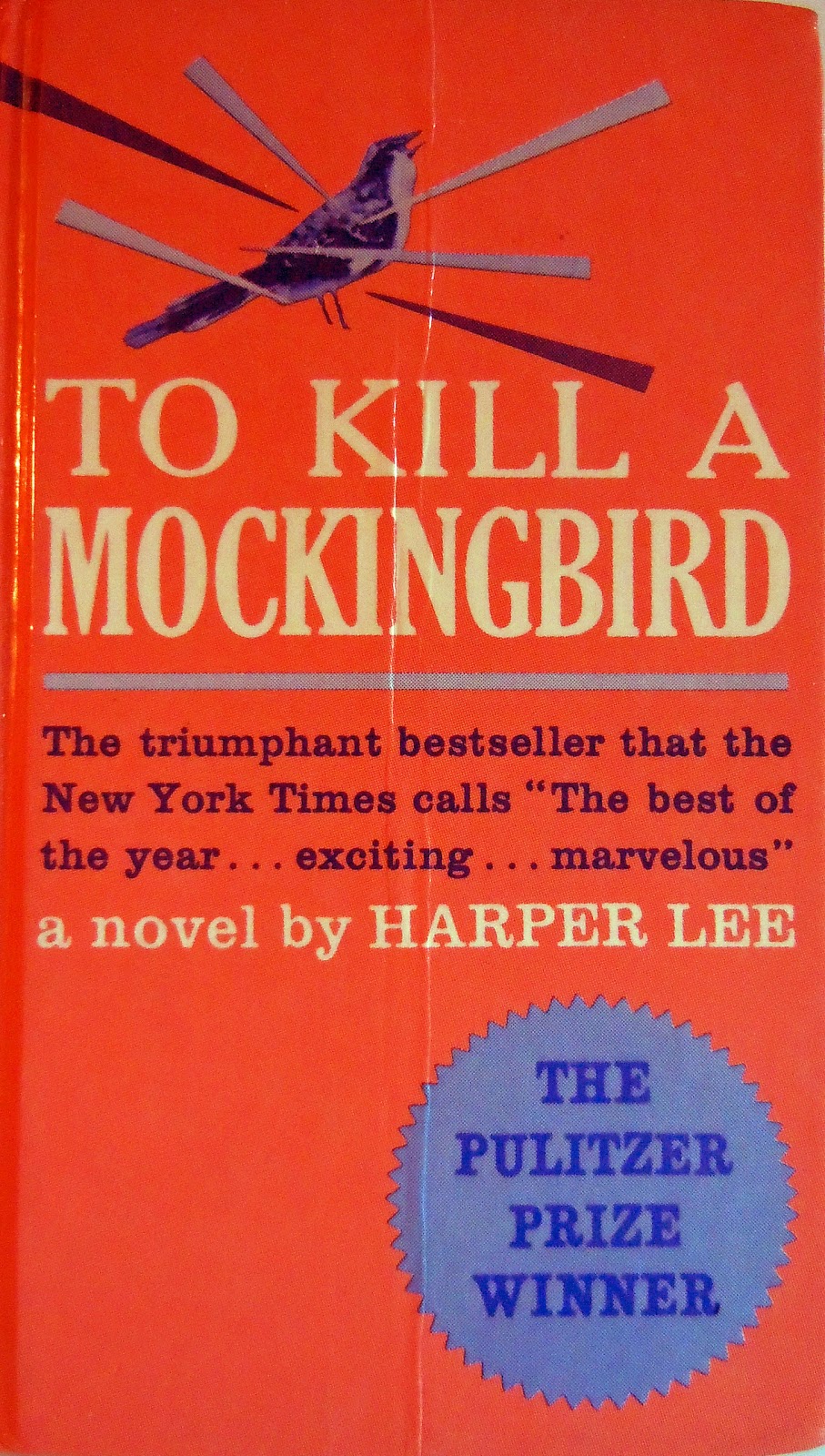
Revisiting a Classic: TO KILL A MOCKINGBIRD

July 11th marks the 50th anniversary of the release of the novel, "To Kill A Mockingbird" by Harper Lee. It's one of my favorite books of all time, and I'm pleased to have an Op-Ed piece about it featured in The Record (the largest circulating daily newspaper in Northern New Jersey). Click HERE to read a version of the article online, where you'll learn more about the book and the author.  Happy Birthday, Mockingbird!