Can you ever really know someone? That's the question evoked by the novel MOLLY FOX'S BIRTHDAY. It is the latest from Irish writer, Deirdre Madden. This richly woven story is told from the point of view of an unnamed narrator, a young woman, a successful playwright, suffering a bout of writer's block. She is house-sitting for her long-time friend, Molly Fox, an equally successful actress, whose need for privacy shrouds her in layers of mystery.
The setting of the book is Ireland and the action takes place all on one day, the Summer Solstice (the longest day of the year), which is also Molly Fox's birthday. Over the course of the story, the narrator inhabits Molly's house and wanders the rooms therein, reliving decades of their friendship via flashbacks. In the process, she conjures scenes of Molly Fox that inspire feelings of love, admiration, jealousy and even resentment. But who really is Molly Fox? This gently paced, beautifully written novel is about how we shape our identities and relationships - the relationship we have to ourselves, our family and friends, our passions and most significantly, our artistic inclinations.
Through the narrative flashback arc, each character in this novel seems a misfit, shaped by some sense of loss and trauma in their families that has encouraged him/her to turn to the arts. The narrator comes from a big, Irish, baby-making clan. It is her brother, a solitary Catholic priest, who helps her understand and appreciate how being different and living an unconventional/introspective life can be an asset and not a liability--especially for a writer. Molly spends her life, off-stage, trying to escape the lasting wounds of a largely absent mother and caring for an emotionally troubled brother. But it is a seemingly secondary character, Andrew, a documentary filmmaker and an old friend of both the narrator and Molly--a man who lost his brother, the favorite son of his family, to the Irish rebel cause--who figures most predominantly into the denouement of this deeply moving story.
"Sometimes the most important and powerful element is an absence, a lack, a burnished space in your mind that glows and aches as you try to fill it," the narrator tell us.
The book seems to suggest that an artistic life--be it on the page, stage or screen--can be a bulwark against loneliness and feelings of emptiness. In the end, the losses and empty spaces in life, and how one responds to them on an emotional level, are what come to define these very authentic, three-dimensional characters. A thought-provoking read!
Yesterday was the birthday of short story writer, O. Henry, also known as William Sidney Porter. In my opinion, O. Henry is an undervalued writer, where many in high-brow literary circles downplay his genius and mastery of the short story form. This is odd (and ironic) because the O. Henry Prize, which lauds the "best" in short fiction each year, actually bestows the award on "literary" as opposed to "commercial" fiction - the type that O. Henry, himself, created. Go figure.
For me, O. Henry's writing is energetic and witty. The elements of mystery and suspense in his stories greatly contribute to the twist endings that have become the hallmark of his work. Revisit his most famous tales like "The Gift of the Magi," "The Ransom of Red Chief," and "A Retrieved Reformation."
My personal favorite is, "The Cop and the Anthem," a story set in Manhattan. It is told from the point-of-view of a homeless man named "Soapy" who knows, while wandering the crisp, fall streets of New York City, that the chill of winter is fast approaching. Soapy is a lost soul, but he's industrious and clever. He sets out on a quest to get arrested, as a night in jail would certainly offer him the warmth and security he seeks. But Soapy's efforts keep falling short until he meets with an ironic twist of fate at the end of the story.
While O. Henry's work has entertained and inspired me, I find the story of his own life as compelling as his fiction. This was posted yesterday on The Writer's Almanac:
September 11: It's the birthday of short-story writer O. Henry, born William Sidney Porter in Greensboro, North Carolina, on this day in 1862 . . . He worked at his uncle's drugstore, becoming a licensed pharmacist when he was 19, and before he turned 20 he'd headed west to Texas, where he spent time on a ranch as a shepherd, domestic servant, and baby-sitter.
He moved to Austin, Texas, worked as a pharmacist, and played guitars on street corners around the city. He eloped with a tuberculosis-infected, rich and beautiful teenage girl whom he'd fallen in love with.
Later, he got a good-paying job as a bank teller so that he could support his wife and young daughter. But he was not a good bookkeeper, and he was fired for embezzlement. He took to writing full time.
The feds did an audit of the bank he'd been working at, and when they found a bunch of discrepancies, they decided to indict him on federal embezzlement charges. His wife's dad posted bail for him, but instead of sticking around for trial, O. Henry fled to New Orleans and then to Honduras, where he stayed for months. But when he found out that his beloved wife was on the verge of dying from her tuberculosis, he came back to Texas and turned himself in. Soon after, his wife died. He stood trial, was convicted of embezzlement, and was sent away to a federal penitentiary in Ohio.
He wrote short stories there, and he came up with the pseudonym O. Henry. Magazine editors were clueless that the stories they published were written by an inmate locked up in a federal penitentiary.
He got out of jail and wrote fast and furiously, about 400 short stories in those years following his release. He became famous, and an alcoholic, and he died less than a decade after getting out of jail, at the age of 47, from liver disease . . .
When asked what advice he would give to young writers, he said, "I'll give you the whole secret of short-story writing. Here it is. Rule I: Write stories that please yourself. There is no Rule II."
Happy Birthday, O!
Only an author as witty and clever as Christopher Meades could craft such a lovable, multi-dimensional character as Henrik Nordmark - a 42 year-old man who lives a solitary and completely nondescript life. From the first pages of The Three Fates of Henrik Nordmark (ECW Press), Meades paints his protagonist with wry, detailed strokes: "Henrik had no redeemable feature to draw one's eyes...(People) passed him as one would pass faded wallpaper during an increasingly urgent search for a toilet."
While Henrik longs to break free of his narrow, mundane existence as a bored security guard and create a fulfilling life that is "unique" (even if it kills him), Meades skillfully creates a backdrop of characters whose lives are as equally claustrophobic as Henrik's. There are three elderly assassins conspiring a plot from Shady Oaks Park retirement home; Bonnie and Clyde, a disillusioned married couple at wit's end with each other; and Roland, a sophomoric, powerless, young man whose life has tragically become reduced to the confines of his office cubicle. A winning lottery ticket figures heavily into this farcical novel filled with quirky, off-beat characters, mistaken identities, and a host of bumbling, nick-of-time plot twists. The slapstick humor of The Three Fates of Henrik Nordmark is bound to offer an entertaining and enjoyable escape.
In Noah's Compass, Anne Tyler delivers (in her eighteenth novel) a quiet, subtle story with a main character whose interior life runs deep. Liam Pennywell is a man in his sixties who has aspired to much more than life has delivered.
When the private school where Liam had been teaching fifth graders "downsizes" him out of job, Liam moves in to a smaller and cheaper apartment. The first night in his new digs, Liam wakes to find himself in the hospital. He doesn't recollect how or why he got there. But we learn, as the story unfolds, that an intruder broke into Liam's apartment and assaulted him.
"The distressing thing about losing a memory was that it felt like losing control," Liam tells us. The trauma of the whole incident rocks the boat of Liam's mundane, unfulfilled existence. In trying to solve (and sometimes even obsessing over) the mystery of what happened at his apartment that night, Liam is ultimately forced to confront the larger issue of who he is, what his life really means, his mortality, and why he feels so disconnected from his quirky family. This includes an ex-wife, three daughters, a sister and even his aging parents.
In the hope that a medical doctor might help him regain his memory of the incident, Liam decides to consult with a neurologist. While in the waiting room, Liam is drawn to a local business tycoon, apparently in the early stages of Alzheimer's. The man is being assisted by a younger woman whose gentle devotion in helping the tycoon to remember things strikes a chord in Liam that encourages him to seek out her help. After the appointment, Liam tracks the woman (Eunice) down under the pretense of looking for a job at the tycoon's company. Liam's relationship with Eunice forces him to delve more deeply into the meaning of life.
Toward the end of the book, there is a very touching scene between Liam and his grandson where they share a conversation about the Biblical story of Noah and the Ark that addresses the underlying themes of this gracefully written and profound novel:
"There was nowhere (for Noah) to go. He was just trying to stay afloat. He was just bobbing up and down, so he didn't need a compass, or a rudder, or a sextant..."
"What's a sextant?"
"I believe it's something that figures out directions by the stars. But Noah didn't need to figure out directions, because the whole world was underwater and so it made no difference."
Liam Pennywell emerges from this story as if he, himself, has voyaged though life like Noah. While his nagging sense of isolation and a lack of direction seem to embody the universality of man, it is Liam's journey that ultimately propels him to a place of greater awareness and peace.
What do the Hancock Building, Lake Michigan, Water Tower Place, the El, and Holy Name Cathedral have in common? All are places in Chicago that award-winning writer Barbara D'Amato has used to create a vivid backdrop in some of her mystery and suspense novels. I discovered D'Amato's work in the 1980s, and I've been reading her novels and short stories ever since. She's a first-class genre writer who creates engaging, multi-dimensional characters and embroils them in perfectly crafted plots. Long before characters like Stephanie Plum , there was Cat Marsala, a tough, gritty, yet very likeable investigative journalist who chronically finds herself in the midst of trouble, and Chicago Patrol Cop, Suze Figueroa. These two, female protagonists headline several D'Amato books.
D'Amato has been able to chart a long, productive career (to date, 16+ novels and numerous short stories), because she writes big, bold, unforgettable scenes and takes on contemporary topics of interest with amazing expertise and authenticity. Check out the diversity of issues she's covered in her books:
International Adoption (White Male Infant)
Autism (Death Of A Thousand Cuts)
Child Abduction (Help Me Please)
Computer and Internet Crime (Killer.App)
Drug Legalization (Hardball)
Yachting (Hard Tack)
The Lottery (Hard Luck)
Christmas Tree Farming (Hard Christmas)
The Gourmet Food Industry (Hard Evidence)
Prostitution (Hard Women)
Spousal Abuse (Hard Bargain)
The Wizard of Oz Festival (Hard Road)
Trauma in the ER (Hard Case)
Ghosts and the Paranormal (Crimes by Moonlight - a brand new MWA anthology that features a new story by D'Amato)
And of course, there are also D'Amato's award-winning police procedural novels: Authorized Personnel Only (winner of the Mary Higgins Clark Award from Mystery Writers of America) and Good Cop, Bad Cop (winner of the Carl Sandburg Literary Award).
If you're looking for a page-turner for the beach this summer, try her latest, Foolproof, which D'Amato co-authored with Jeanne M. Dams and Mark Richard Zubro. Be sure you lather on your sunscreen or better yet, curl up with the book in the shade as once you crack the cover, you're bound to get completely wrapped up in this political, post-9/11 thriller about Cyber-Terrorism that might otherwise give you a scorching sunburn!
In The Girl She Used To Be, David Cristofano parts a curtain that leads inside the world of the Federal Witness Protection Program (also known as Witness Security Program or WITSEC).
The protagonist of this finely-crafted novel of psychological suspense is Melody Grace McCartney. At six years-old, she and her parents accidentally witnessed a violent mob crime that launched them into WITSEC.
When the story opens, it is twenty years later. Melody's parents are gone, but she has remained in WITSEC, assuming a variety of different names and jobs as she has been moved, for her own safety, from place to place around the country. Melody seems relatively safe, teaching mathematical proofs to high school students in order to encourage them to utilize logic. This scenario seems the perfect antidote to combat the nature of Melody's uncertain life:
"Life can be cruel," she says. "...I try to teach one central lesson in every class–and if they get this I will make sure they pass: Each and every equation brings an absolute certain conclusion. Well, that and don’t divide by zero. You see, certainty brings security. Security brings trust. Trust brings love." (Chapter One, p. 2)
It seems fitting that Cristofano utilized a mathematical proof to headline each chapter. (I wondered if my reading experience would've been made even richer if I knew what each proof actually meant and if/how each tied to themes along the way.) What the proofs did reflect was the fact that Melody is an extremely bright woman. She is a survivor. Yet security, trust and love are the variables in her own life that simply don't add up. In fact, a dearth of those three factors is what contributes to her chronic sense of restlessness and isolation.
When it's time for Melody to suddenly uproot her life and begin again in another town, things take a turn. During the move, the Feds mismanage Melody, and she comes face to face with Jonathan "Johnny" Bovaro, the henchman from the mafioso crime family, who has been on Melody's trail for twenty years. It is Bovaro's sudden presence in Melody's life--and the fact that he is the one and only person left in the world who has known her (really known her, her life story and her many identities) since she was six years-old--that forces Melody to question her existence and the meaning of her life. Bovaro tempts Melody to step outside her comfort zone. He actually offers her the chance for a future of her very own--a chance for security, trust and love--beyond the confines of WITSEC. Is it time for her to take a risk?
In his protagonist, David Cristofano has created an intriguing narrator and placed her at the helm of a moving and powerful mystery story that grows into a love story. Each characterization--how the author peels back emotional subtexts and private histories, layer by layer--shatters stereotypes and serves to ratchet up the suspense. It comes as no surprise that this novel was nominated for an Edgar Award, Best First Novel By An American Author, Mystery Writers of America (MWA).
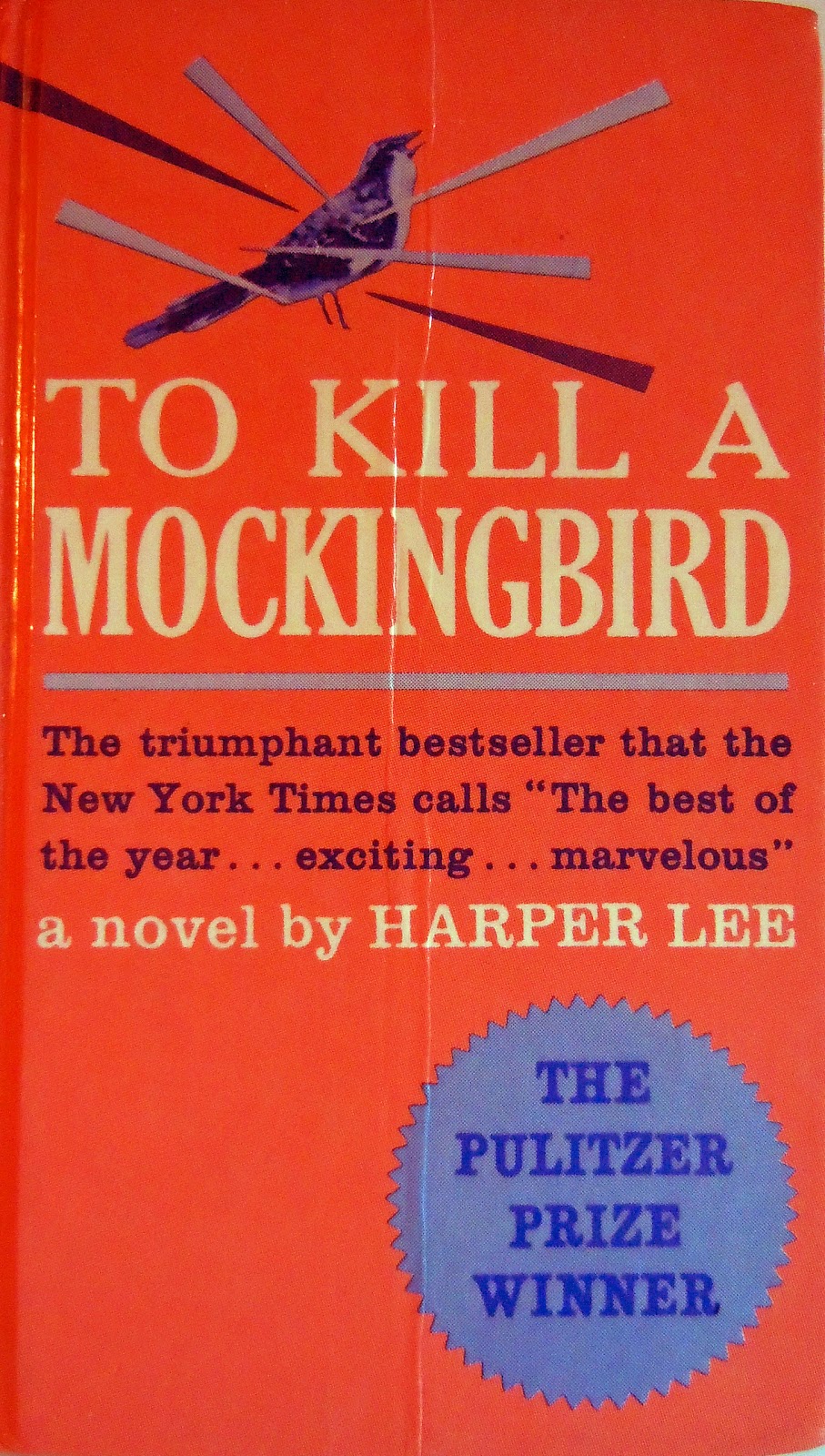
July 11th marks the 50th anniversary of the release of the novel, "To Kill A Mockingbird" by Harper Lee. It's one of my favorite books of all time, and I'm pleased to have an Op-Ed piece about it featured in The Record (the largest circulating daily newspaper in Northern New Jersey). Click HERE to read a version of the article online, where you'll learn more about the book and the author. Happy Birthday, Mockingbird!
She has been called the Jewish Jane Austen. She writes intelligent, witty, social satires. Her name is Cathleen Schine, and her latest, The Three Weissmanns of Westport, is a modern family saga about marriage, money, love, aging, and real estate (the themes are not necessarily addressed in that order).
The plot is this: Seventy-five year-old Betty Weissmann thought she was happily married until Joseph, her husband of forty-eight years, comes home one day and announces that he is divorcing Betty due to "irreconcilable differences." The irreconcilable difference is Felicity, Joseph's mistress, a younger woman who has designs on the couples' posh Central Park West apartment. Betty is essentially thrown out of her own home. She moves to Westport, Connecticut, into an old, run-down beach bungalow offered by a cousin. Betty's loyal and devoted daughters, in their 50s and with problems of their own, rush to their mother's side.
Miranda is a Type-A workaholic literary agent whose career is in crisis thanks to a James Frey-type scandal surrounding one of the authors she represents. Annie, the older sister and a mother of two grown sons, is a rather staid library director, more pragmatic and prone to worry. The three women--with vastly different personalities and quirks, strengths and weaknesses--unite against the injustice bestowed by Joseph. In a show of solidarity, the three women move into the bungalow together. While the daughters think they have come on the scene to support their mother, it is Betty who ultimately rescues her daughters from some very complicated romantic entanglements and the woes of midlife.
As always, Schine's work reflects an authentic New York-Metro area sensibility. She is a master of revealing perceptive, often hilarious, insights about her characters (see also The New Yorkers, She is Me and The Love Letter), while also weaving unexpected twists into her page-turning plots. Chapter Thirteen of The Three Weissmanns of Westport, when the three women set off to celebrate Christmas, Jewish-style, in Palm Beach, is a perfectly paced scene of farce-like proportion. It speaks to the heart (and heartbreak) of the human condition. Once again, Schine shines!
Strong, smart female characters, often outsiders . . . People longing to connect and break through so they can find their place in the world . . . These are recurrent embodiments found in the inventive work of playwright and actress, Claudia Shear.
In her one-woman show (and subsequent book), "Blown Sideways Through Life," Shear chronicled the relentless odyssey of the 64 day jobs she held while striving to become an actress. In Shear's next play, "Dirty Blonde," she posed a question: If people knew who I am, would they still love me? In this play, two lost souls--Jo and Charlie--share an obsession for Mae West, a lonely woman nobody ever really knew outside of her work on the silver screen.
In Shear's latest, "Restoration," currently in production at The New York Theater Workshop, Shear once again explores how a fervent commitment to art has the power to build bridges between people.
When "Restoration" opens, Giulia (played by Shear) is an outcast in the artistic community. Outspoken, she has been sued because she has slandered the restoration efforts of one of her peers. Thus, she is living a rather isolated existence as an art restorer and historian who teaches at Brooklyn College. A mentor and former professor of Giulia's opens a door of opportunity. Through his efforts, Giulia is selected to restore the statue of David (Michelangelo) in Florence, Italy in honor of the 500th birthday of this artistic masterpiece.
Giulia's journey, and each character she meets along the way, explores how cultivating a passion for and an appreciation of art allows a person to serve something larger than her/himself and in the process, restore a sense of purpose and self-worth. "Restoration" is beautifully written and performed. It emerges as a multi-layered love story about beauty, life, death, the redemptive power of art, and the resilient nature of humanity. Don't miss it!
Photo of Claudia Shear and Jonathan Cake from The New York Theater Workshop website
The number of independent booksellers in the U.S. is on the rise and thriving according to reports from the American Booksellers Association (ABA) and BookExpo America, the annual convention of the publishing industry which kicks off in New York City this week (May 25-27).
This is great news for hard-working independent bookstore owners like Sharon Wheeler at Purple Crow Books in Hillsborough, North Carolina, a lovely, historic town west of Chapel Hill.
I had the chance to visit her store while passing through the area last week. Wheeler is smart and savvy to have set up shop in downtown Hillsborough, a literary and artistic enclave, which is home to prominent authors Lee Smith, Hal Crowther, Annie Dillard, Allan Gurganus, Frances Mayes, Michael Malone, and Jill McCorkle to name just a few.
The shop is quaint and small, but it is boundless in reflecting Wheeler's passion and enthusiasm for books -- and local writers. Each title stocked on the shelves at the Purple Crow appears carefully selected, and every detail (down to purple feather bookmarks and a whimsical children's book room) is well thought out, reflecting Wheeler's warm and welcoming nature. Clearly, Wheeler takes pride in offering the personal touch, which has obviously contributed to the success of her business. In addition to regular inventory, the Purple Crow features books (many signed) by local and regional authors, sponsors readings and book events by these authors, and eagerly fulfills special order requests.
In the northeast corner of my home state of New Jersey, there are many outstanding independent booksellers, as well. Among them are Shaw's Bookshop (Westwood), BookEnds (Ridgewood), Womrath's (Tenafly) and Books and Greetings (Northvale). Each of these stores regularly hosts events with authors -- notable heavy-hitters and some first-timers. In Montclair, Watchung Booksellers, like the Purple Crow, boasts books and signing events by a diverse crowd of local writers who reside in and around that literary hub.
In this day and age, there is so much talk that the trend in book publishing is veering toward the digital market. Therefore, it's refreshing to witness the dedication of indie booksellers like Sharon Wheeler at the Purple Crow and those in my own local region and around the country who are seeing to it that writers and the printed page remain at the forefront of the industry. Bravo!
Photos (above) of the Purple Crow Bookstore and Sharon Wheeler by Kathleen Gerard (c) 2010
“No person is a cliché. If you actually get to know them (him/her)…there will be many things deep down that are particular to them (each). That’s what I look for.” Lee Smith, interview in the Citizen-Times
The month of May has been declared as National Short Story Month . . . And Mrs. Darcy and the Blue-Eyed Stranger, a book of new and selected stories by Lee Smith, is a perfect way to celebrate. For me, a satisfying short takes a reader on a journey that lasts for only a short time, but the people one meets and the places one visits linger much, much longer. With that as the criteria, you can sit back and relax with Lee Smith as your literary tour guide.
It's been thirteen years since Smith released a short story collection, and Mrs. Darcy and the Blue-Eyed Stranger (which, by the way, has nothing at all to do with Jane Austen) was surely worth the wait. Smith's dialogue is spot on, and her narrative voice (in first person p-o-v or third) is as strong as her characters and plots. In each story, Smith peels back layers of the human psyche in order to expose the absurdity of people and situations, entertaining her readers while enlightening them along the way.
I've been a fan of Smith's writing since her first novel, The Last Day the Dog Bushes Bloomed, and I've enjoyed and admired her work ever since. With Mrs. Darcy and the Blue-Eyed Stranger, Smith has assembled some of the best stories from her previous collections (Cakewalk, Me and My Baby View the Eclipse, and News of the Spirit), and she's included seven new works. As a whole, the theme of "change" is a thread running through each story. In some instances, change has already been inflicted upon the lives of characters and in other stories, change is about to crest. Smith, a true craftsman of the short form, makes all the right decisions in deciding just where and when to start (and end) each piece. She paints with a full palette to flesh out her smart, quirky characters, and she has an incredible gift for dotting the often sad, bittersweet canvas of life with just the right strokes of humor.
In an interview in Indyweek, Smith recently spoke to that point: "I consider myself a realist; I have always tried to tell the truth as I saw it. Paradoxically, I guess, I have found it easier to do this in fiction than in nonfiction. You can make things up and switch facts around to make your points. But a lot of times, the truth is not pretty—it's hard to bear—I guess that's where the humor comes in. We have to have something to lighten the load a little bit, don't we?"
Most of the stories in Mrs. Darcy and the Blue-Eyed Stranger focus on women - what it means to be a wife, a mother, a daughter, a lover. In "House Tour," a woman's home is overtaken by a group of boisterous, Red Hat Society matrons who mistake the woman's house for one included on a neighborhood historic house tour. The unpredictable presence of these ladies (they are hilarious!), who push their way into the woman's home and begin to explore the nooks and crannies, ultimately force the protagonist to contemplate a deeper meaning for her own life.
In other stories in the collection, Smith tackles aging ("Happy Memories Club", "Between the Lines"); how some members in families appear to be helpful when they are actually only catering to their own self-interests ("Mrs. Darcy and the Blue-Eyed Stranger"); what makes for a long and enduring marriage (the outstanding, "Stevie and Mama"); coping amid unraveling relationships ("Bob, A Dog"); and the power of love ("Ultima Thule," where a hospital worker makes a love connection with a psych ward patient).
Smith is often characterized as a "regional" writer. But in reading (and savoring) the rich gamut of stories and excellent prose presented in Mrs. Darcy and the Blue-Eyed Stranger, Lee Smith once again proves that her range far exceeds the constraints implied by that label. Small towns and close-knit communities--and the challenges fraught therein--are cornerstones of her fiction (the majority of her stories take place in the south). However, in Smith's world, small moments have the potential to change lives. And such moments of personal clarity and revelation serve to broaden the scope of Smith's stories as they open out into more universal themes found in the larger, broader world.
When you want to escape from life for a while, what do you read for fun? If you're like me, a good cozy mystery is the answer and the Dirty Business Series, created by Rosemary Harris, never disappoints. If you enjoy gardening (as I do), quirky characters, and a small town setting, then you're in for another real treat with Harris's latest, Dead Head.
In the trilogy of mysteries, beginning with Pushing Up Daisies and followed by The Big Dirt Nap, Harris has created Paula H0lliday, a smart, gutsy amateur sleuth with whom you'll want to spend time. Paula is a transplanted media executive who moved from New York City to the Connecticut suburbs to start a gardening business. However, in pursuing her bliss, she chronically find herself unearthing mysteries, and her inquisitive nature forces her to dig for the truth. Harris has a real flare for intertwining her passion for gardening into comic, off-beat, and brisk-paced suspense plots.
In Dead Head, Paula's business is suffering amid the current economic climate. She discovers that one of her best clients and a potential partner for her floundering business is living a lie. The woman, a pillar within the community, is actually a fugitive (a convicted drug dealer) who escaped from prison 25 years before. Gee, one never knows just who might be living next door!
Harris successfully fleshes out the story of Dead Head through shifting first-person points-of-view and flashbacks that are bound to keep you riveted to the page . . . distracting you from tilling the soil in your own garden.
For this 'Book of the Week,' I'm offering a special give-away. Drop me an e-mail at katgerard@aol.com and be entered to win a signed, paperback copy of Rosemary Harris's first in the Dirty Business Mystery Series, Pushing Up Daisies.
 Can you ever really know someone? That's the question evoked by the novel MOLLY FOX'S BIRTHDAY. It is the latest from Irish writer, Deirdre Madden. This richly woven story is told from the point of view of an unnamed narrator, a young woman, a successful playwright, suffering a bout of writer's block. She is house-sitting for her long-time friend, Molly Fox, an equally successful actress, whose need for privacy shrouds her in layers of mystery.