Sunday, May 22, 2011

When We Danced On Water

A chance encounter at a coffee bar in Tel Aviv rescues two lost souls from the abyss in Evan Fallenberg's (Light Fell) carefully crafted novel, When We Danced on Water. Teo is a hardened and domineering 85 year-old; an aged, influential choreographer whose life is riddled with sadness and sorrow. Vivi, a 40-something waitress with latent, "interdisciplinary" artistic talent, is completely stalled in her life and her work. The nature of art is what brings these lonely, disillusioned souls together, but it is also what will tear them apart. When their paths cross, a transformation is sparked in each of their lives - but not before they are forced to resurrect the past and face down long-repressed demons. When Vivi and Teo slowly start to form a relationship that seeps beyond the boundaries of artistic friendship, the reader is drawn and captivated by their stories from the past. Teo was a dancer with great promise, who forfeited love to pursue his career, only to have it stolen in wartime by a Nazi brute. While Vivi, an Israeli soldier, forsook her family and the traditions of her Jewish faith for a lover who would later betray her. The novel delves into themes surrounding the perils of passion, evil and regret; the transcendent power of art; and the ultimate healing power of love. The sensitivity that Fallenberg brings to the writing devoted to Teo's life as a dancer in the Danish Royal Ballet, while in the wings and on stage, is passionately evocative - as are the terrifying scenes of his captivity during the war. In the end, it is Teo's story that takes center stage and serves to ratchet up the dramatic tension--past and present--for both Vivi and Teo until the plot unravels into a surprising conclusion of forgiveness and rebirth.

When We Danced On Water by Evan Fallenberg
Harper Perennial, 978-0062033321, trade paperback, 272 pages
Publication Date: May 17, 2011
To order this book via INDIEBOUND link HERE

Please note:  This review is a reprint and is being posted with the permission of Shelf Awareness.  To read this review on their website link HERE

The State of Our Libraries


Opinion/Editorial Section (front page)
BY Kathleen Gerard
The Record
To read the op-ed in its entirety, click on the highlighted article title above

Sunday, May 8, 2011

Hotel Angeline

What happens when 36 writers, of various genres, come together and work on the same novel at 2-hour live intervals for a period of one week? The Hotel Angeline is what happens...a wonderful new book by an imaginative collective of authors who all reside in and around the Pacific Northwest. The novel, written in chapters penned by each of the 36 participants, tells the story of Alexis, a precocious 14 year-old girl whose life is far from ordinary. She and her gravely ill mother live in (and serve as the landlords for) the Hotel Angeline in Seattle, what was once a mortuary, but has since been converted into apartments - dilapidated, run-down apartments that serve as "home" for a group of eccentric, misfit aging artsy types who smoke pot, detest Fox News and the conventionality of the ordinary. Beyond the liberal leanings of those who populate this insightful, well-rendered novel is a wonderful coming of age tale for fatherless, identity-challenged Alexis. She is faced with extraordinary choices and goes to great, often unexpected, lengths to do right by a mother whom she loves and wishes to honor. The unexpected arc of the plot keeps the reader turning pages as Alexis strives to save the Angeline and the residents therein. There is something for every fan of literature here - adolescent lit, thrillers, mysteries, fans of comic, fantasy, domestic fiction and even graphic novels. Over the course of the story, I marveled at how the voice of Alexis carried through the novel so distinctly and seamlessly, despite the influence of multiple authors who lent their time and talent to this project to benefit Seattle7Writers, a literary nonprofit organization. It was also great fun to read the novel with an eye toward authors whose work I already admire-- Elizabeth George, Garth Stein, Mary Guterson--to read their individual chapter contributions and the way in which their literary choices propelled the story forward with great insight, wit and sensitivity (fascinating!)...and also to discover the work of other voices and talents of which I was not familiar. 

Link HERE for a video about the project and the book.

Hotel Angeline (A Novel in 36 Voices)
Open Road Integrated Media LLC, 978-1453218785, 260 pp.
Publication Date: April 18, 2011
To order this book via Amazon.com link HERE

In order to write this review, a copy of the novel was provided to me via Open Road Integrated Media in conjuction with NetGalley

Sunday, April 24, 2011

The Weird Sisters

The Andreas sisters are old enough to realize that the lives they've imagined don't measure up to the ones they're actually living. Is their disappointment and lack of self-fulfillment the result of being named for great Shakespearean characters - as imposed by their father, a scholar of the English Bard?

When their mother falls ill, the three, single sisters--each facing her own personal dilemma and demons--are suddenly reunited. There is Rose (Rosalind), the dutiful oldest sister, who has never left the hometown and is having a hard time committing to the man she loves; Bean (Bianca), a brusque, fashion-conscious middle child with a shopping compulsion; and Cordy (Cordelia), the beatnik baby of the bunch who has lived like a gypsy over the years.

With the trio back under the same roof to care for their ailing mother and emotionally-distant father, the disparate sisters are forced to face each other, their sibling rivalries and the limitations of their lives - all while struggling with issues of mortality, love, and the reversal of parent-child roles.

With fully realized characters, beautiful writing and a meandering story arc that encourages readers to linger over each and every word, what I loved even more about this book was the voice that led me through the narrative. "Our mother was facing a crisis..." "Our little sister was..." By writing via a first person plural point-of-view, it made me feel as though I, myself, were a member of this dynamic, literary-loving family - and that lent a sense of intimacy that further immersed me in this story and enriched my reading experience.

Eleanor Brown's THE WEIRD SISTERS  is a contemporary familial saga that stays true to the tenets of classical Shakespearean storytelling, where you can always count on a birth or a marriage to reconcile domesticity until it brims with hope.

The Weird Sisters by Eleanor Brown
Amy Einhorn Books/Putnam, Hardcover, 9780399157226, 336pp.
Publication Date: January 20, 2011
To order this book via INDIEBOUND click HERE

Sunday, April 10, 2011

Joe DiMaggio: The Long Vigil

From the prologue of The Long Vigil, author Jerome Charyn does not mince words, thoughts or ideas about Joe DiMaggio, The Yankee Great, versus Joe DiMaggio, a man with glaring foibles, weaknesses and crippling limitations. Having been witness to the Yankee Clipper in action when he played in Yankee Stadium, the writing is rich with Charyn's passion and enthusiasm for the game, its history and his own personal intrigue over the larger than life mystique of "The Jolter," as he calls him. But for all of Charyn's adulation of DiMaggio's dignified and elegant baseball prowess, he deems DiMaggio, the person, a "savant" - a man insecure in managing life off the baseball diamond and grossly inept in maintaining interpersonal relationships.

Charyn divides the book into two parts. Part One, "The Player," delves into the years DiMaggio spent as a New York Yankee, racking up accomplishments and setting records. However challenging and physically demanding, for those thirteen years it would seem that Joe DiMaggio felt most alive. In the second part of the book, "The Demon Lover," DiMaggio struggles with the perils of life after baseball, and the story shifts to DiMaggio's obsessive relationship with Marilyn Monroe, the great love of his life. The before and after of these two sections set up possible reasons why Joltin' Joe ultimately left the game and gradually disappeared inside himself and his mystique.

DiMaggio and Monroe were star-crossed lovers who were both private, shy and distrustful of the majority of people who populated their worlds. Charyn sets up a paradigm that shows how alike the two were - Monroe's self-worth came from the screen, DiMaggio's from the baseball field. Both were "fractured beauties," vulnerable and fragile creatures, who achieved great success, yet both were filled with anger and rage that were made manifest in different ways.

When Monroe would not give up her acting career to become the wife and mother DiMaggio wanted, their relationship soured. Monroe's rejection--and later, her tragic death--is the devastating blow from which DiMaggio never recovers. In Charyn's account, DiMaggio wanders through the next 37 years of his life, a broken misfit of a man - yet one who treasured Monroe's memory until he died.

After Monroe's death, money became the priority of DiMaggio's life. Some claimed that to Joe, baseball was "just a business" that fueled his need to keep making a profit off his name, via the greed and stinginess for which he became legendary. The author postulates (p. 75) that DiMaggio's focus on money was all about pride and his way to soothe his own "narrow world of perfection." DiMaggio always had a need to be heralded as "The Greatest Living Ballplayer," and he cultivated that legacy with the same fervor and intensity he gave to the game. The facts Charyn presents indicate that a quest for perfection is inherent in all phases and aspects of DiMaggio's life. And it would seem that the New York Yankees, which would come to define DiMaggio and give his life its sole sense of meaning and purpose, tapped into those roots of perfectionism before he ever took to the field at Yankee Stadium for the first time. 

Charyn paints a picture of New York City, post-Babe Ruth and pre-DiMaggio:  "There was an emptiness, a terrible void, that no one could fill." The author points up the proliferation of Italian-Americans crowding New York and most big-league cities at the time. From a business standpoint, the Yankees' franchise cleverly capitalized on those statistics to boost the appeal of DiMaggio and their fan base. A headline in The Sporting News even read, "Fans Expect Recruit From Coast to be Cobb, Ruth, Jackson In One." Imagine the pressure that placed on the rookie. If DiMaggio, by nature, was a perfectionist, then surely the expectations placed upon him (and even those he placed upon himself) only exacerbated his one-track focus, discipline and dedication to the art of the sport. It brought him the recognition he craved. However, did he ever really feel a sense of personal fulfillment?  Charyn's account suggests that DiMaggio's lack of dominance and control outside of baseball only served to heighten his personal insecurities, making the remainder of his life anti-climactic.

Charyn (The Secret Life of Emily Dickinson) once again succeeds as a thorough and thought-provoking writer. The Long Vigil presents the many facets of the price DiMaggio paid for his success and the sad, tragic burden there was in living the life of Joe DiMaggio - on and off the field.

NOTE:  In order to write this review, I received a copy of this book from Tribute Books.

Joe DiMaggio: The Long Vigil by Jerome Charyn
(Yale University Press, Hardcover, 9780300123289, 192pp.)
Publication Date: March 2011
To order this book via INDIEBOUND click HERE

Sunday, March 27, 2011

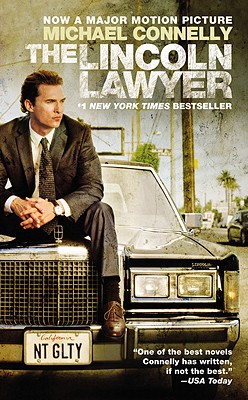
The Lincoln Lawyer

All right, I'll admit it - it was Matthew McConaughey who drew me to read THE LINCOLN LAWYER by Michael Connelly. I don't normally lean toward this type of book, at least not since I devoured Presumed Innocent by Scott Turow more than 20 years ago. But as a fan of MM, I was eager to examine how the story will translate from page to screen. I have yet to see the movie. But having read the book, I cannot picture anyone but Matthew McConaughey playing this part. I wonder if the author wrote the story with this leading man in mind?

The plot boils down to this: high-powered (yet jaded) attorney, Michael "Mickey" Haller knows what he's good at and has a very high opinion of himself - at least amid the legal system. Instead of an office, he works out of his car - a Lincoln Continental (of which there are actually four in the fleet), which serves to chauffeur him to what seems like revolving doors at various courtrooms throughout Los Angeles County. Mickey has done fairly well for himself (his slogan as printed in the Yellow Pages is "Reasonable doubt for a reasonable fee") by defending a slew of guilty lost souls who live on the fringes of society - drug dealers, junkies, prostitutes. You name it and Mickey's defended it - and probably more than once.

Mickey is stymied when he's called upon to defend Louis Ross Roulet, a wealthy resident of Beverly Hills arrested for a violent, ugly assault. Mickey initially sees dollar signs with what he calls a 'franchise case' - an expensive trial with a laundry list of billable hours. But when Mickey rolls up his sleeves and gets down to business, he soon discovers that he's being as hustled as the clients he normally defends. A case that Mickey represented--and plea bargained years before--figures prominently into the Roulet case. Mickey suffers a crisis of conscience and a moral dilemma. Did Mickey's legal counsel of Jesus Menendez, a past client, put Menendez behind bars for the rest of his life for a crime his current client, Roulet, actually committed? It's an ingenious twist that adds texture and depth to this economically written, first person p-o-v story of gripping suspense, vibrant dialogue, and meticulous plotting.

Connelly sets up the first half of the book by establishing the status quo of Mickey's world - one filled with two failed marriages (and two ex-wives who still have a part in Mickey's life), his own shortcomings as a workaholic dad who hasn't always been there for his daughter, and the terrain he mines as a no-nonsense defender of the down and out. The Roulet case tilts Mickey's world on its axis as he tries to figure out a way to help his innocent, yet jailed client (Menendez), while trying not to jeopardize the Roulet case, as it suddenly puts Mickey's own life at risk. The second half of the book deals mostly with the trial and the challenges Mickey faces amid politics on the bench and the back room deals of the legal system.

In the end, however, it is Connelly's flawed protagonist and the arc of his journey that deepens Mickey's redeeming qualities and gains the unwavering empathy of the reader. You can bet that with or without Matthew McConaughey, I'm bound to read Connelly's next legal thriller (The Fifth Witness, a new Mickey Haller book, is due April 5th)...and maybe the backlist of his books, too!

The Lincoln Lawyer by Michael Connelly
Grand Central Publishing, Mass Market Paperback, 9781455500239, 544pp.
Publication Date: January 25, 2011
To order this book via INDIEBOUND click HERE

Tuesday, March 15, 2011

Happy March 17th

        Shamrock St. Patty's Rain Shamrocks RainbowSt. Patty's Clover Pinwheel St. Patty's KiteSt. Patty's Flag WaveShamrock
We interrupt this blog to wish everyone
....most especially my beloved father Patrick and my dear sister Patricia....
Happy St. Patrick's Day! 

Sunday, March 13, 2011

Twelve Rooms with a View

I was actually standing on the edge of my mother’s open grave when I heard about the house. Some idiot with tattoos and a shovel had tossed a huge wad of dirt at me. I think he was perturbed that everyone else had taken off, the way they’re supposed to, and I was standing there like someone had brained me with a frying pan. It’s not like I was making a scene. But I couldn’t leave. The service in the little chapel had totally blown—all that deacon or what ever he was could talk about was god and his mercy and utter unredeemable nonsense that had nothing to do with her—so I was just standing there, thinking maybe something else could be said while they put her in the earth, something simple but hopefully specific. Which is when Lucy came up and yanked at my arm.

“Come on,” she said. “We have to talk about the house.”

And I’m thinking, what house?    

Twelve Rooms with a View (Chapter One, Page One) 

Can you imagine your estranged, alcoholic mother dying and leaving her second husband's $11 million dollar Central Park West (NYC) apartment, to you and your sisters? Well, acclaimed playwright (novelist and screenwriter) Theresa Rebeck imagined it and shaped it into her novel, TWELVE ROOMS WITH A VIEW. In the story, the Finn Sisters suddenly find themselves strategizing ways to keep the historic piece of inherited real estate in their possession - away from the Drinans, the three sons of the second husband who grew up in the legendary, Edgewood Building, and a co-op board that wants to usurp the property from both of the families.

The apartment itself (including a ghost), and the dead, eccentric mother, emerge as central characters in this book narrated by Tina Finn. She is a young woman, a house cleaner, who lives in a trailer park and is on the skids, both professionally and in the relationship department. After the mother's funeral, Tina is appointed by her much more successful and domineering sisters to move into the palatial Edgewood as a squatter and stake the sisters' claim to the apartment they feel they've rightfully inherited. However, when Tina settles in, she is met with legal opposition and entanglements from the quirky Drinan sons (one of whom is a NYPD cop and has romantic designs on Tina), the co-op board, and certain residents of the Edgewood with agendas all their own.

The arc of the story follows Tina, a petty thief, who is suddenly forced (at the age of 32) to assess her own life, the lives of her sisters, the life and death of her mother, and even the Drinan sons on a level much deeper than she's normally accustomed to. It is in doing so that Rebeck offers a fascinating exploration into the themes of family (and the flaws and secrets therein), grief, forgiveness, greed, self-interest and the lengths some people must go to in order to do the right thing and transform their lives - and the lives of those around them.

Rebeck writes big scenes and pitch-perfect dialogue. And while the richly woven characterizations and sprawling interior monologues often over-shadow the plot, for me that's what made the story even more compelling. Beyond the legal and real estate intricacies, you'll be eager to make the journey with Tina Finn because she offers a bold, comically honest and ultimately self-aware voice in modern, contemporary fiction.

Twelve Rooms with a View by Theresa Rebeck
Crown, Hardcover, 9780307394163, 352pp.
Publication Date: May 4, 2010
To order this book via INDIEBOUND click HERE

Sunday, February 27, 2011

The Damage Done

People, and why they do the things they do, are what draw me to a book and hold my interest. In Hilary Davidson's debut crime novel, THE DAMAGE DONE, she has written a provocative, extremely moving story that transcends the genre. For me, the appeal of this novel is the story about two very different sisters and the unshakeable allegiance they have to each other and the bonds of family - even amid a relationship that is frayed, flawed, and distant on so many levels.

How's this for a powerful opening paragraph?
It was the bright yellow tape that finally convinced me my sister was dead. When the police had called me, I’d cried for her, but afterward a slender thread of suspicion had snaked into my brain and coiled itself around my thoughts. Claudia was deceitful, like every junkie has to be, but she also had a temper and hated to be ignored. I’d kept my distance from her since September; maybe being the butt of the world’s worst practical joke was the price I would pay for four months of silence. That suspicion didn’t deter me from getting on the first flight I could out of Barcelona, but it kept my heart beating at a relatively steady pace until I’d arrived in New York. Part of me believed that I would come home and find my sister waiting for me with her dark eyes and twisted smile, pleased with herself for tricking me back into her orbit.

The twist is that Lily, the narrator of this well-rendered novel, learns that the body she has come home to identify is not the body of her sister, Claudia, at all. It seems as though somebody else has died in her apartment (an apartment she had sublet to her sister) and that somebody else had taken on her sister's identity. But where, then, is Claudia? The clues are many. Lily might've been estranged from her sister, but she knew Claudia's tastes always veered more toward Thomas Mann, Dostoyevsky and Poe rather than the Sex in the City DVD she finds left in the player in the apartment. Carefully revealed details like these and an intriguing cast of well-drawn characters make the reader question the motives of nearly everyone involved in this unraveling tale of psychological suspense.

Amid the plot points of the search, Claudia's absence turns into a presence that gradually becomes more and more palpable. Davidson peels back layers to reveal the psyches of these respective sisters, gradually exposing dark secrets spawned from shared traumas experienced in the girls' childhoods. Lily's determined plight to find her sister eventually forces her to confront her past until she ultimately discovers herself and comes to more fully appreciate the meaning of the verb to love. Along the way, Davidson keeps the reader guessing, turning pages to see what will happen next - and there are greats twists along the way.

The Damage Done by Hilary Davidson
Forge Books, Hardcover, 978-0765326973, 352 pages
Publication Date: September 28, 2010
To purchase a copy of this book via INDIEBOUND click HERE

Sunday, February 13, 2011

The Secret Life of Emily Dickinson

I thought I'd read all there was to know about Emily Dickinson. But upon reading Jerome Charyn's historical, largely biographical novel, THE SECRET LIFE OF EMILY DICKINSON, I considered her in a whole new light. Could the famous recluse of Amherst, an obsessively private woman, who secretly stashed 1700 poems that were discovered in a dresser drawer after her death, have had a passionate, wild side?

My view of Emily Dickinson has largely been one of a great poet whose work reflects a life spent railing against a God she could not understand, nor fully accept, and a religious faith that was imposed upon her. Charyn has whittled away that view and has instead emphasized a flesh and blood human being who shares more universal baseline dreams, obsessions and longings. Drawing characters from Emily Dickinson's real life (and interspersing some fictionalized characters), Charyn shatters the image of Emily Dickinson as a repressed, timid spinster and portrays her as a willful, rebellious woman with great desires and ultimately, great disappointments in love. At one point, she even wanders alone into a disreputable "rum resort" and boldly sits on the lap of a man who is void of all manners. Could this really be the same Emily Dickinson whom history has cast as a prim, passive-aggressive-type?

The plot evolves around the great loves in Emily's life - and this part of the story (the real and the imagined) is what entices the reader most. These loves include a host of male figures, including her father and even her beloved dog, Carlo. Her brother, sister, sister-in-law and even a fictionalized best girlfriend from school, Zilpah - who becomes Emily's nemesis - also figure prominently. Charyn has a full grasp on the artistic temperament of his protagonist, a woman who displays dramatic fervor and intense devotion to the people and aims of her life. However, the author leaves admirers of Dickinson's work to speculate how these great loves might have influenced her poetry.

The book is told in the first-person point-of-view of Emily, whose voice is forthright and, at times, wickedly insightful. Charyn intersperses italicized, omniscient narrative chapters to segue scenes and offer back story. The novel opens at the Mount Holyoke Female Seminary. Emily, a reluctant 17 year-old student, is enthralled by Tom, the campus handyman (an illiterate pick-pocket), complete with a racy tattoo on his arm. When Tom becomes ill, Emily secretly goes to help him and their attraction solidifies. When the headmistress gets wind of this, she expels Emily, and Emily is forced to return home. By then, Emily is completely smitten with Tom, who continues to make cameos over the course of Emily's life and the trajectory of the story.

Once Emily returns to "The Homestead," her story becomes rather episodic, entrenched in the relationships Emily has with her controlling father, the rest of her family, and Zilpah, who comes to work as a housekeeper for the Dickinsons and wins the favor of Emily's father (in addition to Emily's resentment). Zilpah and her connection to Tom serve to keep continuity to the plot as a host of men (potential suitors) cross Emily's path - each with his own unique connection to Emily, and vice-versa.

THE SECRET LIFE OF EMILY DICKINSON is a well-told tale as a novel unto itself.  It seems as though the author, in writing such a provocative story, has tried to imagine possible reasons why America's most alluring poetess lived such a mysterious, obscured life.

NOTE: This book was reviewed via an electronic ARC (Advanced Reader Copy) of the novel as provided by Tribute Books

The Secret Life of Emily Dickinson by Jerome Charyn
(W. W. Norton & Company, Paperback, 9780393339178, 352pp.)
Publication Date: February 2011
To purchase a copy of this book via INDIEBOUND click HERE

Saturday, January 29, 2011

The Book of Tomorrow

My name is Tamara Goodwin. Goodwin . . . Sometimes when telling people my name I drop a syllable: Tamara Good, which is ironic as I've never been anything of the sort . . . (p. 3)

There's something about the Irish that makes them natural born storytellers, on and off the page - and Cecelia Ahern is no exception to that rule. This young, prolific, Irish born-and-bred author has become so successful that she's branded her own name. She writes everything from short stories to novels turned screenplays (P.S. I Love You), and she even created the television show Samantha Who?

I must admit that I never read Ahern's work before THE BOOK OF TOMORROW, but I was pleasantly surprised by this, her latest novel. It's the story of Tamara Goodwin, a rich and spoiled 16 year-old whose life is suddenly turned upside- down when her father commits suicide. He dies bankrupt and leaves behind a mountain of debt. This forces Tamara and her stunned, grief-addled mother to vacate their foreclosed mansion in Dublin and move in with distant relatives in an old farmhouse in County Meath (the rural countryside of Ireland). For Tamara, living in a place without her friends, Facebook and Twitter -- and living with a dictatorial aunt and hen-pecked uncle in the middle of nowhere -- is a living hell. But when a cute guy manning the traveling library truck acccidentally enters Tamara's life, things begin to change.

Tamara not only checks out the cute guy from the lending library, but she also checks out a leather-bound, padlocked book, void of title or author name. When she pries the book open, she discovers entries written in her own handwriting and dated for the next day - as if a diary penned twenty-fours in the future (hence the whole "tomorrow" tie-in of the title akin to the protagonist's name). Tamara, while at first skeptical, soon puts the powers of the book to work in order to help her solve the mystery of her father's death, why her mother seems to be plunging deeper into an almost comatose level of grief, and the very strange behaviors of her aunt and uncle. Add to the mix ruins of a burned down castle, an ancient (and charming) bee-keeping nun privy to Tamara's family history and many painful secrets, and Ahern spins this coming-of-age tale into one of magical suspense.

The mystery elements of the story certainly kept me turning pages, but it was the first-person narrative voice of Tamara that hooked me. Her grit, rebellion, and the flares of her sarcasm shed light on how a spoiled teenager navigates through the dark passageways of grief and loss - and that's what made me eager to suspend my disbelief at the fantasy elements of the plot and savor all 310 pages of this intriguing story.

NOTE: This book was reviewed via an ARC (Advanced Reader Copy) of the novel as provided by HarperCollins.

The Book of Tomorrow by Cecelia Ahern
(Harper, Hardcover, 9780061706301, 320pp.)
Publication Date: February 2011
To purchase this book via INDIEBOUND click HERE

Sunday, January 23, 2011

NEWS: Contest Winner

I'm pleased to announce that one of my short stories has won the Ramsfield Press Award for Short Fiction. 
(Ramsfield Press is an independent book publisher based out of the Chicago, Illinois area; William "Bill" Moser is the editor.)  The contest dealt with stories centered around the themes of cooking and food - two of my favorite pastimes! 

In this piece, entitled "B.B.," a young girl tells a tale of the summer she spent with her food-obsessed Southern Grandmother.   

To read the story and learn more about Ramsfield Press, link HERE.